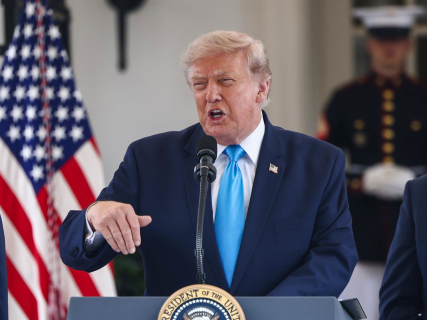

The president of the United States, Donald Trump, has sent a congratulatory message to the king of Morocco, Mohamed VI, on the occasion of the 27th anniversary of the Throne Day, one of the central dates in the Moroccan political calendar. In the communication, the American leader emphasizes the historical relationship between both countries and presents Morocco as a strategic partner of Washington in North Africa.
“This year we celebrate 250 years of American history and a lasting friendship with Morocco, a bond forged on trust and mutual respect,” the statement reads. The tone of the letter reinforces the closeness between Washington and Rabat at a particularly sensitive moment for the region, marked by the issue of Western Sahara, competition for critical minerals, and the debate on security in the western Mediterranean.
Explicit support for Moroccan sovereignty over the Sahara
The most relevant point of the message lies in the position of the United States on Western Sahara. Trump states that Washington “recognizes Morocco's sovereignty over Western Sahara” and supports the Moroccan proposal for autonomy as a “serious, credible, and realistic” initiative.
The American president goes further and asserts that this plan is “the only basis for a fair and lasting solution”. “Any other path prolongs the status quo and is unacceptable. This dispute must end now, and the United States will continue to push for progress to achieve that goal,” the message sent to Mohamed VI states.
A continuity line with the 2020 decision
The position expressed by Trump connects with the decision he made at the end of 2020, shortly before concluding his first term, when he officially recognized Moroccan sovereignty over Western Sahara. Since then, the Republican leader has remained one of the clearest defenders of Rabat's plan for the region.
At that time, Trump justified his decision with a historical reference: “Morocco recognized the United States in 1777. Therefore, it is right that we recognize its sovereignty over Western Sahara,” he wrote when announcing the signing of the document. That recognition altered the diplomatic balance surrounding a conflict that had festered for decades and strengthened Morocco's international position.
Technology, defense, and critical minerals
The letter is not limited to the political plane. Trump makes available to Morocco the “reliable and cutting-edge American innovations” and expressly mentions cooperation in energy, artificial intelligence, critical minerals, and defense.
This section has a clear strategic reading. The United States seeks to reduce its dependence on China for essential raw materials, especially rare earths and critical minerals necessary for the technology industry, energy transition, and defense. In February, Washington and Rabat signed a cooperation and investment agreement in the exploration and extraction of critical minerals that also covers Western Sahara, a detail especially relevant due to the potential value of the Sahrawi subsoil.
Morocco, “pillar of stability” for Washington
Trump praises in his message the leadership of Mohamed VI and presents Morocco as a key player for regional stability. According to the statement, the “wise leadership” of the monarch constitutes a “pillar of stability”, and Morocco's constant commitment to peace, the fight against extremism, and the protection of the security of Americans and Moroccans reinforces that alliance.
“Together we will build a new era, an era that prioritizes the interests of our two peoples,” closes the message. The phrase summarizes the approach of the bilateral relationship: political support from Washington for the Moroccan plan on the Sahara and, in return, enhanced cooperation in security, defense, technology, and strategic resources.
The Trump highway and gestures between Rabat and Washington
The message comes after another symbolic gesture of rapprochement between the two countries. Last week, Trump publicly thanked Mohamed VI for one of Morocco's major civil works bearing his name. “Thanks to the very respected Mohamed VI, king of Morocco. What a great honor,” he wrote on his Truth Social profile.
“I hope to be able to travel soon along its entire route,” added the American president. The decision to rename the highway can be interpreted as a gesture of recognition from the Moroccan king for Washington's support of the Sahara autonomy plan, an issue that has become one of the axes of Rabat's foreign policy.
Ceuta, Melilla, and the territorial debate
The rapprochement between Washington and Rabat also occurs in a context in which Republican voices have generated concern in Spain due to their statements about Ceuta and Melilla. The American congressman Mario Díaz-Balart, chairman of the National Security subcommittee and close ally of Secretary of State Marco Rubio, stated in an interview with EL ESPAÑOL that the two autonomous cities “are not in the geographical territory of Spain.”
Díaz-Balart asserted that “they are in the territory of Morocco” and that such issues “are negotiated and discussed among friends and allies.” He also pointed out that the situation of Ceuta and Melilla and whether they are part of Spain or should be part of Morocco are topics that “are always open” and are resolved through alliances and friendship.
A message with impact for Spain
Trump's letter to Mohamed VI reinforces the alliance between the United States and Morocco at a delicate moment for Spain, especially due to the role of Ceuta and Melilla as external borders of the European Union and the sensitivity of the Western Sahara conflict in Spanish foreign policy.
The American support for Moroccan sovereignty over the Sahara consolidates a line that Rabat considers fundamental and that conditions its relations with European and North American partners. For Morocco, Washington's backing is a diplomatic victory; for Spain, it serves as a reminder that the relationship with Rabat operates on an international board where security, migration, energy, defense, and strategic resources are increasingly interconnected.