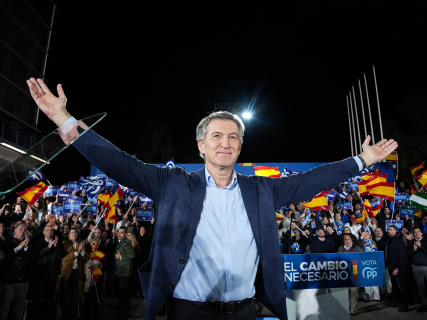
SocioMétrica’s poll at the close of the polls gives 137 seats to the PP, 115 to the PSOE and 53 to Vox

PP and Vox would add up to 190 seats, fourteen above the absolute majority, according to El Español’s poll for the general elections on 29N. With UPN’s two seats, the right would reach 192. Regarding the latest campaign tracking, the PP gains four seats, Vox loses eight, and the PSOE retains its 115.

fotonoticia 20261127213023 1920

fotonoticia 20261127213023 1920

Add DEMÓCRATA to Google

Ask FREN

Published

Last updated

4 minutes

Most read

Escrutinio provisional del Ministerio del Interior; se actualiza cada minuto. Mapas: Instituto Geográfico Nacional (es-atlas, CC BY 4.0). Demócrata.

The PP would be the most-voted force in the general elections on 29 November with 33.1% of the votes, according to the SocioMétrica poll for El Español released at 20:00. The institute places the Popular Party between 131 and 141 seats, with 137 as the central estimate. The PSOE would obtain 28.8% and between 111 and 120 representatives, with a central projection of 115. Alberto Núñez Feijóo’s advantage over Pedro Sánchez would be 4.3 points and 22 seats.

Vox would reach 16.9% of the votes and between 48 and 57 seats, with 53 in the central scenario. The PP and Santiago Abascal’s party would thus gather exactly 50% of the vote and 190 seats. The 50.5% that the study attributes to the whole of the right also includes the Navarra candidacy UPN-PP, which it assigns two seats to separately.

The figures correspond to an online electoral panel released after the close of the ballot boxes. The official result will depend on the count.

What has changed since the last campaign poll

On 23 November, SocioMétrica gave the PP 32% of the votes and 133 seats. Six days later, its estimate rises by 1.1 points and four seats. The PSOE goes from 29% to 28.8%, but it retains its 115 representatives. The distance between the two parties widens from three to 4.3 points and from 18 to 22 seats, in both cases taking the PP separately from UPN.

The biggest change occurs in Vox. The latest campaign tracking assigned it 61 seats and the 20:00 poll brings that figure down to 53. The PP recovers four of the eight seats that it gives up to its would-be partner in the national balance. The total of both parties falls from 194 to 190. If UPN is included in both releases, the bloc goes from 196 to 192.

Seats from 23J and SocioMétrica estimates for November 23 and 29
PartyBallot boxes 2023Nov. 23Nov. 29Change from MondayChange from 2023
PP137133137+40
PSOE1211151150−6
Vox336153−8+20
UPN¹1220+1
PP + Vox170194190−4+20
With UPN171196192−4+21
Sources: results of the general elections of July 23, 2023 and central estimates by SocioMétrica for El Español. ¹ In 2026, the institute presents the UPN-PP candidacy for Navarre separately. Absolute majority: 176 deputies.

Against 23J, the PP would repeat its result and Vox would contribute the 20-seat difference

The comparison with the 2023 ballot boxes offers a different reading of the last week of the campaign. The PP would repeat practically its share of the vote and exactly its 137 deputies. Vox, despite the decline compared with Monday’s tracking, would move from 33 to 53 representatives. The 20 additional seats that PP and Vox would win versus 23J correspond entirely to the growth of Abascal’s party. In 2023 they fell short by six of the 176. Now they would exceed it by fourteen.

The PSOE would be six deputies below the 121 it achieved three years ago. To its left, Frente Amplio would obtain between four and eight seats with 4.7% of the vote. SocioMétrica counts Compromís–Front Valencià, Chunta Aragonesista, and the Canary Islands candidacy UPCan separately. This difference in composition matters when comparing the range for Frente Amplio with the 31 deputies that Sumar gathered in 2023.

ERC–Podemos would reach between 10 and 12 seats and Adelante Andalucía would enter with between three and five

The joint candidacy of ERC and Podemos would place between ten and twelve deputies, versus the three to five that Junts would obtain. In the Basque Country, EH Bildu would reach between seven and eight representatives and the PNV would move between three and four. Adelante Andalucía, with 2% of the national vote, would enter the Congress with between three and five deputies.

The study distinguishes between Podemos votes where it presents its own list and those of the coalitions in which it participates. Podemos on its own would obtain 0.8% and would be left out in the central scenario. In the Canary Islands, UPCan retains an option to win a deputy. SALF would reach 1.9% and would also be left without representation in the central estimate.

SocioMétrica poll for the Congress of Deputies · November 29, 2026, 20:00
CandidacyVoteEstimated seats
PP33.1%131–141
PSOE28.8%111–120
Vox16.9%48–57
Broad Front4.7%4–8
ERC-Podemos2.5%10–12
Adelante Andalucía2.0%3–5
SALF1.9%0 in the central scenario
EH Bildu1.5%7–8
Compromís–Front Valencià1.3%3–4
Junts1.2%3–5
BNG0.9%2
EAJ-PNV0.8%3–4
Podemos alone0.8%0 in the central scenario
UPN-PP0.5%2
Coalición Canaria0.4%1
Chunta Aragonesista0.3%0–1
UPCan0.3%0–1
Other parties2.1%0 in the central scenario
Source: SocioMétrica for El Español. The ranges correspond to each candidacy. The central scenario published assigns 137 deputies to the PP, 115 to the PSOE, and 53 to Vox.

More key points, information and questions with FREN

AI-GENERATED CONTENT

At what stage of the electoral process is the official scrutiny after the polls close?

After the polls close, the scrutiny at the polling stations begins: we are not yet facing the final result nor the proclamation of the elected representatives. Then comes the general scrutiny by the electoral boards, which checks the documentation, incorporates the corresponding overseas votes, and allows for resolving incidents. It is important to distinguish these phases from the provisional results disseminated during election night.

1. The counting at the polling stations

The first step is the counting of the votes cast at each polling station and their reflection in the electoral records. Therefore, saying that everything that happens that night is "provisional" needs a nuance: the actions of the polling station have legal value; what does not yet constitute the final result is the informative sum that becomes known during the night.

This difference matters because the electoral documentation, not a results screen, serves as the basis for subsequent verifications. The Judgment 135/2004 of the Constitutional Court precisely highlights the relevance of the session record for the general scrutiny and distinguishes its function from the immediate publicity of the results.

2. Provisional dissemination does not close the process

While the ballots are being counted, results are communicated and aggregated to inform the public. This dissemination allows knowing the progress of the count, but does not replace the general scrutiny nor proclaim elected officials.

Even when one hundred percent of the polling stations are counted, this does not mean that all electoral operations have finished. The information from the polling stations may have been completed without all legally required votes being incorporated or claims resolved. The percentage of informational progress and the legal conclusion of the process are different things.

3. The general scrutiny and overseas voting

The next phase corresponds to the competent electoral boards. In it, the documentation from the polling stations is contrasted and the vote of Spaniards residing abroad registered in the CERA, the census of absent residents, is integrated according to the applicable procedure.

A documented example appears in the Judgment 95/2023 of the Constitutional Court: it describes how the Provincial Electoral Board of Madrid compared the polling station records with provisional data and incorporated the scrutiny of the CERA vote. It is a precedent that explains the mechanism, not a description of the specific progress of tonight's count.

4. Incidents, claims, and proclamation

The general scrutiny does not mean automatically recounting all ballots. The same judgment explains that there is no general right to review all null votes without a justified reason. Requests for review must be supported by specific circumstances.

After verifications and resolution of claims through the corresponding channels, the proclamation of elected officials arrives. This can be subject to judicial challenge: proclamation and final firmness are not necessarily simultaneous.

In summary: immediately after closing, we are in the initial phase of counting and documenting the polling stations, accompanied by provisional dissemination. To consider the result legally closed, the general scrutiny, incorporation of overseas votes, claims, and proclamation must be completed, without prejudice to appeals. That is the sequence of the procedure; it should not be confused with a confirmation of the real-time progress of each constituency.

What are the powers and functions of the Prime Minister according to the Spanish Constitution?

In the 1978 Spanish Constitution, the Prime Minister is the highest authority of the executive power and the center of direction of state policy. Their powers are scattered mainly in articles 97, 98, 99, 100, and 112 to 115 of the Constitution, and are complemented by laws that develop their statute (such as the Government Law).

1. Director of Government action and general policy

Article 97 establishes the key idea: the Government directs domestic and foreign policy, the civil and military administration, and the defense of the State, and exercises executive function and regulatory power. Within that Government, the Prime Minister is the one who directs its action and coordinates the functions of the other members. This has several consequences:

  • Sets the main lines of general policy (economic, social, foreign, defense, etc.).
  • Establishes the legislative priorities that the Government will promote in the Cortes.
  • Coordinates the actions of ministers and resolves conflicts between departments.
  • Assumes the highest political responsibility of the Government before the Congress.
2. Relationship with the King: appointment and dismissal

The Prime Minister is formally appointed and dismissed by the King, but always at the proposal of the Congress:

  • According to article 99, after elections or the resignation/fall of the Government, the King proposes a candidate for the Presidency, who must obtain the confidence of the Congress (investiture).
  • Once elected by the Congress, the King formally appoints them Prime Minister.
  • Dismissal occurs, among other cases, due to loss of parliamentary confidence (motion of censure, vote of confidence) or after new elections, and the King declares it as such.

Although the King intervenes, the system is parliamentary: the decisive element is the will of the Congress.

3. Appointment and dismissal of ministers

Article 100 provides that the other members of the Government (vice presidents and ministers) are appointed and removed by the King at the proposal of the Prime Minister. In practice:

  • The Prime Minister chooses and configures the Government structure (which ministries exist and who occupies them).
  • Can dismiss and replace ministers freely, without Parliament intervention.

This reinforces their role as head of the executive within the Council of Ministers.

4. Political responsibility and parliamentary control

The Constitution subjects the Prime Minister to intense control by the Congress:

  • The Government as a whole, and especially the Prime Minister, are politically responsible before the Congress (art. 108).
  • Must appear and respond to questions and interpellations from deputies.
  • Can raise a vote of confidence (art. 112): asks the Congress to ratify its support for the political line or a program. If lost, the Prime Minister must resign.
  • Can be removed through a constructive motion of censure (art. 113), which designates a new Prime Minister. If it succeeds, the Prime Minister ceases and the alternative candidate is automatically invested.

All this shapes a scheme in which the Prime Minister only remains while retaining the confidence of the parliamentary majority.

5. Dissolution of the Cortes and calling elections

Article 115 grants the Prime Minister the power to propose the dissolution of the Congress, the Senate, or the Cortes Generales to the King, who formally decrees it. They can also propose the calling of general elections. There are limits:

  • Cannot be proposed while a motion of censure is pending.
  • A minimum period between dissolutions must be respected.

It is a very relevant political instrument to unblock parliamentary deadlocks or reconfigure majorities.

6. Direction of defense and states of crisis

The Prime Minister assumes a central role in defense and security:

  • As head of the Government directing the defense of the State, coordinates security and defense policy together with the competent minister.
  • Participates in the decision to declare states of alarm, exception, and siege (art. 116), which the Government formally approves and the Congress controls.
7. Other relevant powers

Additionally, the Constitution and laws assign other functions, among which stand out:

  • Representation of the Government in its relations with other State powers and with other States or international organizations.
  • Signing, on behalf of the Government, of royal decrees and regulatory provisions that develop laws.
  • Promotion and coordination of the Government's legislative activity (bills, royal decree-laws, royal legislative decrees, etc.).
  • Participation in the decision to submit to a consultative referendum under article 92 those issues considered of special political importance, which the King calls at their proposal, with prior authorization from the Congress.

Overall, the Constitution configures the Prime Minister as the center of gravity of the executive power: directing government action, answering to Parliament, controlling the Government's composition, and having decisive instruments such as the vote of confidence or the proposal to dissolve the Cortes.

What was the final composition of the Congress of Deputies after the 2023 general elections?

The final composition of the Congress after the general elections on July 23, 2023 was 350 deputies: PP, 137; PSOE, including PSC, 121; Vox, 33; Sumar, 31; ERC and Junts, 7 each; EH Bildu, 6; PNV, 5; and BNG, Coalición Canaria, and UPN, 1 each. It is important to distinguish this electoral result from the subsequent organization of the Chamber, which was structured into nine parliamentary groups.

Final distribution of seats

The distribution by candidacies, grouping PSOE and PSC to facilitate joint reading, was as follows. The official reference is the publication of the electoral results in the Official State Gazette.

CandidacyDeputies
People's Party137
PSOE and PSC121
Vox33
Sumar31
ERC7
Junts per Catalunya7
EH Bildu6
EAJ-PNV5
BNG1
Coalición Canaria1
UPN1
Total350

There is an important clarification about the 121 socialist seats: the electoral breakdown distinguished between 102 from PSOE and 19 from PSC-PSOE. They were not 121 PSOE deputies plus another 19 from PSC, but 121 in total. Subsequently, both were integrated into the same Socialist Parliamentary Group.

How the parliamentary groups were organized

An electoral candidacy and a parliamentary group are not exactly the same. This difference explains why there were eleven candidacies with representation in the previous distribution, but nine groups to organize the Chamber's work. The consolidated initial distribution was:

  • Popular Group: 137 deputies.
  • Socialist Group: 121 deputies, including PSC representatives.
  • Vox Group: 33 deputies.
  • Plurinational Sumar Group: 31 deputies.
  • Republican Group: 7 deputies from ERC.
  • Junts per Catalunya Group: 7 deputies.
  • Euskal Herria Bildu Group: 6 deputies.
  • Basque Group, EAJ-PNV: 5 deputies.
  • Mixed Group: 3 deputies, corresponding to BNG, Coalición Canaria, and UPN.

The initial three members of the Mixed Group were Néstor Rego, for BNG; Cristina Valido, for Coalición Canaria; and Alberto Catalán, for UPN. Their seats are counted individually in the electoral result, although they shared a parliamentary group.

During the constitution of the groups, there were temporary transfers of deputies: two from Sumar to ERC and four socialists to Junts. These movements facilitated the formation of the groups but should not be confused with the number of seats obtained by each candidacy at the polls. Demócrata explained this process in its information about the transfers of parliamentarians.

What "final composition" means

To answer your question, the reference is the definitive 2023 electoral result, not the changes in affiliation that occurred later during the legislature. For example, the five Podemos deputies were initially included in the 31 from Sumar; their later departure from the group did not change the result of those elections, as reflected in the parliamentary analysis by Demócrata.

Numerically, the PP obtained the largest number of seats, but no candidacy reached the 176 deputies for an absolute majority on its own. The picture to be retained is, therefore, that of the 350 seats distributed above, distinguishing it from subsequent changes in the groups.

Play

Test your knowledge with FREN!

How much do you know about this topic? Answer the following 3 questions.

What percentage of votes and how many seats does the PP obtain according to the central survey by SocioMétrica?

Question 1 of 3

What is the total number of seats for the PP and Vox bloc according to the central estimate?

Question 2 of 3

Which party sees a reduction in the number of seats compared to the last campaign tracking by SocioMétrica?

Question 3 of 3