29N | Exit poll sampling: Sigma Dos declares the PP the winner and brings it closer to an absolute majority alongside Vox

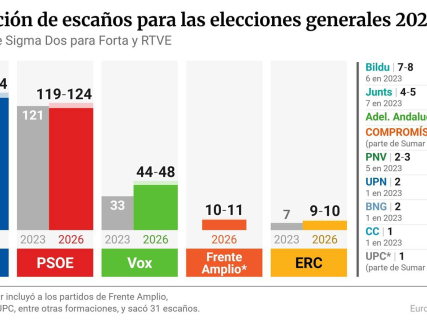
At the close of the polls in mainland Spain, Ceuta, Melilla and the Balearic Islands, the Sigma Dos poll for the public corporation RTVE and for FORTA yields a first estimate of results that gives the PP a range of 129-134 seats

fotonoticia 20261129201123 1920

fotonoticia 20261129201123 1920

Add DEMÓCRATA to Google

Ask FREN

Published

Last updated

2 minutes

Most read

Escrutinio provisional del Ministerio del Interior; se actualiza cada minuto. Mapas: Instituto Geográfico Nacional (es-atlas, CC BY 4.0). Demócrata.

Just when the schools for 29N have closed, with the exception of those in the Canary Islands, a Sigma Dos poll for RTVE and the Federation of Organizations or Entities of Autonomous Radio and Television (FORTA) has produced the first data from unofficial counts of the election day that we have just lived through, which must be taken as an estimate of votes.

The public corporation announced that it would provide its results at 20:00 hours, coinciding with the closing of the polling stations in the Peninsula, the Balearic Islands, Ceuta and Melilla, despite the fact that the Central Electoral Board had reminded the media that they cannot publish polling-station results until 21:00 hours in the Peninsula in order to preserve objectivity, transparency and equality during the voting, for which there remains one hour in the Canary Islands to conclude. This is what it has done, and its estimate of votes obtained by the different parties indicates that PP and Vox would move closer to the absolute majority in the upper end of the range.

seat estimate 29N according to sigma two

29N poll for RTVE and FORTA

🔵 PP: 129–134
🔴 PSOE: 119–124
🟢 VOX: 48
🟣 FA: 10–11
ERC: 9-10

The poll has been made public at the same time as the counting of the votes for the Congress and the Senate of the 29N general elections has begun in each polling station. Previously, the chair of each polling station will have introduced in the ballot boxes the envelopes of the vote by mail, after checking that they meet the requirements. Next, the members of the polling station and the election monitors have proceeded to vote. First the ballots for the Congress of Deputies are counted and then those for the Senate. No official data will be made public until 21:00.

Election night, in DEMÓCRATA

In DEMÓCRATA you will be able to consult the first election estimates, the evolution of the count, the allocation of seats by constituencies, and the possible parliamentary majorities. You can also follow all the reactions from the parties and the appearances by the candidates in the live coverage of the 29N general elections, as well as consult the election results in real time. With 350 seats at stake, the figure that determines the chances of reaching an absolute majority in Congress is 176 seats.

More key points, information and questions with FREN

AI-GENERATED CONTENT

What stage is the investiture of the Prime Minister at following the November 29 elections?

As of November 29, 2026, the investiture of the Prime Minister has not yet formally begun: today is the election day itself. There is no official candidate proposal from the King, no set date for the debate, nor any investiture vote. The next scheduled institutional milestone is the constitution of the new Chambers, on December 23 at 10:00 a.m..

Current situation: before the investiture

It is important to distinguish the election of deputies from the election of the Prime Minister. November 29 determines the composition of the Congress, but does not directly invest any candidate. The investiture is the subsequent procedure by which the Congress grants its confidence to a person proposed by the King.

Therefore, the situation is not that of a candidacy pending a second vote or an already convened debate. We are at the electoral moment prior to those procedures. According to information from Demócrata about election day, the first provisional results are expected from 9:00 p.m. peninsular time.

Steps ahead
  • Complete the electoral count. The general scrutiny is scheduled from December 4 to 7 and will include the vote of Spaniards residing abroad. The provisional distribution on election night should not be confused with the definitive result that determines the seats.
  • Constitute the new Chambers. Congress and Senate have their constitutive sessions scheduled for December 23 at 10:00 a.m. That convocation is not an investiture session: these are distinct acts and the candidate vote will require its own convocation.
  • Hold the King's consultations. Felipe VI must consult parliamentary representatives and, through the Presidency of the Congress, make a candidate proposal. Having run as an electoral aspirant does not equate to having received that formal proposal.
  • Call the debate. After the proposal, the date for the investiture session must be set. In the sources consulted, this convocation has not yet been recorded.

The separation between the constitution of the Chambers and the future investiture also appears in Demócrata's information on the institutional calendar. For now, December 23 is the reference for the parliamentary start, not an announced date to choose the Prime Minister.

Majorities required

When the vote arrives, the candidate will need 176 favorable votes in the first round: this is the absolute majority of the 350 deputies. If not obtained, the same candidacy may be submitted to a second vote 48 hours later, in which more votes in favor than against will suffice.

Abstentions can be decisive in that second vote, but do not replace the 176 supports required in the first. This is explained by Demócrata's guide; its numerical examples are simulations, not actual results from November 29 nor commitments of support.

The two-month deadline has not yet started

The constitutional two-month deadline to resolve an investiture begins with the first investiture vote, not with the elections. Since that vote has not taken place, that deadline has not yet started, according to the electoral calendar consulted.

In conclusion: there is no formal candidate yet, no debate convened, nor parliamentary result. The next concrete date is the constitution of the Cortes; the investiture will have its own calendar afterwards.

What are the powers and functions of the president of the Central Electoral Board in Spain?

The president of the Central Electoral Board (JEC) leads and represents the body, but does not personally concentrate all its powers. The fundamental distinction is between the functions of the Presidency, related to the institution's operation, and the electoral decisions that correspond to the Board as a collegiate body.

1. Presidency and internal operation

The Presidency organizes the Board's work: convenes and chairs its sessions, directs deliberations, and channels the adoption of agreements. It also exercises institutional representation and formalizes decisions that must be externalized through its signature. This does not mean it can replace by personal criterion what the members have decided.

It is important to distinguish, therefore, between leading a meeting and resolving a matter. The first task corresponds to the presiding person; the second, when it concerns a power attributed to the JEC, requires the decision of the body according to its operating rules. The president's signature also does not turn a collegiate agreement into a personal resolution.

2. Interpretation and application of electoral regulations

The JEC has a central role in interpreting and applying electoral legislation. Its president directs the necessary work to adopt those criteria, but institutional interpretation corresponds to the Board, not to an autonomous normative power of its president.

Among the JEC's powers is to revoke certain decisions of provincial electoral boards and, where applicable, autonomous ones when they contradict its interpretation of electoral regulations. This attribution is recorded in article 19.1.e of the Organic Law of the General Electoral Regime (LOREG), reproduced in a resolution published in the BOE.

3. Appeals, claims, and results

The Board is also responsible for resolving appeals and claims attributed to it by electoral legislation. Not all electoral conflicts reach it directly: there are powers of territorial boards and specific judicial review procedures.

Its intervention can have consequences on the result: for example, ordering a territorial board to proclaim elected candidates after correcting the vote count. This is recorded in Constitutional Court Ruling 146/1999. It is a decision of the JEC, although its president heads the body.

In elections to the European Parliament, the JEC intervenes in the proclamation of elected candidates. Ruling 64/2024 records a proclamation agreement and its possible challenge before the Supreme Court. This function should not be generalized as if the president personally proclaimed all Spanish electoral results.

4. Institutional relations and limits

Before the Government, the Cortes, and other authorities, the president represents the JEC and communicates its decisions. That representation does not imply political subordination nor allow altering adopted agreements.

The relevance of these decisions is considerable: Ruling 25/2022 records the binding nature of JEC agreements for authorities and institutions within its electoral scope. However, its decisions are subject to legally provided judicial control.

In short, powers to correct irregularities or impose sanctions should not automatically be attributed to the president: it is necessary to distinguish the Board's powers from the functions proper to its Presidency. Presiding, representing, and formalizing does not equate to deciding unilaterally.

What results did the Popular Party obtain in the previous general elections?

The Popular Party won the previous general elections, held on July 23, 2023, with 8,160,837 votes, 33.06%, and 137 deputies in the Congress. It was the most voted candidacy and the one that obtained the most seats, although that result did not allow it to form a government. (PP results, 2023).

Main figures

Taking as reference the elections prior to those called for November 29, 2026, the PP's result in the Congress is summarized as follows. The data correspond to the July 2023 vote, not to a result from the current election day:

  • Votes: 8,160,837 ballots for the Popular Party. (PP results, 2023).
  • Percentage: 33.06% of the national vote, approximately one in three votes. (General results, 2023).
  • Representation: 137 deputies in the Congress, which placed the PP as the first force by number of seats. (PP results, 2023).

These are three different ways to describe the same result: votes express the support received; the percentage allows measuring its weight over the whole; and the seats indicate the parliamentary representation obtained. It is important to distinguish them to avoid confusing winning in votes with having a sufficient majority to govern.

Comparison with November 2019

The PP improved its result compared to the November 2019 general elections: it went from 89 to 137 deputies, that is, it obtained 48 more seats. The comparison reflects an increase in its representation in Congress, not just a rise in vote percentage. (Results and electoral comparison).

In percentage terms, the PP went from 20.81% in November 2019 to 33.06% in July 2023. The difference was 12.25 percentage points; percentage points are used because two electoral percentages are being subtracted, not calculating relative growth between them. (Results and electoral comparison).

Therefore, both comparisons offer a consistent conclusion: the PP increased both its vote share and its number of deputies compared to November 2019. It is important to maintain that specific reference, because comparing with another call would produce different differences. (Comparison with November 2019).

Why winning did not mean governing

The PP, led by Alberto Núñez Feijóo, was first at the polls, but its 137 seats fell short of the 176 needed to reach an absolute majority: it lacked 39 deputies to reach that threshold alone. (Summary of the July 23 elections).

The sum of PP and Vox seats reached 170 deputies, six less than the absolute majority. Ultimately, Feijóo did not manage to form a government and Pedro Sánchez was invested president. That difference between electoral result and investiture result is key to understanding what happened after those elections. (Result and consequences of July 23).

Play

Test your knowledge with FREN!

How much do you know about this topic? Answer the following 3 questions.

What majority is needed in the Congress of Deputies to achieve an absolute majority?

Question 1 of 3

How many seats does the Sigma Dos poll estimate the Spanish Socialist Workers' Party (PSOE) would obtain?

Question 2 of 3

What warning did the Central Electoral Board issue regarding the publication of exit polls?

Question 3 of 3