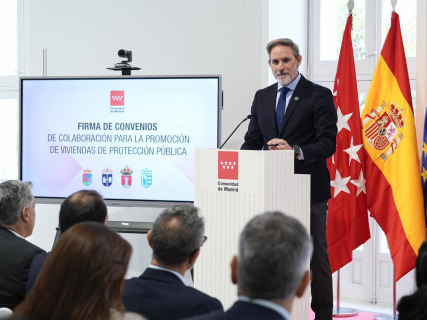

The Housing, Transport and Infrastructure adviser, José María García Gómez, presented this Friday the accounts of his department for 2027, in which the Community of Madrid’s investment effort is increased and, as he has emphasized, they are “made from love”.
“If I had a cheesy vision, which is so popular now, I would tell you that these are the budgets made from love: love for things done well, love for the human being, love for this region, which deserves the best,” he said during his appearance before the competent commission in the Assembly of Madrid.
The accounts of the Ministry of Housing, Transport and Infrastructure grow by 2.5% with respect to the current budget, reaching 3,374.4 million euros, placing housing as the central axis of the action of the regional Executive. He highlighted the “qualitative change” that means moving past the exceptional impact of the Recovery and Resilience Mechanism (MRR), which would raise the actual increase to 11.3%.
As he explained, the Community of Madrid is replacing “temporary and circumstantial resources with its own effort” and “ordinary regional investment gains weight”. “Let’s not confuse accounting variations with political priorities. Where temporary resources end, the Community maintains the necessary actions and establishes lasting instruments,” he emphasized.
He insisted that the budget is aimed at increasing the supply and access to housing, carrying out the major Metro expansions and improving intermodality, preserving and modernizing the road network, and ensuring the financing of affordable, reliable and technologically advanced public transport.
“We combine ambition and responsibility to prepare the future, responsibility to address the present, and a clear priority. That Madrid’s growth should translate into more opportunities to live, work and move around freely in our region,” he argued.
He said that the chapter that “best defines this budget” is that of real investments, which amounts to 712 million euros (+25.4%), approximately one third of the total. “This is not a statement of intentions; they are works, they are homes, they are roads, they are interchanges and rail expansions with specific funding,” he reiterated.
Housing: Plan Vive, rent assistance and rehabilitation
The three housing programs, "a top-priority social and economic matter", total €552 million. Among the main actions, it has cited €78.3 million for new social and affordable housing and the development of the Vive Plan, €36 million for rental assistance and youth emancipation, and €35 million for the Mi Primera Vivienda program. The Plan Rehabilitar Madrid will have €83 million and another €30 million has been set aside for the Regional Plan for Lifts.
The Agency for Social Housing will continue to build new homes for families with lower incomes, to which it will devote €90.4 million, and it will increase from €10.8 million to €25.2 million the item earmarked for the purchase of properties.
Metro, CRTM and transport infrastructure
In the transport area, the budget provides €705.8 million for infrastructure, with an investment chapter that will reach €550 million, 35.6% more.
In 2027, Metro de Madrid will have €1.544 billion, 4.1% more than in the current financial year. Within this figure, it has highlighted €530 million for maintenance and upkeep, "as important and essential as we have seen with the terrible rail accidents in Adamuz and Urda".
The Regional Transport Consortium (CRTM) will have €2.114.4 million, which represents an increase of 6.7%. "The public budget covers 64.2% of total needs, that is, the user pays 35.8%, and this is with frozen fares", it has detailed.
It has criticized that the State’s ordinary nominative contribution has been frozen for more than ten years at €126.9 million (5.9% of total cost), and it has compared these figures with Catalonia, which receives "an allocation per kilometer, per trip, 74%" higher than Madrid’s.
Investment in intermodality will reach €33.9 million, with progress in the interchanges at Conde de Casal and Alcalá de Henares. On roads, the budget amounts to €252.8 million, 2.4% more than in 2026, with actual investments of €108.8 million: €38.4 million for new infrastructure (+9.8%) and €70.4 million for maintenance, road safety, and replacement.
"This is a budget designed to expand opportunities—opportunities to access housing, to better connect the municipalities, and so that a region that is growing continues to have the infrastructure it needs", it concluded.
Criticism from the opposition
From Más Madrid, the deputy Jorge Moruno has reproached the regional executive for "doing nothing on housing," being "totally consistent" with its model of reducing these allocations "because its goal is not to facilitate access to housing," but that, in his view, it seeks for "the richest 1% in this community to keep increasing the wealth it accumulates."
In terms of transport, the deputy María Escalante has denounced the absence of proper planning —"they are condemning families to have one or two cars, because the freedom to be able to use public transport does not exist"—, has again demanded a regional mobility survey, and has recalled that the new concession map, which is being "a long ordeal," is born "with major flaws" for being based on outdated population data.
She has also pointed out that "no community has wanted to sign agreements with the Community of Madrid for transport passes for people who are not registered residents" and has warned of a 23% drop in the sale of transport passes in 2026.
For its part, from the PSOE, the deputy Javier Guardiola Arévalo has emphasized that the 2027 accounts "contain no real transformation" to address the "biggest concern" of people in Madrid, housing, which "represents only 1.7% of the total budget" and continues to be "the engine of inequality." "Maybe they don't love these budgets so much for the problems of people in Madrid," he joked.
In transport, he has questioned planning that, as he said, does not address population growth or new developments, either in roads or in Metro expansions, and that pushes workers toward the periphery, with "a metropolitan belt that is housing other provinces such as Guadalajara, Toledo or Segovia and Ávila." He has also criticized that the allocation for Line 7B is being reduced when "they have lost the courts and will have to pay compensation."
From Vox, the deputy Beatriz Tejero Oller has stressed that the regional Government spends "more than ever" but cuts "where people in Madrid need it." "This housing budget boils down to three ideas: they cut housing in the year of the highest spending in history; what they budget they do not carry out and what grows is the structure, the staff and external contracts, not housing; and there is no difference between this budget and the one the PSOE could put forward: more spending, more bureaucracy, more intervention and the same results," she summarized.
His partner, Javier Pérez Gallardo, has insisted on the importance of reinforcing maintenance after the train accidents in Adamuz and Urda and has criticized that, in his view, the accounts are not geared toward “population growth” and that the investment is focused on Metro when “all the road access to Madrid” is “congested”.