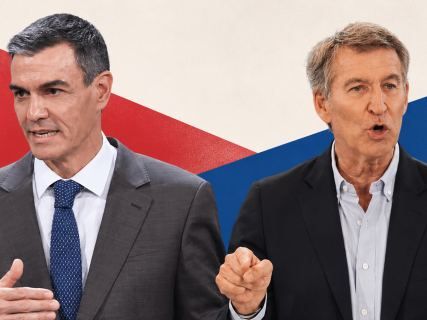
Poll | Who won the debate between Pedro Sánchez and Alberto Núñez Feijóo? Vote here

The PSOE and PP candidates headline the only head-to-head matchup of the campaign for the general elections of 29N. Participate in the DEMÓCRATA poll and choose who has been more convincing

Collage editorial de Sánchez y Feijóo

Collage editorial de Sánchez y Feijóo

Add DEMÓCRATA to Google

Ask FREN

Published

Last updated

1 minute

Most read

Elecciones 29N · Encuestas

La media de las encuestas

Media a 19 de noviembre de 2026 · 19 institutos

  • PP31,0 %
  • PSOE27,7 %
  • Vox19,0 %
  • Frente Amplio6,2 %
  • ERC2,6 %
01020304050ene 2024jul 2024ene 2025jul 2025ene 2026jul 2026

Media del último estudio de cada instituto en 30 días y su evolución semanal desde el 23J. Partidos con al menos un 2 %.

Todas las encuestas

Elecciones generales del 29 de noviembre · Demócrata

Ten days after the general elections of November 29, Pedro Sánchez and Alberto Núñez Feijóo have faced off this Thursday in one of the most anticipated events of the election campaign. The president of the Government and the leader of the Partido Popular have defended their proposals and confronted their models of the country in a face-to-face moderated by María Casado, with the intention of convincing voters before their appointment with the ballot boxes.

During the meeting, held at the Television Academy, the two candidates have had the opportunity to set out their positions on housing, the economy and taxation, social policy and public services, corruption and democratic renewal, migration and foreign policy. The debate has offered voters the chance to compare the proposals of the two main contenders to lead the Government.

Who has been more convincing? Which candidate has defended his proposals better? DEMÓCRATA launches a poll to learn the opinion of its readers about the face-to-face between Sánchez and Feijóo.

Poll: who has won the debate between Sánchez and Feijóo?

Take part in DEMÓCRATA’s poll and vote for the candidate who, in your view, has won the electoral debate this Thursday.

More key points, information and questions with FREN

AI-GENERATED CONTENT

What is the parliamentary process that will follow the general elections on November 29?

After the general elections on November 29, the process will have two main focuses: constituting the new Chambers and processing the investiture of the President of the Government. They are not a single vote: first the Parliament is organized and then the Congress decides whether to grant its confidence to a candidacy.

1. Constitution of the new Congress

The Congress will meet on the date and time indicated in the royal decree calling the election. Therefore, the election day should not be confused with the effective start of the work of the new Chamber.

The constitutive session will initially be presided over by the oldest elected deputy present, assisted by the two youngest. After reading the call, the list of elected members, and the electoral appeals submitted, the Board will be elected, the body that organizes and directs parliamentary work.

  • Presidency of the Congress: requires an absolute majority in the first vote. If no one achieves it, the two most voted candidacies compete and the one with the most votes wins.
  • Four vice presidencies and four secretariats: are elected in separate votes for each set of positions; the persons with the most votes are elected.

Afterwards, the deputies will take an oath or promise to uphold the Constitution. The Presidency will declare the Congress constituted and will communicate it to the King, the Senate, and the Government.

2. Groups and organization of work

Within the five working days following the constitutive session, parliamentary groups must be formalized. As a general rule, fifteen deputies are needed; they can also be formed with five if they meet the required electoral percentages: 15% in the constituencies where they presented candidacy or 5% nationally. Those who do not join a group will go to the Mixed Group.

The Regulations also establish the constitution of permanent commissions within ten working days and a solemn opening session within fifteen working days. This ceremonial opening is different from the constitutive session and the investiture.

3. Debate and investiture vote

Upon receiving the proposed candidacy for the Presidency of the Government, the Presidency of the Congress will convene the Plenary. The proposed person will present their program without time limit and request the confidence of the Chamber. Then the groups will intervene and replies will be developed.

  • First vote: requires an absolute majority of the members of Congress.
  • Second vote: if the first fails, it is held forty-eight hours later. A simple majority suffices: more favorable votes than opposing.

The vote will be public by roll call: each deputy will respond "yes," "no," or "abstention." If the candidacy obtains confidence, the Presidency of the Congress will communicate it to the King for appointment purposes.

4. If no candidacy obtains support

Successive proposals may be processed by the same procedure. The decisive period is two months from the first investiture vote, not from the elections nor from the constitution of the Congress. If no candidacy gains confidence, the General Courts will be dissolved and elections called.

5. Continuity between legislatures

Until the constitution of the new Congress, its Permanent Deputation maintains limited functions: it safeguards the powers of the Chamber, decides on royal decree-laws, and exercises the powers provided for states of alarm, exception, and siege. It does not replace the Plenary in all its ordinary activity. Afterwards, it will report its decisions to the new Congress.

These steps are supported by articles 1–5, 23–25, 37, 46, 56–59, and 170–172 of the Congress Regulations.

What are the competencies of the President of the Government according to the Spanish Constitution?

The Spanish Constitution does not contain a single "closed catalog" of competencies of the President of the Government, but it does clearly define his role as head of the Government and the main functions he exercises. These powers mainly derive from articles 97, 98, 99, 100, 112, 113, and 115 of the Constitution, in addition to the general rules about the Government.

1. Political direction of the Government

The starting point is in article 97 CE, which establishes that "the Government directs domestic and foreign policy, the civil and military Administration, and the defense of the State". Although the competence is attributed to the Government as a collegiate body, the Constitution configures the president as the one who effectively directs and coordinates that action.

Article 98.2 CE specifies that the President of the Government:

  • Directs the action of the Government, that is, sets the broad lines of government policy in all areas (economic, social, foreign, defense, etc.).
  • Coordinates the functions of the other members of the Government (vice presidencies and ministries), ensuring coherence of government action.

In constitutional practice, this means that the president:

  • Sets the general political priorities of the Executive.
  • Defines the orientation of draft laws and royal decree-laws that the Government submits to the Cortes or approves.
  • Arbitrates and resolves conflicts of criteria between ministries.

2. Internal organization of the Government

Also, article 98.2 CE grants the president decisive power over the composition of the Executive. By virtue of this provision and in connection with article 100 CE, the president:

  • Proposes to the King the appointment and dismissal of vice presidents and ministers. Legally, the appointment is made by the King, but the political decision is the president's.
  • Can restructure the Government (create, suppress, or modify ministries and vice presidencies) through the corresponding normative initiative, deciding the distribution of competencies among portfolios.

Thus, the Constitution places the president at the center of the direction of the government team: he chooses his main collaborators, decides who enters and who leaves the Government, and organizes its basic structure.

3. Relationship with the Cortes Generales

The Constitution grants the president several specific competencies in the Government–Parliament relationship:

  • Vote of confidence (art. 112 CE): the president can submit to the Congress of Deputies a vote of confidence on his program or on a general policy statement. If he loses that vote, he must resign.
  • Intervention in the motion of censure (art. 113 CE): although the motion of censure is a parliamentary initiative, it is directed against the president and his Government. If it succeeds, the president ceases and is replaced by the alternative candidate proposed by the Congress.
  • Political responsibility of the Government (art. 108 CE): the Government as a whole is jointly responsible before the Congress, but that responsibility is mainly channeled through the president, who appears and responds in parliamentary sessions.

4. Dissolution of the Chambers and calling elections

One of the president's most relevant competencies is his role in the dissolution of the Cortes:

  • According to article 115 CE, it is the President of the Government who proposes to the King the dissolution of the Congress, the Senate, or the General Courts and the calling of general elections. The formal decision is made by the King, but only at the president's proposal and under his responsibility.
  • The same provision sets limits: dissolution cannot be proposed while a motion of censure is in process and a minimum period between dissolutions must be respected.

This competence grants the president a powerful power to manage political timing, being able to anticipate elections within the margins set by the Constitution.

5. Investiture and countersignature

Article 99 CE regulates the investiture procedure of the President of the Government: after the candidate is proposed by the King, the Congress grants or denies its confidence. Once elected, the president:

  • Is appointed by the King, but is democratically legitimized by the confidence of the Congress.
  • From that moment, becomes the main countersigner of the King's acts related to the Government (for example, appointment and dismissal of ministers), according to article 64 CE, where the general rule of countersignature is established.

6. Summary

Overall, the Constitution configures the President of the Government as:

  • Head of the executive power, who directs the Government's action and sets the general political orientation.
  • Coordinator of the ministers and responsible for the cohesion of the government team.
  • Main interlocutor before the Cortes, with the capacity to propose the vote of confidence and subject to possible motion of censure.
  • Key figure in the dissolution of the Chambers and in calling general elections, through the proposal to the King provided in article 115.
  • Central figure of the parliamentary system, concentrating the political responsibility of the Government and embodying the link between parliamentary majority and Executive.

All these competencies are exercised always within the general framework of the Government as a collegiate body and under the political control of the Congress of Deputies.

What differences are there between the competencies of the President of the Government and those of the King according to the Constitution? How is the relationship between the President of the Government and the Cortes Generales developed in practice? What limits and controls exist over the use of the power to dissolve the Cortes Generales?

What has been Pedro Sánchez's political trajectory before becoming President of the Government?

Before becoming President of the Government in June 2018, Pedro Sánchez had worked as an advisor in the international field, been a councilor in Madrid and a deputy in Congress, and led the PSOE in two stages. His trajectory was not continuous: he lost his seat in 2011, left the socialist leadership in 2016, and regained the party leadership in 2017.

Early steps: membership and international experience

Sánchez joined the PSOE in 1993. Before holding elected positions, he developed a professional stage linked to international institutions: between 1998 and 1999 he worked in the European Parliament as an advisor to the socialist MEP Bárbara Dührkop. It is important to distinguish that role from a representative position: he was not a MEP. Later, in 1999, he joined the cabinet of Carlos Westendorp, the international high representative for Bosnia-Herzegovina. These were his first experiences of political work outside Spain (La Moncloa biography).

After returning to Spain, he worked as Director of International Relations of the Consumers and Users Organization and as economic advisor to the Federal Executive Commission of the PSOE. His activity thus combined professional responsibilities with advisory work within the party, before making the leap to municipal representation (ABC profile).

2004-2009: councilor in Madrid

In 2004 he joined the Madrid City Council to replace a socialist councilor who had left her position. He remained as a councilor until 2009, in the PSOE municipal group. It was his first stage as an elected public representative and preceded his entry into national parliamentary politics. During those years he was also a member of the General Assembly of Caja Madrid, proposed by the socialist group, a responsibility he held between 2004 and 2010 (PSOE Archive).

2009-2013: entry, exit, and return to Congress

In September 2009 he entered Congress as a deputy for Madrid, filling the vacancy of Pedro Solbes. His first parliamentary stage ended in 2011: he ran in the general elections that year, but his position on the socialist list did not allow him to obtain a seat. He returned in January 2013 to replace Cristina Narbona, who left the Chamber after being appointed counselor of the Nuclear Safety Council (PSOE Archive).

2014-2016: socialist leadership and national candidacies

The leap to the front line came in July 2014, when he won the socialist primaries and was elected secretary general of the PSOE, succeeding Alfredo Pérez Rubalcaba. From that responsibility, he acted as leader of the opposition to Mariano Rajoy's Government and headed the socialist candidacies in the general elections of December 2015 and June 2016 (PSOE Archive).

The 2016 internal socialist crisis meant another interruption in his career. Sánchez resigned as secretary general on October 1, 2016 and, that same month, also resigned his seat. Thus, he temporarily closed both his stage at the head of the party and his activity in Congress (PSOE Archive).

2017-2018: recovery of leadership and arrival to Government

In 2017 he won new primaries against Susana Díaz and Patxi López and formally resumed the Secretary General on June 18. A year later, on June 1, 2018, Congress approved the motion of censure against Mariano Rajoy. Sánchez took office as president on June 2: culminating a trajectory that had passed through international advising, City Council, Congress, and PSOE leadership (PSOE Archive).

Play

Test your knowledge with FREN!

How much do you know about this topic? Answer the following 3 questions.

Who participated in the televised debate ten days before the general elections on November 29?

Question 1 of 3

Who moderated the debate between Pedro Sánchez and Alberto Núñez Feijóo?

Question 2 of 3

What topics were discussed during the debate between Sánchez and Feijóo?

Question 3 of 3