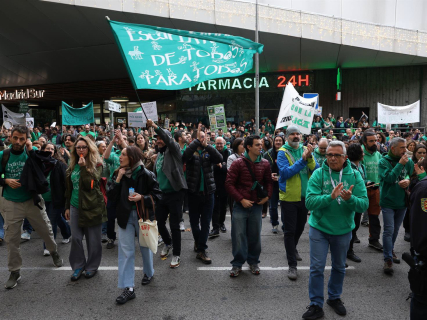

The Community of Madrid has sent this Thursday to public schools and institutes in the region some instructions that prohibit displaying support posters for the educational strike and using classrooms to promote protests among students. The document, signed by the vice-counselor for Education Policy and Educational Organization, José Carlos Fernández Borreguero, also contemplates the possibility that families, students and workers communicate possible breaches through a form addressed to the educational Administration.
With these measures, the Government of Isabel Díaz Ayuso intends to reinforce the ideological neutrality of public centers during the indefinite strike that began on October 14. The 11-page instructions detail the conduct that teachers must avoid, the obligations of the management teams, and the intervention mechanisms of the Educational Inspectorate. Noncompliance may result in disciplinary responsibilities.
The initiative comes amid the mobilization of teachers in Madrid, who are demanding labor and educational improvements, and has opened a legal debate about the limits of institutional neutrality and its relationship with fundamental rights such as freedom of expression, freedom of chair, and the right to strike.
What the Community of Madrid prohibits in educational centers
The instructions establish that teachers may not use their professional position or the resources of schools and institutes to promote students’ adherence to political, ideological or union options.
Among the conduct expressly prohibited is urging students to participate in strikes, rallies, protests or signature collections. Nor will it be allowed to take advantage of classes, tutorials, assignments, exams or complementary activities to ensure that students support one of the parties in a union or political conflict.
The restriction extends to the periods in which teachers are fulfilling minimum services. In addition, these instructions apply to institutional channels and the material resources of the centers.
As for posters and signage, the Department prevents displaying on facades, fences and common spaces banners or symbols that could attribute to the school or institute an institutional endorsement of certain organizations or demands. The ban includes an exception for the union noticeboards provided for in current regulations.
The Autonomous Executive justifies these limitations with the obligation to ensure that the public school maintains its ideological neutrality. As the document states, the role of the centers is to “educate, not indoctrinate”.
Families and students will be able to report possible breaches
One of the changes in the instructions is the authorization of a mechanism to report to the Administration possible violations of the rules.
Parents, mothers, students and staff of the centers will be able to submit communications by means of a form addressed to the Territorial Area Directorates when they consider that any teacher has failed to comply with the restrictions.
The Educational Inspectorate may intervene both on its own initiative and based on these communications. In cases in which an infraction is found, the instructions contemplate the requirement to assume the corresponding disciplinary responsibilities.
The procedure thus introduces a specific channel for the educational community to report conduct related to the use of facilities, school resources, or teaching activity during protests.
The right to strike and academic freedom, at the center of the legal debate
The ideological neutrality of public centers is already contemplated in Spanish legislation. Article 18 of the Organic Law regulating the Right to Education (LODE) requires that educational activities be carried out with respect for constitutional principles and the religious and moral convictions of families.
However, the legal discussion focuses on determining how far that obligation can extend when it affects labor and union demands.
The professor of Administrative Law at the Complutense University Julio González considers that the instructions do not sufficiently take into account the constitutional protection of the right to strike, recognized in Article 28 of the Constitution.
In his view, the measures are unconstitutional and may foster accusations against teachers for actions linked to the exercise of fundamental rights.
Rosa Galán, associate professor of Financial and Tax Law at the Complutense, also warns that ideological neutrality must be reconciled with academic freedom. The instructor distinguishes between preventing indoctrination and restricting any manifestation related to a labor conflict.
For his part, Pablo Gómez Perpinyà, professor of Constitutional Law at the University of Extremadura, questions that administrative instructions can impose restrictions on fundamental rights reserved for higher-ranking rules.
The assessments of these specialists differ from the interpretation of the Madrid Government, which defends the instructions as a tool to preserve the neutrality of the centers and prevent students from being used to promote union demands.
Madrid also reinforces the minimum services of the educational strike
Along with the instructions on neutrality, the Community of Madrid has approved an expansion of the minimum services in view of the extension of the stoppages.
The new order, published this Thursday in the Official Gazette of the Community of Madrid, will enter into force on Friday, November 20, and includes a strengthening of educational care, especially in the courses that provide access to degrees and higher studies.
According to the calculations of the regional Executive, the strike had potentially affected 413,076 teaching hours up to November 16, after 23 teaching days since the start of the mobilizations.
The regional Administration has also ordered that teaching schedules be reviewed in order to recover the content affected by class interruptions.
Other communities have approved measures on educational neutrality
Madrid’s regulation has recent precedents in other autonomous communities, although with differences regarding the obligations imposed on the centers.
In the Valencian Community, PP and Vox modified the educational inspection regulations last July to reinforce supervision of ideological neutrality in teaching activities and to establish a communication channel for possible infringements.
Canarias has also incorporated references to institutional neutrality into its educational instructions, while Galicia has strengthened administrative control of certain complementary activities organized in schools and institutes.
In Madrid, the new instructions arrive after several weeks of confrontation between the Education Department and trade union organizations over the indefinite strike. The latter had already questioned orders to remove posters and banners supporting the mobilizations, considering that they affect the exercise of trade union rights.