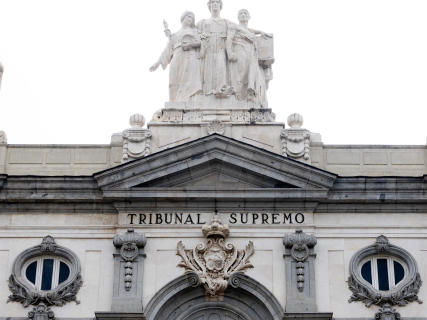

The Social Chamber of the Supreme Court has decided not to admit for processing the appeal filed by the Gipuzkoan company Goki Erreformak SL, which sought to revoke the consideration of an accident at work, with a diagnosis of adjustment disorder with anxiety, of the period of temporary incapacity that one of its employees went through after being assaulted by a colleague.
As CCOO Euskadi has pointed out, the decision of the High Court once again supports the position of the worker, in the same line as the ruling issued at the beginning of this year by the Superior Court of Justice of the Basque Country (TSJPV), which had already declared that period of sick leave as a work accident by understanding that the adjustment disorder with anxiety was directly caused by the physical assault suffered by another employee of the company.
In that ruling, the TSJPV concluded that the triggering element of the mental pathology that led to the medical leave was the assault that the worker suffered at the hands of a colleague and the fact that, after that episode, he was forced to coincide with his aggressor on a daily basis, both when entering and when leaving the workplace.
In addition, the TSJPV judgment emphasized that this situation lasted without the company putting in place any action to correct it, despite the fact that the assaulted worker himself had requested the adoption of measures.
Criticism of the attempt to avoid the classification
After the Supreme Court’s ruling became public, the head of occupational health at CCOO in Euskadi, Alfonso Ríos, criticized that Goki Erreformak SL "did not seem to have time or resources to implement the preventive measures that, according to the TSJPV, it required of the assaulted worker himself", while he has denounced that, "it does seem to have that time and those resources to go to the Supreme Court to try to avoid the classification of this episode as an accident at work".
Ríos also stated that CCOO had already made clear that, during the judicial process, "Goki Erreformak SL had already tried this same thing on more occasions by citing alleged extrawork difficulties and aspects related to the personal characteristics of the worker, an argument that the TSJPV chose not even to consider".