The survey of surveys: this would be the result of the general elections of 29N by combining opinion polls and electoral trackings

The PP reaches 30.9% of the votes, the PSOE stands at 27.3% and Vox obtains 19.1% in a mean of 17 institutes. The available parliamentary projections leave the Populars and Vox around 195 seats, above the absolute majority

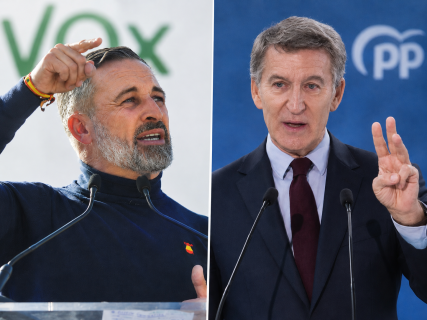
Abascal y Feijóo  voces políticas enfrentadas

Abascal y Feijóo voces políticas enfrentadas

Add DEMÓCRATA to Google

Ask FREN

Published

Last updated

7 minutes

Most read

Elecciones 29N · Encuestas

La media de las encuestas

Media a 14 de noviembre de 2026 · 15 institutos

  • PP31,4 %
  • PSOE26,9 %
  • Vox19,1 %
  • Frente Amplio6,4 %
  • ERC2,5 %
01020304050ene 2024jul 2024ene 2025jul 2025ene 2026jul 2026

Media del último estudio de cada instituto en 30 días y su evolución semanal desde el 23J. Partidos con al menos un 2 %.

Todas las encuestas

Elecciones generales del 29 de noviembre · Demócrata

ELECCIONES 29N

¿Cuál es tu pronóstico? 29N

Reparte los 350 escaños del Congreso como creas que quedarán el 29 de noviembre. Puedes cambiar tu pronóstico hasta que cierren los colegios.

0 de 350 escaños

PP
PSOE
Vox
Frente Amplio
ERC
Junts
EH Bildu
PNV
Más partidos
Podemos
BNG
SALF
CC
UPN
Adelante
Aliança
Otros

Protegido por reCAPTCHA de Google: privacidad y condiciones

Pronóstico de DemócrataParticipación abierta, no es una encuesta

The polls for the general elections of November 29 offer different results, but their combination makes it possible to summarize the balance of forces. An arithmetic mean of the latest measurements collected from 17 institutes places the PP in first position, with 30.9% of the vote, followed by the PSOE, with 27.3%, and Vox, with 19.1%.

The calculation incorporates surveys and daily follow-ups with a common rule: each firm counts only once. When it has a more recent tracking, that submission replaces its earlier survey. It also includes the CIS, so both the selection and the weighting differ from the usual average of the Demócrata aggregator, which excludes the public body and weights by seniority and sample.

The result in votes: the PP maintains first place

The gap between PP and PSOE stands at 3.5 points before rounding the percentages. The combined total of the popular party and Vox reaches 50.0%: practically half of the estimated vote in this set of studies.

The mean brings together forecasts that are far apart. Among the measurements included are the 33.1% that DYM attributes to the PP, the 33.3% of the PSOE in the CIS, and the 31.6% socialist figure from the last follow-up consulted from SW Demoscopia. Including them with the same weight allows a common reference to be built, but it does not eliminate their methodological differences.

29N general elections: average vote by party

The simple average of the 17 firms collected places the PP at 30.9%, the PSOE at 27.3%, and Vox at 19.1%.

Vote estimate for Congress. Consultation cutoff: .
Party or grouping Vote share
People's Party (PP) 30.9%
Spanish Socialist Workers' Party (PSOE) 27.3%
Vox 19.1%
Other candidacies and blank vote* 22.7%

Source: editorial calculation based on the latest measurements collected from 17 institutes. Simple arithmetic mean, with one submission per firm and the same weight for all, including the CIS. The trackings replace the previous polls from the same institute.

The result in seats: PP and Vox are close to 195 deputies

Fifteen of the 17 signatures used provide a parliamentary estimate for the three main parties. Their average leaves the PP with 129.8 deputies, the PSOE with 109.8, and Vox with 65.6. The combined total of the Popular Party and Vox reaches 195.4, about 19 above the 176 needed for an absolute majority.

These figures come from averaging the seats published, not from converting the national vote percentage into deputies. When a firm provides a central figure, that estimate is used; when it publishes only a range, its midpoint is taken. The decimals express the result of that operation and do not represent fractions of deputies that could be obtained at the polls.

The main parliamentary conclusion is that the combined total of PP and Vox continues to be above the absolute majority in this combination of studies. That does not mean that all the institutes predict that outcome: the latest tracking consulted from SW Demoscopia puts both at 173 deputies, while 40dB. assigns them 189.

General elections of 29N: average seats by party

The 15 available projections place the combined PP and Vox total at an average of 195.4 deputies. The absolute majority of the Congress is 176.

Average parliamentary projections. Consultation cutoff: . The decimals express averages, not an exact electoral allocation.
Party or grouping Average seats
Popular Party (PP)* 129.8
Spanish Socialist Workers' Party (PSOE) 109.8
Vox 65.6
Remainder of candidacies** 44.8
Subtotal PP + Vox* 195.4
Threshold for absolute majority 176

Source: editorial calculation based on 15 available projections for PP, PSOE and Vox.

Comparison with 23J: Vox concentrates the growth of the right

With respect to the 2023 general elections, the average reflects a reversal for the two major parties and a growth for Vox. Using percentages rounded to one decimal place, the PP goes from 33,1% to 30,9%, the PSOE from 31,7% to 27,3%, and Vox from 12,4% to 19,1%. The changes are −2,2, −4,4, and +6,7 points, respectively.

In parliamentary representation, the average places the PP about seven MPs below its 137 from 23J and the PSOE about eleven below the 121 it achieved then. Vox appears to be close to doubling its 33 representatives. The advance of Santiago Abascal’s party offsets, in this joint photograph, the loss of seats for the Popular Party.

Comparison with 23J: changes in vote and seats

Compared with the 2023 elections, the average places PP 2.2 points below and PSOE 4.4 points below. Vox increases by 6.7 points.

On mobile, swipe horizontally to view all columns.

Results of the election compared to the average of polls and trackings, with the consultation cutoff on .
Party 23J vote 29N average vote Change in percentage points 23J seats 29N average seats Seat difference
PP* 33,1% 30,9% −2,2 137 129,8 −7,2
PSOE 31,7% 27,3% −4,4 121 109,8 −11,2
Vox 12,4% 19,1% +6,7 33 65,6 +32,6

Sources: results of the 2023 general elections and editorial calculation on the measurements compiled for 29N. The vote average uses 17 institutes and the seats average uses 15. Vote differences are calculated based on the percentages shown, rounded to one decimal place.

How this average has been calculated

The selection brings together 40dB., Sigma Dos, SW Demoscopia, Winston, SocioMétrica, DYM, IMOP, GAD3, Ateneo del Dato, NC Report, Sondaxe, Data10, Celeste-Tel, Target Point, Hamalgama Métrica, More in Common and the CIS. A single measurement per institute is used from among the collected data, with the same weight for each firm, without correcting any possible biases and without incorporating reestimates that are unrelated such as independent surveys.

The breakdown is limited to PP, PSOE and Vox because the other candidacies do not appear grouped uniformly in all the studies. Frente Amplio, its territorial coalitions and Podemos require additional harmonization in order to obtain comparable individual averages. That is why they are presented within the rest, rather than attributing to them artificially precise figures.

More key points, information and questions with FREN

AI-GENERATED CONTENT

At what stage of parliamentary processing is the legislation regulating the publication and dissemination of electoral polls in Spain?

The regulation of electoral polls is already in force: it is mainly found in Article 69 of Organic Law 5/1985, of the General Electoral Regime (LOREG). Another matter is the reform that aimed to increase the transparency of polls by requiring the publication of anonymized microdata: that project reached the Congress, but expired with the dissolution of the Cortes for the November 29, 2026 elections. Therefore, as of November 14, it should not be described as a reform still progressing through the Chambers.

What initiative was being processed

The relevant initiative is the Organic Law Bill amending Organic Law 5/1985, of June 19, on the General Electoral Regime, file 121/000063 of the Congress. Its text was published in the Official Bulletin of the General Courts and addressed two matters: electoral debates and the information obligations accompanying polls. It can be consulted in the bill text.

Regarding polls, it proposed adding to the information required by Article 69 the publication of anonymized microdata: the individual responses used to prepare the poll, without data that could identify the interviewed persons. The objective was to facilitate verification of results and the preparation of independent estimates, as explained by the Ministry of the Interior.

How far it went and what happens now

The identified process includes the initial approval of the draft bill by the Council of Ministers on April 15, 2025, its public hearing — open until June 26 of that year — and its subsequent publication as an organic law bill in Congress. The hearing was a governmental drafting phase, not a parliamentary approval, according to information published by Demócrata about the reform.

The located documentation confirms its entry into the Congress processing, but not a definitive approval of that reform on polls. With the dissolution of the Cortes, pending bills expire: their parliamentary process ends and they are not simply suspended until after the elections. To recover those measures, a new initiative will need to be presented in the next legislature.

This matters because a previous reference placing the project "in processing in Congress" describes a past stage, not its current situation. It should also not be confused with other amendments to LOREG that have different purposes.

Which rules continue to apply

The Article 69 of LOREG continues to apply, which establishes, during the period between the call and the elections:

  • The identification of who conducts and commissions the poll, its technical characteristics, the questions, and the responses not obtained.
  • The supervision of the Central Electoral Board and the obligation to disseminate the corrections it requires.
  • The prohibition to publish, disseminate, or reproduce polls during the five days prior to voting.
  • The access of candidacies, upon request, to the results of polls conducted by public bodies.

Additionally, the Instruction 1/2024 of the JEC develops the obligations of those public bodies; it is not a pending parliamentary reform. In conclusion: the current regulations remain enforceable and the general transparency expansion foreseen in the project did not become a new legal obligation.

What are the competencies of the president of the CIS according to current regulations?

The president of the Sociological Research Center (CIS) exercises the top management, representation, and administration of the organization, including its programming, budget, contracting, and certain personnel functions. Their competencies are mainly listed in Article 13 of Royal Decree 1214/1997, as amended by the 2025 reform, within the framework of Law 39/1995.

Competencies attributed to the Presidency

Article 13.2 of Royal Decree 1214/1997 establishes the following powers:

  • Direction and coordination: exercise the top management of the organization, promote and coordinate its services, and preside over the meetings of the Advisory Council —letter a—.
  • Official representation: represent the CIS, particularly in its relations with analogous organizations, public or private, national or foreign —letter b—.
  • Budget: propose the draft budget and execute the organization's budget. The regulation distinguishes, therefore, between proposing the draft and executing the approved credits —letters c and d—.
  • Annual programming: prepare the activity program and coordinate its development, according to the CIS functions and budget availability —letter e—.
  • Activity report: approve the execution report of the previous year's program and submit it to the Congress and Senate, through the Ministry of the Presidency, Justice and Relations with the Cortes and via their presidents —letter f—.
  • Parliamentary information: send, through that channel, completed works incorporated into the database and advances of polls on voting intention, parties, and political leaders. The submission includes, when appropriate, the regional legislative assemblies —letter g—.
  • IT resources: approve computerization projects and the assignment of computer equipment to the center —letter h—.
  • Agreements: sign those related to sociological research —letter i—.
  • Contracting and payments: contract on behalf of the organization, arrange necessary expenses, and order payments —letter j—.
  • Personnel and appointments: propose to the minister the appointment of the heads of the General Secretariat and departments, and exercise personnel competencies attributed by public function and autonomous organizations regulations —letters k and l—.
  • Residual functions: perform other functions corresponding to the highest authority of the organization and not expressly assigned to other bodies —letter m—.

Delegated exercise of competencies

Not all these powers are exercised personally. The Resolution of September 5, 2022 delegates to the General Secretariat:

  • Management of personnel expenses and, up to 950,000 euros, of chapters II, IV, VI, and VIII; also non-budgetary payments without amount limit.
  • Management and collection of economic rights, including refunds of undue income.
  • Disposals and certain acts regarding movable goods unfit for service.
  • Contracting whose estimated value does not exceed 950,000 euros and the refund of bonds and guarantees.
  • Compensable service commissions and salary deductions for unjustified absences.

Limits and responsibility

These powers are not unlimited: Article 2 of Law 39/1995 requires objectivity, neutrality, equal access to data, and respect for citizens' rights and statistical secrecy. Its Article 4 obliges submitting the report to the Cortes during the first quarter of each year.

Finally, Article 13.4 of the royal decree provides that acts and resolutions of the Presidency exhaust the administrative route; this does not exclude judicial review.

What has been Santiago Abascal's political trajectory before leading Vox?

Before presiding over Vox, Santiago Abascal developed nearly twenty years of political career in the Popular Party. His trajectory began in the Basque Country, where he was a youth leader, councilor, provincial procurator, and regional parliamentarian, and continued with appointed positions in the Community of Madrid. He left the PP in November 2013 and assumed the presidency of Vox in September 2014. (RTVE; Demócrata).

Beginnings in the Basque PP

Abascal joined the Popular Party in 1994, at 18 years old. His first stage was linked to the party structures in Álava and to Nuevas Generaciones, the PP's youth organization. Later he joined the provincial committee of Álava, combining his internal activity with the start of his institutional career. (RTVE).

Between 2000 and 2005 he presided over Nuevas Generaciones of the Basque PP. He also was part of the party's National Board. Therefore, before creating his own formation, he had already held responsibilities both in the territorial organization and its national bodies. (20minutos).

Councilor and representative in Basque institutions

His first elected office was as councilor of the Llodio —Laudio— City Council, in Álava, which he held between 1999 and 2007. That municipal stage partially coincided with his later passage through provincial and regional institutions. (El Diario Vasco).

Between 1999 and 2003 he also worked as an advisor to the Government Subdelegation in Álava. Then he was a procurator in the General Boards of Álava between 2003 and 2004, before joining the Basque Parliament. His institutional path thus passed through municipal, provincial, and regional levels. (Chronology of his trajectory).

He held a seat in the Basque Parliament in two periods: from January 2004 to February 2005, after replacing Carlos de Urquijo, and from October 2005 to January 2009. Both stages corresponded to his membership in the PP; he had not been a deputy in Congress before assuming Vox leadership. (Chronology of his trajectory).

DENAES and positions in Madrid

In 2006 he participated in the creation of the Foundation for the Defense of the Spanish Nation, DENAES, which he came to preside over. That responsibility added to his party and institutional positions a public activity from a foundation focused on defending the Spanish nation. (El Confidencial).

Later he developed an administrative stage in Madrid. Between 2010 and 2012 he directed the Data Protection Agency of the Community of Madrid, by appointment of the regional government of Esperanza Aguirre, and represented the Community in the Advisory Council of the Spanish Data Protection Agency. (Infobae).

In April 2013 he was appointed managing director of the Foundation for Patronage and Social Sponsorship, linked to the Madrid Administration. It was another public management position, different from the representative offices he had held in the Basque Country. (Vozpópuli).

The break and the move to Vox

Abascal left the PP in November 2013, citing disagreements with Mariano Rajoy's leadership. He then participated in the launch of Vox, publicly presented in January 2014, and assumed its presidency in September that year. His arrival at Vox leadership thus culminated a previous trajectory within the PP and several public institutions. (Demócrata).

Play

Test your knowledge with FREN!

How much do you know about this topic? Answer the following 3 questions.

What is the average estimated number of seats that PP and Vox would obtain together according to the cited projections?

Question 1 of 3

Which party shows the greatest growth in vote percentage compared to the 2023 general elections according to the average of polls?

Question 2 of 3

What is the estimated vote percentage for the People's Party (PP) in the average of the 17 polls and trackings?

Question 3 of 3