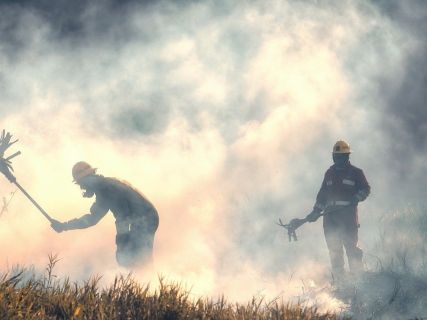
Active fires in Spain today: the status of the main fires that keep authorities on alert

The second heatwave keeps emergency services on maximum alert with several active forest fires in different parts of Spain. Catalonia concentrates the most complex situation, while the operational teams continue working in Castellón and Cádiz to prevent reactivations and protect the population.

4 minutes

Add DEMÓCRATA to Google

Ask FREN

Published

Last updated

4 minutes

Most read

The second heat wave keeps a good part of Spain on alert and has complicated the extinction efforts of several forest fires that remain active this Tuesday. Catalonia concentrates the most delicate situation with several simultaneous fires, while emergency services also continue working in Castellón and Andalusia to prevent the flames from regaining intensity.

The extinction devices deployed by the different autonomous communities, together with the Military Emergency Unit (UME) in the areas where it has been required, maintain hundreds of personnel on the ground in a context marked by high temperatures, low humidity, and wind. Although some fires have already been stabilized, authorities insist that the risk of re-ignition remains high and ask the population to take extreme precautions and respect all instructions from emergency services.

Anoia (Barcelona): stabilized after affecting more than 400 hectares

The fire declared between Carme and La Pobla de Claramunt has been one of the most serious episodes recorded in recent hours. The fire forced the confinement of some 33,000 people in several municipalities in the Anoia region and caused significant material damage, including the destruction of several industrial warehouses.

The Bombers de la Generalitat confirmed this Tuesday the stabilization of the fire, which has allowed the lifting of the confinement decreed for the affected population. However, the operation maintains numerous personnel on the ground to cool the perimeter and prevent re-ignitions, as high temperatures and wind continue to hinder extinction.

Sentmenat (Barcelona): the fire that most worries emergency teams

The Sentmenat forest fire continues to be the focus of greatest concern for the Catalan authorities. The Bombers keep the fire active and still not controlled, after the flames have already affected some 90 hectares and have the potential to continue advancing if weather conditions worsen.

Protecció Civil keeps several urbanizations affecting around 7,000 residents confined and has asked the population to strictly follow the instructions of emergency services. The Generalitat has also requested the support of the Military Emergency Unit (UME) given the simultaneity of large fires affecting Catalonia.

Artesa de Segre (Lleida): deployment continues to secure the perimeter

The fire declared in Artesa de Segre continues to mobilize a large extinguishing device. Although the evolution during the early morning has been favorable, the Bombers continue working to consolidate the perimeter and prevent reactivations due to the forecast of extreme temperatures throughout the day.

The authorities consider that the evolution will depend largely on the behavior of the wind and the intensity of the heat wave affecting a large part of the Iberian northeast.

Les Gavarres (Girona): stabilized but under permanent surveillance

The forest fire in Les Gavarres remains stabilized, although emergency teams maintain constant surveillance over the entire affected area.

The Bombers of the Generalitat have warned that the meteorological conditions remain very unfavorable for extinguishing work, so they do not rule out possible reactivations as long as the extreme risk situation for fires persists.

Soneja (Castellón): stabilized after affecting 183 hectares

The forest fire declared in Soneja has been stabilized, as reported by the Generalitat Valenciana, after burning about 183 hectares.

The Minister of Emergencies and Interior, Juan Carlos Valderrama, has pointed out that the nocturnal meteorological conditions have favored the evolution of the fire, although the teams continue to cool the entire perimeter before allowing the evacuated residents to return. Part of the aerial device has already been demobilized, although the terrestrial operation continues to be deployed.

Grazalema (Cádiz): more than 180 evacuated and maximum caution

In Andalusia, the fire declared in the El Alamillo area, in Grazalema, forced the preventive evacuation of 188 people from a hotel and several nearby homes.

The Emergency Agency of Andalusia raised the fire to emergency level 1 due to its initial evolution. More than 70 personnel and a dozen aerial resources continue to work on the ground to consolidate control of the fire, while authorities insist that the population respect all safety instructions and avoid accessing the affected areas.

La Bisbal d'Empordà (Girona): surveillance continues after a fire that has ravaged more than 2,300 hectares

The forest fire declared last Friday in La Bisbal d'Empordà remains under close surveillance by the Bombers de la Generalitat after burning more than 2,300 hectares, most of them within the natural space of Les Gavarres. Although the advance of the flames was managed to be stopped during the weekend and the fire is stabilized in a large part of its perimeter, the extinction teams maintain a large deployment on the ground due to the risk of reactivations caused by the heatwave and strong gusts of wind.

Authorities recall that the natural space continues to be subject to restrictions and that the investigation into the origin of the fire remains open. Within the framework of the investigations, the Mossos d'Esquadra arrested a worker related to the work being carried out in the area when the fire began, while the investigation tries to determine the responsibilities and the exact circumstances that triggered the fire.

The heatwave maintains the extreme risk of fires

The State Meteorological Agency (AEMET) maintains the extreme risk of forest fires in large areas of the Peninsula and the Balearic Islands due to the second heatwave of the summer. Forecasts indicate that temperatures above 40 degrees, low humidity, and wind gusts will continue to favor a scenario of maximum danger during this Tuesday, so emergency services remain on alert due to the possibility of new outbreaks.

More key points, information and questions with FREN

AI-GENERATED CONTENT

What are the competencies and functions of the Military Emergency Unit (UME) in fighting forest fires according to Spanish legislation?

The Military Emergency Unit (UME) has, as a general rule, the mission to intervene anywhere in the national territory in situations of serious risk, catastrophe, or calamity, and these expressly include forest fires. Its operation is mainly regulated by the Intervention Protocol approved by Royal Decree 1097/2011, of July 22, complemented by the Agreement creating the UME (Resolution of January 19, 2006) and by the general framework of the Organic Law 5/2005, on National Defense. Additionally, the 2014 State Civil Protection Plan for Emergencies due to Forest Fires and Law 17/2015 of the National Civil Protection System position the UME as a state extraordinary means of support and reinforcement to the autonomous communities in extinguishing large fires.

General legal framework of the UME's mission

The Organic Law 5/2005, in its article 15.3 (as stated in the preamble of Royal Decree 1097/2011), establishes among the missions of the Armed Forces, together with other state institutions, the task of preserving the security and welfare of citizens in cases of serious risk, catastrophe, or calamity.

On this basis, the Council of Ministers Agreement of October 7, 2005, published by the Resolution of January 19, 2006, creates the UME with the mission to intervene throughout the national territory, when decided by the President of the Government or the delegated minister, to contribute to the security and welfare of citizens in such situations. Subsequently, Order PRE/1776/2006 develops its initial operation.

Specific competencies regarding forest fires

Material scope: forest fires as a case for action

The core of the regulation is in Royal Decree 1097/2011, which approves the UME Intervention Protocol. This royal decree provides:

– That the UME's mission is to intervene to safeguard the life and integrity of people and their property, the environment, natural spaces and their resources, and the historical-artistic heritage (protocol, art. 2).
– That its actions focus on planning, training, and intervention, and that it will only carry out necessary prevention tasks to face a declared emergency (i.e., its preventive role is linked to a specific emergency situation).
– That intervention may be ordered, among others, in serious emergency situations caused by forest fires (art. 3.1.b).

Who orders the intervention and relationship with the Autonomous Communities (CCAA)

For forest fires not declared of national interest, the Protocol establishes that:

– The autonomous civil protection authorities may request the Ministry of the Interior for UME collaboration (art. 4.1).
– The Ministry of the Interior, after assessing the emergency and available resources, may request the Ministry of Defense for UME intervention (art. 4.2).
– The Minister of Defense, by delegation from the President of the Government, orders the UME intervention, upon proposal from the Minister of the Interior (art. 4.3).

The UME must adjust its actions to civil protection legislation and the distribution of competencies between the State and the autonomous communities (art. 4.4), reinforcing its role as a support and reinforcement force, not a substitute for autonomous extinguishing services.

Operational command in emergencies of national interest

In forest fires that reach the category of emergency of national interest according to civil protection regulations, the Protocol foresees that:

– A UME command is always integrated into the Operational Coordination Center directing the emergency.
– If the UME is decided to intervene in a national interest emergency, the operational direction and coordination of actions in the affected civil protection area corresponds to the Head of the UME, under the dependency of the Ministry of the Interior (art. 6).

Additionally, the royal decree links the UME with the aerial firefighting resources operated by the 43rd Air Force Group, allowing that, in operations of national interest, the UME may request and assume command of these resources, through collaboration agreements between Defense and the then Ministry of Environment.

UME as an extraordinary state resource in the National Civil Protection System

Law 17/2015, of the National Civil Protection System, recognizes the UME in its preamble as one of the new effective state intervention means integrated into the system, along with other state resources.

The State Civil Protection Plan for Emergencies due to Forest Fires, approved by Resolution of October 31, 2014, specifies this function. In it:

Extraordinary means are defined as state-owned resources mobilized in support of autonomous plans, explicitly including the Armed Forces and the UME (except certain aerial means acting by agreement).
– It foresees that UME commanders form part of the Integrated Operational Command of the State Plan, along with leaders of other action groups, for coordinated management of large forest fires.

The Basic Civil Protection Planning Guideline for forest fires, approved by Royal Decree 893/2013, also references the UME Intervention Protocol when defining the general architecture of means and plans against these risks.

Recent context of regulatory reinforcement

Royal Decree-law 15/2022, of August 1, urgently strengthens the basic state framework on forest fires (annual planning, de-seasonalization of devices, inter-administrative coordination). Although it does not introduce specific changes regarding the UME, it consolidates the logic of a permanent state support device to autonomous services, whose key military piece is precisely the UME, already defined in the cited regulations.

What are the legal and administrative requirements to decree the confinement of municipalities due to forest fires in Catalonia?

In Catalonia, the confinement or strong mobility restrictions of municipalities due to forest fires rely on a dual level: the basic state civil protection regulations (which set the framework and limits) and the Catalan autonomous regulations, which organize the plans and competent authorities. Generally, measures are articulated through civil protection plans (such as the special fire plan) directed by the Generalitat, and only in extreme scenarios would the state of alarm be invoked. All must respect principles of necessity, proportionality, temporal limitation, and formal motivation in administrative acts or general provisions.

1. State framework: what can enable intense mobility restrictions

1.1. National Civil Protection System

The Law 17/2015, of July 9, of the National Civil Protection System establishes the basic coordination framework among administrations and planning for civil protection emergencies, including those derived from forest fires. This law, accessible in the BOE (full text), configures state and autonomous plans and foresees the possibility of declaring emergencies of national interest, in which case the State assumes direction.

1.2. State of alarm for catastrophes, including fires

The Organic Law 4/1981, of June 1, on states of alarm, exception, and siege (BOE-A-1981-12774) expressly provides that the state of alarm may be declared in the face of "catastrophes, calamities or public disasters, such as (...) urban and forest fires". Once declared by decree of the Council of Ministers, the Government (or, by delegation, the president of the affected autonomous community) may:

– Limit the circulation or presence of people and vehicles at certain times and places.
– Adopt other extraordinary measures necessary to protect people and property.

In practice, a generalized and prolonged municipal confinement fits more securely within this exceptional instrument, although the decision is political and subject to parliamentary and judicial control.

1.3. Basic guideline and specific fire planning

At the state level, the repealed (partially still in force as a transitional reference) Royal Decree 893/2013, which approves the Basic Civil Protection Planning Guideline for forest fire emergencies (BOE-A-2013-12823), and the State Civil Protection Plan for Emergencies due to Forest Fires approved by Council of Ministers Agreement of October 24, 2014 (BOE-A-2014-11493), set the minimum model for autonomous and local plans.

Additionally, the Royal Decree-law 15/2022, of August 1, on urgent measures regarding forest fires (BOE-A-2022-12926), strengthens prevention and device organization but does not specifically regulate population confinement.

2. Catalan framework: who decides and with what instruments

2.1. Catalan civil protection law and plan structure

The core regulation is Law 4/1997, of May 20, on Civil Protection of Catalonia (BOE-A-1997-14409; consolidated text in Catalan at portaljuridic.gencat.cat). This law:

– Defines civil protection as a public service to protect people, property, and the environment against situations of serious collective risk, catastrophes, and public calamities.
– Creates an integrated planning system: Civil Protection Plan of Catalonia (PROCICAT), special plans (including the forest fire plan, operationally known as INFOCAT), territorial plans, and municipal action plans, as well as self-protection plans for activities and urbanizations.

Special and territorial plans are the technical-legal support where phases and emergency levels are foreseen, as well as access control measures, evacuations, and, if necessary, mobility or presence restrictions in certain areas.

2.2. Competencies and types of acts

According to Law 4/1997 (and its consolidated Catalan version, LLEI 4/1997), ordinary civil protection competence corresponds to the Generalitat of Catalonia, through the department competent in interior/civil protection and the plan management bodies (plan director, technical committee, etc.), in coordination with municipalities.

In practice, a municipal confinement due to fires would be adopted through:

Declaration of phase/level of emergency of the special forest fire plan (INFOCAT) or PROCICAT.
– A resolution or order from the plan director or the competent conseller, specifying the measure ("access prohibition", "movement restriction", "home confinement" in certain areas or zones).
– The corresponding official dissemination and communication to municipalities, which issue proclamations and activate their own municipal plans.

No specific provision on judicial authorization or ratification of these orders in Catalonia has been found in consulted sources; therefore, it can only be stated with certainty that they must respect the autonomous competence in civil protection and the basic state framework.

2.3. Sectoral forestry and prevention regulations

The block is completed with Catalan sectoral legislation, mainly focused on prevention:

Law 6/1988, of March 30, Forest Law of Catalonia (BOE-A-1988-10913).
Law 5/2003, of April 22, on prevention measures for forest fires in urbanizations without immediate continuity with the urban fabric (BOE-A-2003-10529) and its consolidated Catalan version (LLEI 5/2003).

These laws do not directly regulate confinement but do establish self-protection and planning obligations in urbanizations and forests, which are then operationalized in INFOCAT/PROCICAT plans, from which access or presence restrictions are adopted in case of fire.

3. Material principles that must be fulfilled

In any case, both the state of alarm and autonomous civil protection measures are subject to common principles: legality (support in enabling norm and approved plan), necessity and proportionality (measures strictly indispensable to protect lives and property; see LO 4/1981), temporality (time limitation, review according to fire evolution), and motivation (technical justification based on risk situation, firefighter reports, etc.).

In summary: the Generalitat can order punctual confinements of municipalities or nuclei via civil protection and special plans, and in large-scale catastrophe scenarios the State could declare a specific state of alarm for fires, with the capacity to impose much broader mobility restrictions.

What regulations govern the management and protection of natural spaces like Les Gavarres against forest fires in Spain?

In Spain, protection against forest fires in natural spaces like Les Gavarres relies on a "framework" of state regulations (forests, natural heritage, and civil protection) and autonomous regulations (in this case Catalan, on forests, protected spaces, and extinguishing services). At a basic level, the Forest Law and the Natural Heritage and Biodiversity Law apply, developed by state biodiversity and civil protection plans against fires. In Catalonia, there is additional specific forestry regulation, specific planning of natural interest spaces – including Les Gavarres – and rules organizing Bombers, Agents Rurals, the use of technical fire, and prevention plans. All this is finally concretized in autonomous, regional, and municipal prevention and emergency plans.

1. Basic state framework: forests, biodiversity, and civil protection

1.1. Forest Law and forest fires

The core regulation is Law 43/2003, of November 21, on Forests (text in BOE), particularly modified by Law 21/2015 (BOE-A-2015-8146). This law:

– Defines what a forest is and who is competent (the autonomous communities) in its management. – Establishes the obligation to have forest management and planning instruments (management plans, defense plans, etc.). – Introduces classification of public utility forests and protective forests, reinforcing their protection when part of protected natural spaces or the Natura 2000 Network. – Regulates key aspects of prevention and post-fire restoration (for example, the prohibition of land use change in burned areas for long periods, consolidated by several Constitutional Court rulings).

The climate emergency situation led to the approval of Royal Decree-law 15/2022, of August 1, on urgent measures regarding forest fires (BOE-A-2022-12926), which modifies the Forest Law to:

– Oblige autonomous communities to have prevention, surveillance, and extinction plans covering their entire territory, operational year-round. – Strengthen the minimum content of these plans (high-risk zones, critical management points, stable resource allocation, conditions to limit access and uses during risk periods, etc.). – Establish a basic catalog of prohibitions and sanctions linked to fire risk.

1.2. Natural heritage, biodiversity, and state planning

Management of protected forest spaces is inserted in Law 42/2007, on Natural Heritage and Biodiversity, modified by Law 33/2015 (BOE-A-2015-10142) and Law 7/2018 (BOE-A-2018-10240). This law sets the basic framework of:

Protected natural spaces and Natura 2000 Network. – Planning instruments (inventories, strategic plans, green infrastructure strategies, etc.) that must integrate fire prevention as a main threat.

In development of this law, the State Strategic Plan for Natural Heritage and Biodiversity to 2030 is approved by Royal Decree 1057/2022 (BOE-A-2022-23751), which guides state action in conservation and land management, including measures against fires in sensitive habitats and species.

1.3. Civil protection plans for forest fires

In civil protection, the specific framework is twofold:

– The Basic Civil Protection Planning Guideline for forest fire emergencies, approved by Royal Decree 893/2013 (BOE-A-2013-12823), which sets minimum requirements for state, autonomous, and local plans (structure, emergency levels, coordination, self-protection plans in urban-forest interface zones, etc.). Although this royal decree has been partially repealed by the new Basic Civil Protection Standard, its provision recognizes that the guideline continues to apply until effective replacement. – The State Civil Protection Plan for Emergencies due to Forest Fires, approved by Council of Ministers Agreement of October 24, 2014 and published by Resolution of October 31, 2014 (BOE-A-2014-11493). It organizes the response of state resources (UME, aerial means, etc.) and support mechanisms to autonomous plans when national interest or fire magnitude justify it.

2. Specific Catalan regulations applicable to Les Gavarres

2.1. Forestry and natural spaces legislation

Catalonia develops the basic legislation through Llei 6/1988, forestal de Catalunya (Portal Jurídic de Catalunya). Its preamble highlights that Title III contains "extensive regulations on the prevention of pests and forest fires" and regulates Forest Defense Groups (ADF), granting them legal personality to collaborate with autonomous and local administration in territorial prevention.

Les Gavarres is a space included in the Plan of Natural Interest Spaces (PEIN), approved by Decree 328/1992, of December 14 (Decree 328/1992). The PEIN Rules:

– Delimit the spaces and set basic protection determinations based on their scientific, ecological, landscape, cultural, and social values. – Provide that, in these spaces, forestry, agricultural, livestock, and tourism uses are maintained only compatibly with conservation. – Incorporate specific documents of "preventive actions and other determinations", which serve as a basis for management and risk prevention plans such as fires.

2.2. Prevention and extinguishing services: Bombers and Agents Rurals

Operationally, Llei 5/1994, regulating prevention and extinguishing fire and rescue services of Catalonia (Llei 5/1994), modified by Llei 5/1999 (Llei 5/1999) and Llei 9/2010 (Llei 9/2010), organizes:

– The Cos de Bombers de la Generalitat and municipal services, with their prevention, planning, and extinguishing functions in all types of fires, including forest fires. – The integration of these services into Catalonia's civil protection system, key for managing large fires in protected natural spaces.

Decree 312/2006, on the management of technical fire (Decree 312/2006) regulates the use of technical fire by Bombers both in active prevention (fuel management burns in vulnerable forest areas) and in the extinguishing phase (widening burns, backfires). It emphasizes that these actions must be supported by plans, with control and safety guarantees.

In parallel, the Cos d’Agents Rurals – Catalonia's environmental police – is regulated by Decree 266/2007, Regulation of the Cos d’Agents Rurals (Decree 266/2007). Among its specialization areas are prevention and investigation of forest fires and surveillance of protected natural spaces, making it a key piece in daily management of Les Gavarres (fire use control, complaints, monitoring prevention infrastructures, etc.).

2.3. Prevention plans and specific aids

At the detailed planning scale, the Generalitat promotes that municipalities and supra-municipal entities have forest fire prevention plans, mandatory especially in municipalities with urban-forest interface or included in high-risk zones. A recent example is Order ARP/199/2025, which approves aid bases for local entities for drafting delimitation maps or forest fire prevention plans (Order ARP/199/2025).

In the specific case of Les Gavarres, the combination of its PEIN status, application of Catalan forest law, organization of Bombers and Agents Rurals, and the requirement of prevention and emergency plans (INFOCAT and municipal plans) constitutes the legal framework governing its management and protection against fires, always under the basic umbrella of the Forest Law and state natural heritage and civil protection regulations.

Play

Test your knowledge with FREN!

How much do you know about this topic? Answer the following 3 questions.

Which forest fire remains the biggest concern for emergency services in Catalonia?

Question 1 of 3

What was the main cause of the confinement of about 33,000 people in the Anoia region?

Question 2 of 3

What device has the Generalitat of Catalonia requested due to the simultaneity of large fires?

Question 3 of 3

Hola, soy Fren. ¿Cómo te ayudo?