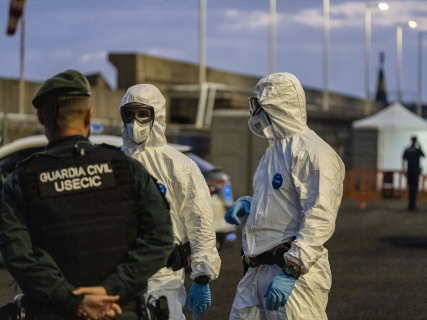

The operation deployed in Tenerife to manage the evacuation of the MV Hondius has left one fatal victim among the members of the security device. A 62-year-old civil guard died this Sunday after suffering a heart attack while participating in the coordinated efforts at the port of Granadilla de Abona, where during the weekend the disembarkation of passengers linked to the hantavirus outbreak detected on the cruise ship took place.
The death of the agent was reported by several media outlets citing official sources and professional associations of the Guardia Civil. The civil guard was assigned to the general staff of the Tenerife Command and was on duty within the operational command post deployed to coordinate the evacuation.
Health services present at the pier tried to revive him for around 40 minutes, although they were ultimately unable to save his life.
For the moment, there is no official information relating the death to a hantavirus contagion or a possible exposure to the virus. The information disseminated so far speaks exclusively of a heart attack suffered during the development of the operation.
A broad international deployment
The device organized in Tenerife has been one of the largest recent health and logistical operations activated in Spain in the face of an international epidemiological alert.
During the weekend, different agencies and security forces participated, including the Guardia Civil, Policía Nacional, Military Emergencies Unit (UME), Sanidad Exterior, specialized medical teams, and international authorities coordinated with the World Health Organization (WHO).
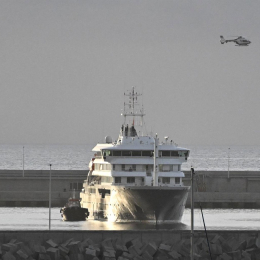
The MV Hondius arrived at the port of Granadilla de Abona after several days of international monitoring due to the hantavirus outbreak detected on board. During the disembarkation, dozens of passengers of different nationalities were evacuated using special security and health surveillance protocols.
Part of the Spanish passengers were subsequently transferred to Madrid for preventive monitoring, while other travelers were repatriated to their countries of origin through flights organized by different governments.
What Health and the WHO Say
The Ministry of Health maintains that the risk to the general population remains low and has insisted that the operation took place "with normality and safety". The Minister of Health, Mónica García, also explained that the evacuated passengers were asymptomatic at the time of disembarkation.
The WHO continues to investigate the origin and transmission chain of the outbreak. The main hypothesis the organization is considering is that the first affected individuals contracted the virus before boarding, after a trip through South America, and that secondary transmission may have subsequently occurred within the ship.
Tedros Adhanom Ghebreyesus, Director-General of the WHO, has reiterated in several appearances that the transmission of the Andes hantavirus between people is still considered infrequent and normally associated with close and prolonged contact.
On the same line, Maria Van Kerkhove, technical lead for epidemics at the organization, has insisted that the outbreak is limited to a very specific environment of prolonged cohabitation and closed spaces within the cruise ship.
International health authorities now continue with the epidemiological surveillance and monitoring of passengers and close contacts.
The incubation period of hantavirus can last for several weeks, which is why different countries maintain preventive protocols and health controls on people related to the cruise ship.
Even so, both the WHO and the US CDC continue to insist that hantavirus does not present a transmission capacity comparable to that of respiratory viruses such as covid-19 and recall that the main route of contagion continues to be contact with infected rodents or with particles contaminated by saliva, urine or excrement.