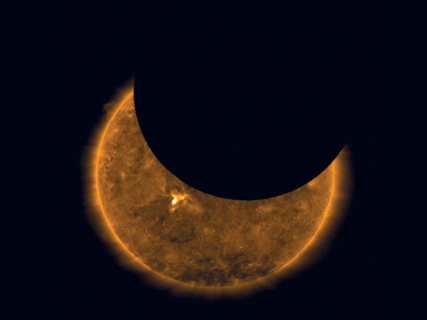
The total eclipse of August 12, 2026 will have a characteristic that completely conditions its observation: the Sun will be very low, close to the horizon. For this reason, these days a particularly useful circumstance occurs, as the Sun occupies practically the same position it will have that day, which allows us to check in advance from where it will be visible.
That coincidence makes this Thursday, April 30, an opportunity to carry out a real observation test. Just position yourself in the chosen place at the same time the eclipse will occur and check if the Sun is visible or if there are obstacles such as buildings, mountains, or trees that could obstruct the view.
This essay takes on special importance in an astronomical phenomenon that will be infrequent in Spain. The Iberian Peninsula will witness between 2026 and 2028 a succession of eclipses —two total and one annular— that had not occurred for more than a century, according to the Spanish National Research Council (CSIC).
A total eclipse greatly conditioned by the horizon
The first of those eclipses will be on August 12, 2026, and will be total. The path of totality, where the Moon will completely cover the Sun, will cross Spain from east to west and will pass through several provincial capitals from Oviedo to Palma de Mallorca.
One of its main particularities is that it will occur near sunset. This implies that the Sun will be very low in the sky, making it essential to choose an observation point with good visibility towards the west.
This circumstance is what explains the usefulness of these previous days, in which the Sun reproduces practically the same apparent trajectory. If from a specific place it can be seen now, that same point will be valid to observe the eclipse.
A triad of eclipses in Spain
The second will also be total and will take place on August 2, 2027. In this case, the path of totality will cross the Strait of Gibraltar and cover the southern tip of the Iberian Peninsula and North Africa, including cities such as Cádiz, Málaga, Ceuta, and Melilla. The maximum duration of totality will occur in Ceuta, with 4 minutes and 48 seconds.
The third will be an annular eclipse on January 26, 2028. In this type of eclipse, the Moon's disk does not completely cover the Sun's, creating a luminous ring visible around the lunar shadow.
A key phenomenon for science
Eclipses have played a prominent role in the history of science. Already in Antiquity, Aristotle used the observation of lunar eclipses to conclude that the Earth is round.
Later, the study of eclipses allowed for fundamental advances. In 1868, helium was discovered by analyzing solar prominences during an eclipse, and in 1919, Einstein's theory of relativity was experimentally confirmed by observing how the Sun's gravity bent starlight.
Scientific expeditions to observe eclipses began in the 18th century and have allowed the study of the Sun's outer layers, despite the difficulty of working with phenomena that last only a few minutes.
The study of the Sun and its observation
Knowledge of the Sun has advanced thanks to both eclipses and direct observation through telescopes and space missions. Among the latter, Solar Orbiter stands out, a European Space Agency mission launched in 2020 in which Spain participates and which allows us to study our star without the interference of the Earth's atmosphere.
In parallel, ground-based solar telescopes, such as those at the Teide Observatory or the Roque de los Muchachos Observatory, allow observing the Sun without needing to wait for an eclipse.
The Sun presents complex characteristics, such as the difference in rotation speed between its equator and its poles or the reversal of its magnetic field approximately every 11 years.