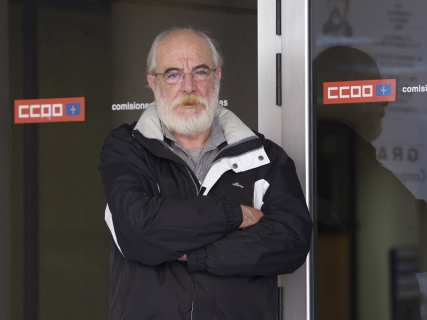

The veteran union leader Francisco Prado Alberdi, first general secretary of Comisiones Obreras (CCOO) of Gijón, has died this Thursday at the age of 81.
As communicated by the Gijón Regional Union of CCOO in a press release, his biography was marked by a constant dedication to union and political activism, both within the union and in the Communist Party of Asturias and Izquierda Unida. "Known in union circles since the clandestine period by the nickname 'El Pipas', Alberdi was one of the members of the Asturian delegation at the Barcelona Assembly, of which 50 years will be completed next Saturday," they state.
He became decisively involved in the workers' commissions of the former Uninsa and came to be part of the organization's secretariat during the Franco dictatorship. His activity cost him his arrest, torture, and imprisonment in 1973, as well as his dismissal from the company. After being elected general secretary of CCOO of Gijón in 1977, he held the position for a little over a year. Later, he returned to his job at the then Ensidera, thanks to the labor amnesty approved after the dictator's death.
Although he withdrew from official positions for a period, he intervened on behalf of the Communist Party of Asturias in the drafting of the Statute of Autonomy. Subsequently, with the launch of Izquierda Unida, he assumed local coordination of the coalition.
In 1991, Alberdi was again elected general secretary of the CCOO Regional Union, a position he held for two consecutive terms.
Recognitions and union legacy
In recognition of his entire career, the Gijón City Council awarded him the Silver Medal of the City of Gijón in 2010. The union leader Jorge Espina has described him as "a fundamental reference for the left in Gijón, Asturias, and I would dare to say, for all of Spain."
CCOO of Asturias has expressed its deep sorrow at the death of Alberdi, whom they describe as a "union reference" and "living memory and history" of the organization. The general secretary, José Manuel Zapico, highlighted that "he knew the union like no one else" and that "his reflections helped to move forward," emphasizing his "innate curiosity and class fraternity."
Zapico has also emphasized that the historic trade unionist "connected like no one else with the youth," being for the new generations "a great learning experience and a link between the past and the future." The union recalls that he defended that the fight for labor rights "did not end at the factory gates," and that he himself defined himself as "a trade unionist who engaged in politics."