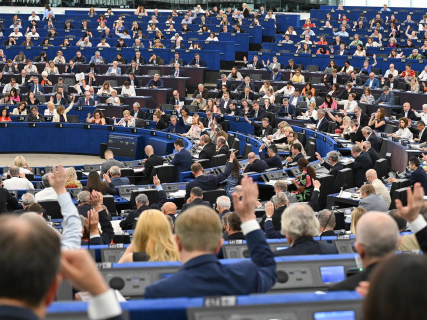

Galician MEPs from PPdeG, PSdeG, and BNG, Francisco Millán Mon, Nicolás González Casares, and Ana Miranda, have defended this Thursday in the European Parliament the need for a thorough reform of the Common Fisheries Policy (CFP) adapted to the reality of Galicia. The Bloque representative also took advantage of her speech to demand measures against barrels with radioactive waste sunk in the Atlantic Trough, along with the revision of the CFP.
In the debate on the evaluation of the Common Fisheries Policy, and as reported in a statement, the Popular Party MEP Francisco Millán Mon described the report's diagnosis as "accurate," which describes "a declining fishing fleet, stagnant aquaculture, and a more prosperous processing industry." Faced with this scenario, he asked the European Commission for a firm response in two priority areas.
On the one hand, he called for the presentation "as soon as possible" of an "omnibus" package of regulatory simplification for the fishing sector. He applauded the Commission's willingness to revise the multiannual plan for the Mediterranean and the EMFF, but warned that these proposals, although positive, "are not enough."
In this regard, he argued that the future "omnibus" should include the exclusion of longline fishing from the Deep-Sea Waters Regulation and the revision of several points of the Control Regulation "which have proven to be very difficult or even impossible to comply with."
As an example, he referred to Article 14 of the Control Regulation, concerning the obligation to record catches from the first kilogram in the fishing logbook. Millán Mon urged the Commission to register the "omnibus" package without delay because, as he stressed, "fishermen cannot wait any longer."
The Popular MEP also proposed that the CFP relax the landing obligation and the strict application of Maximum Sustainable Yield. Furthermore, he called for redefining the concept of fishing capacity to facilitate the decarbonization and modernization of vessels, and for the setting of Total Allowable Catches (TACs) and quotas to take socioeconomic factors into account.
Millán Mon concluded his speech by recalling that the European Commission holds the monopoly of legislative initiative and called for immediate decisions: "Commissioner, it is time to act, to make political decisions, as you yourself acknowledged at the beginning of your speech."
"Guarantee the future of fishing and fishing communities"
In parallel, and as indicated in another press release, the MEP of the PSdeG Nicolás González Casares urged the European Commission to urgently present a proposal for the reform of the Common Fisheries Policy to "guarantee the future of fishing and fishing communities".
During the plenary debate on the recent evaluation of the CFP, González Casares stressed that, although the 2013 reform contributed to improving the biological sustainability of catches, it is now a priority to "guarantee the sustainability of fishing communities".
"As you know, Commissioner, I am from Galicia and Galicia cannot be understood without the sea and fishing," stated Casares, insisting that the CFP must clearly reinforce the social and economic dimension of fishing activity.
The socialist recalled that the evaluation published by the European Commission confirms that, after 12 years in force, the latest reform did not achieve the set objectives. He listed "destruction of 30% of employment in the sector, loss of purchasing power, failure in generational renewal, obsolescence in the fleet. We are not talking about implementation problems, we are talking about design problems and new realities that must be faced".
He also warned that these difficulties will be aggravated by the "unacceptable" cut in funds allocated to fishing proposed by the Commission in the next multiannual financial framework.
In this context, he called on the Commissioner to "propose a specific reform of the CFP" to correct the detected failures: rebalance the three aspects of sustainability —social, economic, and environmental—; favor generational renewal; address the aging of the fleet; review the "obsolete approach" to fishing capacity; promote multiannual TACs and set limits on international fluctuations of TACs and quotas, among other actions.
"The sector is running out of patience. No more promises, Commissioner. Do your job to guarantee the future of fishing and fishing communities," he concluded.
In another statement, the BNG MEP, Ana Miranda, explained that she considered the evaluation carried out by the Fisheries Commissioner, Costa Kadis, on the CFP to be "very timid and a disaster". She advocated for the European Union to safeguard fishing competences for Galicia, "the recognition of the confraternities at European level" as beneficiaries of community funds, and denounced the "lack of aid for the shellfish sector" which, she warned, is going through a serious crisis "due to the pollution of the estuaries, the warming of the waters derived from climate change and the lack of environmental preservation policies by the Xunta".
Removal of the drums from the Atlantic Trench
Ana Miranda also took advantage of her speech to convey her concern about the possible "advanced state of deterioration" of the drums with radioactive waste deposited in the Atlantic Trench and warned the European Commissioner for Fisheries and Oceans, Costas Kadis, of the risk they pose to the marine environment and fishing activity.
In this context, she demanded immediate action from the European Commission in order to prevent damage to marine ecosystems and Galician fisheries.
The BNG MEP maintained that the EU must analyze the compatibility between the presence of radioactive waste and the protection of health, sustainability, and safety of the oceans, fishing grounds, and coastal communities.
Miranda has also sent several letters to the European Commission demanding "concrete actions" to verify the real state of the drums, and that Brussels "fulfill its legal obligation under Article 35 of the Euratom Treaty by promoting and supervising the scientific missions of the Member States, such as Spain, and investigating the impact and compatibility of these drums with European regulations".
The letters were addressed to the Executive Vice-President of the European Commission, Teresa Ribera; the Commissioner for the Environment, Jessika Roswall; the Commissioner for Fisheries and Oceans, Costas Kadis; and the Commissioner for Energy, Dan Jorgensen.
Ana Miranda questions whether this dumping complies with the European Union's Biodiversity Strategy 2030, the Marine Strategy Directive, the Zero Pollution Action Plan, and, ultimately, the European Green Deal.