León XIV in Barcelona today, June 10: schedules, events, closed streets, and where to watch live

The Pope stars this Wednesday in the central acts of his visit to Catalonia, marked by a broad security device, traffic restrictions, and the inauguration of the Tower of Jesus Christ in the Sagrada Familia.

3 minutes

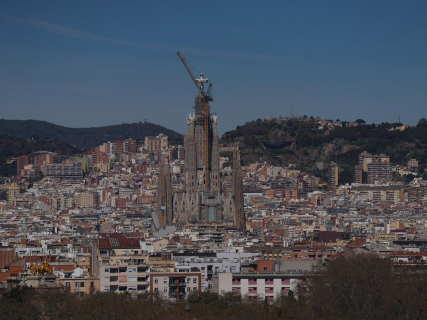
View of the Basilica of the Sagrada Familia, on March 16, 2026, in Barcelona, Catalonia (Spain) David Zorrakino - Europa Press

View of the Basilica of the Sagrada Familia, on March 16, 2026, in Barcelona, Catalonia (Spain) David Zorrakino - Europa Press

Add DEMÓCRATA to Google

Published

Last updated

3 minutes

Most read

Barcelona faces this Wednesday the most intense day of León XIV's visit to Catalonia. After landing on Tuesday in the Catalan capital and participating in various religious events, the Pontiff faces a day full of symbolism that takes him from the Brians 1 penitentiary center to the Sagrada Família Basilica, the scene of the most anticipated event of his apostolic journey.

The Pope's agenda combines pastoral meetings, institutional visits, and religious celebrations on a day that mobilizes hundreds of security agents and keeps a large traffic operation active at various points in Barcelona.

Brians 1 and Montserrat, first stops of the day

Official activity began mid-morning with a visit to the Brians 1 penitentiary center, where León XIV met with inmates and conveyed a message focused on reintegration and human dignity.

Subsequently, the Pontiff traveled to the Abbey of Montserrat to participate in the Holy Rosary prayer with the Benedictine community. The visit also included lunch with the monks of the monastery, one of Catalonia's most emblematic religious sites.

Montserrat has thus become one of the main stages of this papal visit, in an event that reinforces the historical bond between the Catalan Church and the Holy See.

Meeting with social entities in Sant Agustí: 4:30 PM

In the afternoon, León XIV will return to Barcelona at 4:30 PM to hold a meeting with charitable and diocesan assistance organizations at the church of Sant Agustí, in the Raval neighborhood.

The event aims to focus on the social work carried out by entities linked to the Church in areas such as social exclusion, care for vulnerable people, or support for at-risk groups.

The Sagrada Família, epicenter of the visit: 7:30 PM

The culminating moment will arrive at 7:30 PM with the celebration of Holy Mass in the Sagrada Família Basilica.

The ceremony coincides with the centenary of the death of Antoni Gaudí and will also serve to officially inaugurate the Tower of Jesus Christ, one of the most emblematic structures of the architectural project designed by the Catalan architect.

The celebration will bring together thousands of faithful and will feature a significant organizational and security deployment. After the mass, a light show is planned to mark the end of the day.

Street closures and traffic alternatives

Barcelona faces this Wednesday the second day of the large-scale security and mobility operation that keeps about 500 agents of the Guardia Urbana mobilized until Thursday, June 11.

The situation is concentrated in three large areas of the city:

In l'Eixample, considered the most critical point, a large security perimeter is maintained throughout the day —until Thursday morning— which cuts off traffic and prohibits parking in the vicinity of the Sagrada Família. This restriction affects major arteries such as Avenida Diagonal and streets such as Rosselló, Mallorca, and Provença.

In Ciutat Vella, traffic diversions and parking limitations continue in the vicinity of the Cathedral and in the Raval neighborhood, with a particular impact on areas close to Plaça de la Gardunya.

In Montjuïc, the total lockdown initiated on Tuesday is maintained, with access restricted exclusively to accredited vehicles in the vicinity of the Estadi Olímpic Lluís Companys.

Given the intensity of the operation at these three key points, authorities recommend avoiding the use of private vehicles, prioritizing public transport, and, where possible, opting for teleworking. The operation will begin to be progressively deactivated from Thursday, June 11.

Where to watch the events live

The events of this second day of the visit can be followed live on the news special on La 1 de TVE and on Canal 24 Horas, in addition to its streaming broadcast via RTVE Play.

The program, presented by Alejandra Herranz and Lorenzo Milá, includes in its first part the Pope's visit to the Brians 1 penitentiary center and, subsequently, his trip to Montserrat, where he will tour the basilica and share lunch with the community of Benedictine monks starting at 12:00 PM.

Later in the afternoon, at 7:30 PM, La 1, Canal 24 Horas, and RTVE Play will broadcast the visit to the Basílica de la Sagrada Família, in a special hosted by Pepa Bueno and Gemma Nierga. At this event, the Holy Mass will be celebrated, the blessing of the new tower will take place, coinciding with the centenary of Gaudí's death, and the day will conclude with a light show at the temple.

More key points, information and questions with FREN

AI-GENERATED CONTENT

What competencies and functions does Pope Leo XIV have according to canon law?

Competencies and functions of Pope Leo XIV according to Canon Law

Brief answer

There is no Pope Leo XIV in history or in current canon law, so there are no specific rules regulating his competencies. In Canon Law, competencies are attributed to the Roman Pontiff in general, without distinguishing by specific names, and apply to the Pope in office at any given time. Therefore, it is only possible to explain what powers and functions any Pope (including a hypothetical Leo XIV) has according to the Code of Canon Law and the apostolic constitution that organizes the Roman Curia. These competencies are detailed below, understanding that they refer to the office of Roman Pontiff in the abstract, not to a specific historical person.

1. Holder of supreme power in the Church

Canon Law defines the Pope as the Roman Pontiff, successor of Peter and head of the College of Bishops. He is attributed with the supreme, full, immediate, and universal power over the entire Church. This means:

First, his authority extends to all the faithful and all particular Churches (dioceses, patriarchates, etc.), without territorial restrictions. Second, this power is ordinary (proper to his office, not delegated), full (not limited by any higher authority within the Church), and immediate (he can act directly on any faithful or institution, without legally necessary intermediaries). Third, the Pope is not only primus inter pares, but the visible head of the Catholic Church and the ultimate guarantor of ecclesial communion.

2. Supreme legislative, executive, and judicial power

The Roman Pontiff concentrates in his person the three classic functions of power within the canonical order:

Legislative function. The Pope can promulgate universal laws for the entire Church (for example, apostolic constitutions, motu proprio, modifications to the Code of Canon Law). No synod, episcopal conference, or particular council can legitimately approve norms that contradict a valid pontifical law. Additionally, the Pope can authentically interpret Canon Law and repeal or dispense from ecclesiastical laws in specific cases.

Executive and governing function. As supreme pastor, the Pope appoints, transfers, and removes diocesan bishops, erects and modifies dioceses, ecclesiastical provinces, and other jurisdictions, and approves statutes of institutes of consecrated life and societies of apostolic life of pontifical right. He also directs the activity of the Roman Curia, which acts in his name, and can intervene directly in the administration of any diocese in serious situations.

Judicial function. The Roman Pontiff is the supreme judge of the Church. No canonical sentence can be validly appealed against him. The tribunals of the Holy See (such as the Roman Rota or the Supreme Tribunal of the Apostolic Signatura) act by his authority, and he can bring to his judgment in any case he deems appropriate, even bypassing ordinary instances. Likewise, he can grant pardons, amnesties, or remissions in canonical penal cases.

3. Relationship with bishops and councils

The Pope is also Head of the Episcopal College. This means, first, that no ecumenical council can be legitimately convened or considered as such without the approval of the Roman Pontiff. It is the Pope's responsibility to:

Convene ecumenical councils, establish their main agenda, and preside over them personally or through legates. Additionally, he closes the council and decides on the approval and promulgation of its decrees. Without pontifical confirmation, conciliar decisions do not acquire binding force for the universal Church.

Secondly, the Pope guarantees the doctrinal unity of the bishops. When he teaches ex cathedra on matters of faith or morals, his definitions are considered irreformable by themselves, not by the subsequent consensus of the Church. At the same time, he maintains collegiality by allowing and encouraging the action of episcopal conferences, although always subordinated to the authority of the Apostolic See.

4. External relations and appointments

Externally, the Roman Pontiff acts as Head of State of Vatican City and as the sovereign authority of the Holy See in the international sphere. Among his competencies are:

The power to appoint and accredit apostolic nuncios and other pontifical representatives before States and international organizations, as well as to conclude concordats and agreements with civil governments regarding religious freedom, Church regime, canonical marriage, religious education, etc. These functions have significant political and legal impact also in countries like Spain, where agreements with the Holy See form part of the applicable regulatory framework.

5. Limits and control of his power

Although the Pope's powers are legally supreme within the Church, Canon Law emphasizes that the Roman Pontiff is obliged to respect the deposit of faith and the fundamental norms of the Church. His authority is understood as service, not arbitrary power. However, there is no higher human instance that can judge the Pope in the exercise of his office; control is mainly theological, moral, and historical rather than procedural or jurisdictional.

Conclusion

In summary, a hypothetical Pope Leo XIV would have, according to Canon Law, the same competencies as any Roman Pontiff: supreme legislative, executive, and judicial power in the Church, full authority over bishops and councils, and international representation of the Holy See. Since there has been no historical Leo XIV, there are no singular provisions or specific circumstances that modify this general framework, which is set by current canonical norms for the Petrine ministry at any time.

What is the ecclesiastical career and personal background of Leo XIV before being elected Pope?

Brief answer

There is no actual Pope named Leo XIV to date, so there is no verifiable ecclesiastical career or personal background for that figure. The last Pope with that name was Leo XIII (Vincenzo Gioacchino Pecci), who reigned from 1878 to 1903. Currently, the reigning Pope is Francis (Jorge Mario Bergoglio), and the previous one was Benedict XVI (Joseph Ratzinger). Any biography of a hypothetical Leo XIV would therefore belong to the realm of speculation or fiction.

Historical context of Popes named Leo

Although there is no Leo XIV, it is possible to contextualize what that pontifical name has historically meant. Throughout the history of the Catholic Church, there have been thirteen Popes named Leo, from Leo I (known as Saint Leo the Great, in the 5th century) to Leo XIII, in the contemporary era. Many of them have been associated with moments of special political, doctrinal, or diplomatic relevance.

Leo I stood out for his role in Christological councils and in the defense of Rome against invasions, becoming a key figure both religiously and politically. Centuries later, Leo X is remembered as the Pope at the beginning of the Protestant Reformation, in the midst of the Renaissance, in a context of intense interaction between spiritual and temporal power. Finally, Leo XIII, the most recent, was closely linked to the social question and the birth of the Church's social doctrine.

This historical trajectory makes the name “Leo” in a Pope usually associated with profiles with certain political and intellectual weight, capable of setting the line on doctrinal issues or in the Church's relationship with States, which would have significant political implications if there were ever a real Leo XIV.

Current situation of the papacy

In reality, the current Pope is Francis, elected in 2013, and his pontificate has had notable political and social repercussions, also in Spain. His position on issues such as migration, climate change, poverty, or abuses in the Church has influenced public debate and national political agendas, including Spain's. The previous pontiff, Benedict XVI, resigned in 2013, a very unusual event in Church history, which highlighted the institutional and political dimension of the papacy as head of state (Vatican City) as well as religious authority.

Any future Pope, regardless of his name, has a dual condition: spiritual leader of the Catholic Church and head of state of Vatican City. This means that his prior biography (ecclesiastical career, academic training, national origin, positions in the Curia or local Churches) has international political relevance. Previous experience in Vatican diplomacy, national episcopal conferences, or dioceses with strong social tensions is usually a determining factor in the choice of a Pope.

Political relevance of a Pope's biography

From a political and social perspective, the question about a Pope's “ecclesiastical career and personal background” is key to anticipating lines of action. Elements such as:

1) Geographic origin and sociopolitical context: a Pope from Western Europe usually has a different sensitivity than one from Latin America, Africa, or Asia, due to the different Church–State relationship, secularity, religious pluralism, or social inequality. This influences his priorities when speaking about migration, poverty, peace, or human rights.

2) Career within the Church: a profile forged in theological academia is not the same as one with strong grassroots pastoral experience or one with a long diplomatic career in the Secretariat of State. Each tends to imprint a different orientation: more doctrinal, more social, or more diplomatic.

3) Previous positions: speeches, writings, and pastoral decisions prior to election serve governments, parties, and analysts to interpret what his future stance might be on bioethics, economic model, migration policies, or dialogue with other religions, topics that impact the political agenda of many countries, including Spain.

Limitations of the answer

Since Leo XIV does not exist as a historical or current figure, it is not possible to provide concrete data about his biography, positions held, ordinations, studies, or public interventions. Any such detail would be invented and therefore unreliable. It is only possible to place the question within the general framework of the papacy and the tradition of Popes named Leo, and explain why, if there were ever a Leo XIV, his prior trajectory would be especially relevant from a political and social point of view.

If your question referred to a work of fiction, a historical uchronia exercise, or a hypothetical future scenario, the description of his biography would depend entirely on that fictional or speculative framework, not on real sources. From a political and social analysis perspective, it is only possible to work with documented Popes and trajectories.

What legal requirements and procedures does the Barcelona City Council demand to establish security devices like those deployed during the papal visit?

The implementation of a device like the one deployed by the Barcelona City Council during the papal visit mainly combines a municipal authorization for public road occupation, traffic and mobility regulation, and the application of Catalan and state regulations on security and public events, as well as data protection rules if cameras are involved. In practice, any fencing, detector arch, perimeter closure, or access control on the street requires a file with a technical report, plans, a self-protection plan (if the event is massive), and a mobility plan. All this is coordinated among the Urban Guard, Mossos d’Esquadra, and the Government Delegation, which adjust the police device and traffic cuts. For events of maximum relevance, such as the Pope's visit, planning begins months in advance and is formalized through municipal decrees and specific resolutions.

Basic legal and competence framework

At the municipal level, the action is based on the traffic and road safety ordinance and the rules for the use of public space, which regulate traffic cuts, parking reservations, and the temporary installation of elements on sidewalks and roadways (fences, booths, arches, platforms). For elements that alter the urban image, the Ordinance on the uses of the urban landscape of Barcelona also comes into play, which sets criteria on structures, supports, and occupations of public domain.

At the regional level, security in Catalonia is framed within the Public Security Law and, for massive events, within the regulations on public shows and recreational activities, which require security measures, capacity control, and in many cases, a self-protection plan. At the state level, the Organic Law on the protection of citizen security supports access controls, preventive searches, or temporary passage restrictions, while the basic local regime legislation assigns the City Council the management of public space and local security.

When mobile cameras or video surveillance systems are used, image capture in public spaces must comply with the General Data Protection Regulation and Organic Law 3/2018. A clear legal basis, security purpose, proportionality, visible informative signs, and, if the surveillance is police in nature, submission to the specific video surveillance regime in public spaces are essential.

Common technical and administrative requirements

For an extraordinary device in Barcelona, a file is usually required with:

Formal application to the City Council, submitted by the event organizer or responsible administration, indicating dates, times, affected areas, expected attendance, and type of devices (fences, security arches, access controls, platforms, booths, etc.).
Technical and security report, justifying the need for the measures, describing the operation of the device, the planned human resources, and the relation to identified risks.
Plans of location detailing security perimeters, filter points, emergency service accesses, alternative pedestrian routes, and evacuation zones.
Technical reports on structure stability, compatibility with public space, accessibility, impact on commerce and urban services (public transport, loading and unloading, emergency services).
Self-protection plan or equivalent document when it concerns high-attendance or special risk events, covering emergency scenarios, evacuation, communications, and operational command.

Additionally, a mobility and traffic plan is usually processed, which includes lane closures, bus line detours, temporary parking prohibitions, reservations for official vehicles, and provisional signage. This plan is validated with municipal mobility services and the Urban Guard.

Operational and institutional coordination

The City Council, through the Urban Guard, leads the management of public roads (traffic, access, signage, support for controls). The Mossos d’Esquadra assume the public security and order device, defining filters, security rings, and incident response protocols. The Government Delegation participates in devices involving state competencies (e.g., protection of high authorities, anti-terrorist measures, state police video surveillance) and coordinates state security forces when they intervene.

In the recent papal visit to Barcelona, the City Council itself explained that a broad device was activated with reinforcement of the Urban Guard, coordination with Mossos d’Esquadra and the Government Delegation, review of self-protection plans of key points, and mobility regulation through traffic cuts, restrictions, and public transport reinforcement, disseminated through official communications and decrees (Barcelona City Council note).

Deadlines and formalization

For complex events or high-level institutional visits, device planning begins several weeks or months in advance, as technical services, mobility, police, civil protection, and, if applicable, external administrations must intervene. Measures that broadly affect citizens (closures of large avenues, massive parking restrictions, changes in public transport routes) are formalized through decrees or resolutions, which are published as early as possible and disseminated through official channels and media.

In summary, a police decision alone is not enough: the deployment of devices like those for the papal visit requires a complete administrative file, based on municipal ordinances, Catalan and state security regulations, technical reports, and intense inter-administrative coordination to balance security, mobility, and citizens' rights.

Play

Test your knowledge with FREN!

How much do you know about this topic? Answer the following 3 questions.

What has been Pope Leo XIV's first official stop on his busiest day in Barcelona?

Question 1 of 3

What special event will take place at the Sagrada Família during Pope Leo XIV's visit?

Question 2 of 3

What does the Barcelona City Council recommend regarding traffic restrictions during the papal visit?

Question 3 of 3

Hola, soy Fren. ¿Cómo te ayudo?