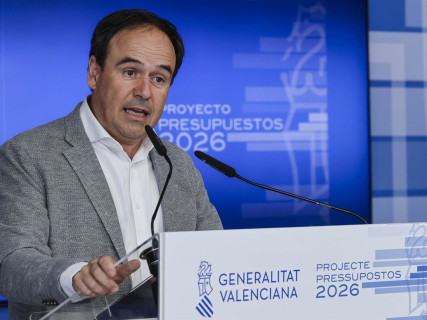

The 'president' of the Generalitat, Juanfran Pérez Llorca, has reiterated that he will respect the decision made by the Popular Party regarding who will be the candidate of the PPCV in the next regional elections. He stressed that he lives "with absolute tranquility throughout this debate" and that he will not change his way of working. "I have an obligation and a commitment and, unlike others, I do it exclusively, without anything distracting me," he remarked.
During an informative breakfast organized by Fórum Europa Tribuna Mediterránea held this Thursday in València, presented by the general secretary of the PP, Miguel Tellado, the head of the Consell recalled that he came to the Presidency "in a different way," after the resignation of Carlos Mazón and at the direct request of the party leader, Alberto Núñez Feijóo. "We both spoke and he considered that I should take the step," he explained.
Pérez Llorca has defended that he accepted that proposal without demanding any quid pro quo. He did not ask for "anything in return." "I assumed the commitment and started working. Today I also continue with that idea. I ask for nothing in return. My party asked me for a mission and I will carry it out to the end, which is to manage things well while I am the 'president' of the Generalitat.
Along these lines, he insisted that, "when the time comes to decide who should be the candidate" of the PPCV for the Presidency of the Generalitat, he will limit himself to "abiding by what is said." He stressed that he faces the situation calmly: "What I can convey is that I live with absolute tranquility throughout this debate. Those around me know it and it will not change my way of doing things or proceeding until that happens."
When asked about the absence of a date for the regional congress of the PPCV and about the latest moves of the former president of the Generalitat Francisco Camps, Pérez Llorca avoided entering into polemics with the former leader, who has been demanding the convening of the 'popular' conclave for months. He concluded that he is "a person who has all my respect."
PP Congresses and internal debate
He specified that in regional congresses "candidates for the Generalitat are not elected, party presidents are elected, which are two different things, although the figure generally coincides, but sometimes it may not coincide" and recalled that "there have been some cases in Spain". In his opinion, internal assemblies are necessary: "Regarding congresses, I have always stated it. What is a person who has dedicated so much time to the organic [party structure] going to say. Of course, regional congresses must be held. And of course, we have to dialogue and discuss among ourselves".
However, in a scenario where "nobody is clear" when the general elections will be called —"they can be called in months or maybe not"—, he warned that citizens "would never forgive us if we were more focused on discussing". For him, it is "a matter of priorities".
Later, he stressed that he is "not at all distracted by candidacies, polls, or anything", but "focused on the mission" entrusted to him, "which was to work for the Valencians and try to solve problems". And he added that, if the PP wants the polls to reflect that "we exceed 40 deputies", the only way is "to work, work, and work".
Internal Unity and Provincial Leadership
In relation to the president of the Diputació de València and provincial leader of the PP, Vicent Mompó, the 'president' recalled that it was he who had the "idea" in 2023, after the elections, to try to govern the institution when "everyone took it for granted that it could not be done". He pointed out that it was not just about the PP taking control of the Diputación, but that he saw Mompó as a good leader: "I was not just looking to govern it by my party, I believed that a person like Vicent Mompó could be a good president".
Therefore, he said he was "more than satisfied" to have "collaborated and contributed my bit to achieve it" and to see Mompó, Marta Barrachina (Castellón), and Toni Pérez (Alicante) at the head of the diputaciones. In his opinion, thanks to their management "the quality of life in the towns, especially the small ones, has greatly improved this legislature".
He also recalled the period in opposition to underline the importance of internal cohesion: "What I am telling you with all this is that, in the PP, when we were in opposition, those eight years we learned something: that as long as we have internal discussions, we will never be a solvent government project. And when we learned that, and it was especially learned in this province, we began to be an alternative government. Therefore, I can assure you that we have learned from past mistakes and that we will all go united to endorse the deputations and the Generalitat in the next elections," he concluded.
Relationship with Vox and political pacts
Regarding his relationship with Vox, Juanfran Pérez Llorca has defended the need to reach agreements, but not with the intention of "favoring one ideology or another," since, in his opinion, "what is important are not ideologies, but people." He explained that, when he sits down to negotiate, he does so to gain support for "a project or a proposal that I believe is good for the Comunitat."
He gave as an example the negotiation of the budgets after the DANA, a moment he described as "so crucial," in which Vox "rose to the occasion" while Compromís and the PSPV, as he said, did not. "They had other priorities or more political positioning than Vox, which disagreed with many things but ended up accepting our budget proposal," he pointed out, while insisting that he never closed himself off "to negotiating with anyone else."
However, he considered that, in the current situation, the PP only has "the capacity to reach agreements with Vox," because in this party "they are willing to sit down and the other parties are not."
Mónica Oltra and the return to the front line
Regarding Mónica Oltra's return as Compromís candidate for the Mayoralty of València, Pérez Llorca maintained that the former vice-president of the Generalitat has not "resurrected" because she "never left," but rather "they put her in the fridge for a while so she could come out again."
He contrasted that situation with the PP's position in judicial cases: he defended that, in his party, a person "who is going to sit on the bench for having covered up the abuse of a minor is not that they would not run again, but that they would not even be a member." He framed it as "a matter of principles and of word" and recalled that Oltra was "a woman who, when she was the spokesperson for the opposition in the Generalitat, even stated that for the mere fact of being indicted, you had to leave."
Therefore, he wondered "what the Valencian society will think of her when she returns, when she is prosecuted and sitting on a bench." He concluded that "I will never believe in that kind of politics and in that kind of politicians in my life."
Financing Model and Treatment of the Valencian Community
In terms of regional financing, Pérez Llorca has criticized the central government for addressing the new model "with a bilateral negotiation with ERC," since, as he said, "we all know that special privileges are being established for Catalonia and not for the rest of the Autonomous Communities." He insisted that the "only exceptionality" that should be considered is that of the Valencian Community, "for being the most underfunded and for the dana." "A serious government, the first meeting it should have had was with this land," he added.
He highlighted that the PP leaders "did not take five minutes to recognize that there had to be a Valencian exceptionality" and censured the "lack of rigor" of the central Executive on this matter. Even so, he urged the Government to present a new proposal that could be accepted "by all," since the current one does not even have the support of the communities governed by the PSOE, "except Catalonia." In his opinion, "deep down, what it does not intend is to modify the financing model, but to get votes to resist."