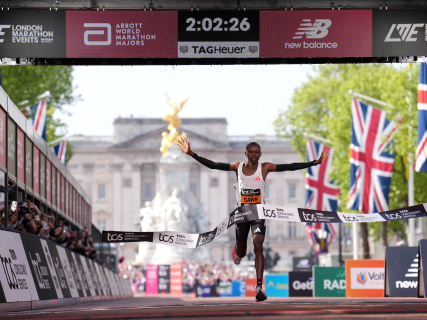

The history of athletics changed this Sunday in the streets of London. Kenyan Sabastian Sawe became the first man in history to complete an official marathon in under two hours, stopping the clock in an extraordinary 1:59:30 during the 2026 London Marathon.
With that record, Sawe not only conquers a frontier considered almost impossible for decades, but also lowers the previous world record and places his name among the great legends of sport. The two-hour barrier had been for years the great Everest of international long-distance running: a symbol comparable to the first four minutes in the mile or the jump beyond ten seconds in the 100 meters.
A race for eternity
From the first kilometers it was clear that the race was moving at unusual paces. The leading group passed the 5 kilometers in 14:14 and reached the 10K in 28:35, times that already pointed to a historic day if the pace was maintained.
Sawe shared the initial lead with some of the big names on the international circuit, including Jacob Kiplimo, Olympic champion Tamirat Tola and debutant Yomif Kejelcha. However, natural selection began to take its course as the kilometers passed and the extremely high pace started to break up the group.
After the hares withdrew and once the halfway point of the race was passed, the Kenyan decided to launch the definitive attack. First he opened a gap alongside Kejelcha and, later, he was left alone at the front to sign off a memorable final stretch.
The man who broke the wall
For years, running a marathon in under two hours in an official race was seen as a physiological chimera. Although Eliud Kipchogemanaged to run in 1:59:40 in Vienna in 2019, that mark was not homologated because it was a special event with conditions specifically designed for the attempt.
What Sawe has achieved now has official status: an open race, a regulation circuit, and real competition. That is why his 1:59:30 goes directly into the history books as the first recognized sub-2-hour marathon.
Furthermore, it surpasses the previous record held by the late Kelvin Kiptum, author of a 2:00:35 that already seemed like a benchmark from another dimension.
London: the importance of context
The British capital offered ideal conditions: mild temperatures, low humidity, and a fast course accompanied by thousands of spectators. London, one of the major marathons alongside New York, Berlin, Boston, Chicago, and Tokyo, thus adds another iconic chapter to its history.
The atmosphere in the final stretch, with Sawe launching towards a mark unthinkable just a few years ago, turned the finish into one of the sporting images of the year.