
The United States once again faces one of its darkest constants: political violence against its presidents. The attempted attack registered last night in Washington against Donald Trump brings the number of attacks suffered by the current president to three in just two years, an unprecedented recent sequence that reactivates the debate on presidential security in a country marked by assassinations.
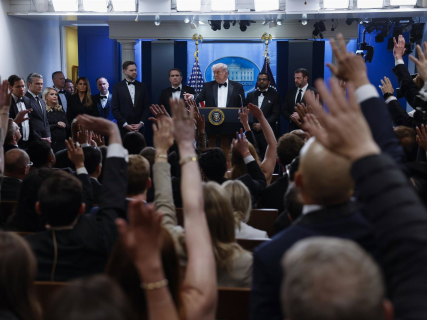
The latest episode occurred during the annual dinner of the White House Correspondents' Association, held at the Washington Hilton hotel. An armed man broke into the security area and was subdued by the Secret Service before reaching the main hall where Trump was. The suspect, identified as Cole Allen, 31 years old and a native of California, was arrested. The president was unharmed.
Three attacks in the same political stage
The foiled attack in Washington is not an isolated case. Trump had already survived two other serious episodes since 2024.
The first took place on July 13, 2024, at an electoral rally in Butler (Pennsylvania). While delivering a campaign speech, a shooter opened fire on the stage. Trump suffered a wound to his right ear caused by a bullet graze. An attendee died in the attack and another was injured. The perpetrator, Thomas Matthew Crooks, 20 years old, was shot down by security forces.
Two months later, on September 15, 2024, a new attempt occurred at Trump's golf club in West Palm Beach (Florida). Secret Service agents detected a man armed with a rifle hidden among the vegetation near the course. The suspect, Ryan Routh, 58, fled the scene and was later arrested.
To those episodes was added an additional incident on October 12 of that same year, when Vem Miller, 49 years old, was arrested armed at a security checkpoint before a political rally in Coachella, California. Although he was released on bail and denied homicidal intentions, the case increased concern surrounding the security of the then-Republican candidate.
A historical constant in the United States
Violence against political leaders is not new in American history. Four sitting presidents have been assassinated since the country's founding.
The first was Abraham Lincoln, shot down in 1865 at Ford's Theatre in Washington by Confederate actor John Wilkes Booth. He was followed by James A. Garfield, shot in a train station in 1881. In 1901 William McKinley was assassinated during a public event in Buffalo, and in 1963 John F. Kennedy fell, assassinated in Dallas during a parade in a convertible car.
The statistic is overwhelming: one out of every nine United States presidents has died victim of an attack.
Failed attempts and survivors
In addition to the completed assassinations, several leaders have survived attacks. Theodore Roosevelt was shot in 1912 during a speech in Milwaukee and continued speaking after the impact. Ronald Reagan was seriously wounded in 1981 as he left a hotel in Washington.
Also Harry Truman, Gerald Ford and Bill Clinton faced attacks or frustrated attempts during their terms.
Weapons, polarization and public exposure
Security experts point to three structural factors that explain this American singularity: the enormous circulation of firearms, growing political polarization, and the extreme public exposure of its leaders.
The United States combines a highly mediatized political life with arms legislation much more permissive than that of other Western democracies, which multiplies the risks.
Trump and a presidency under threat
The three attacks suffered by Trump in two years turn his political stage into one of the most sensitive of the modern era in terms of presidential security. The latest incident, in the institutional heart of Washington, once again raises uncomfortable questions about the country's political climate.
Beyond the immediate impact, the succession of attacks shows that political violence remains a real threat in the world's first democracy.