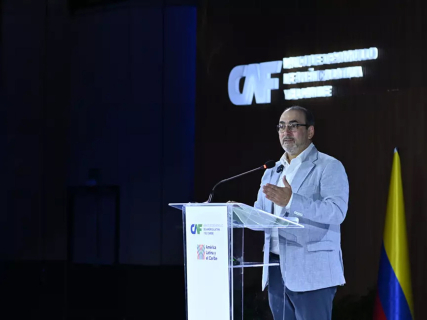

The Development Bank of Latin America and the Caribbean (CAF) has announced that it will mobilize 10 billion dollars (8.605 billion euros) by 2031 with the aim of supporting projects that strengthen economic integration among Latin American countries.
According to the note released by the institution, these funds will be channeled towards "strategic areas" such as physical and digital infrastructure, intra-regional trade, energy, tourism, innovation, logistics, and transportation.
The executive president of CAF, Sergio Díaz-Granados, emphasizes that the articulation of the region's economies constitutes an "imperative for its development, competitiveness, and global positioning," especially in the current geopolitical, commercial, and financial scenario.
In this regard, he has remarked that "integration is the answer to protect our strategic ecosystems, generate employment, confront informality, and defend the democratic values that sustain our coexistence, freedom, and future."
Díaz-Granados has reiterated the priority of promoting large value chains, the energy transition, food security, and the "new productive architecture of the world." In his opinion, "regional integration already has advances, but now it must enter a more ambitious execution phase. Fewer barriers, more infrastructure. Fewer diagnoses and more projects."
CAF has indicated that, in the last three decades, 118 credit operations linked to integration initiatives have been authorized, for a combined amount of 16.730 billion dollars (14.397 billion euros).
The multilateral organization cites among its actions the support for the Brasilia Consensus in 2023, the "Integration Routes" program developed together with the Inter-American Development Bank (IDB), the National Bank for Economic and Social Development (BNDES), and FONPLATA, which allowed the mobilization of another 10 billion dollars, as well as the launch of the "Region Brand Latin America and the Caribbean."