
This Friday, a key step in the new commercial relationship between the European Union and Mexico will be staged. The European Commission will sign the Modernized Global Agreement, the update to the framework in force since 2000, in a move with strong economic and geopolitical weight due to its content and momentum. For the first time, a delegation of MEPs will officially accompany the European delegation in the signing of an agreement of this nature. Antonio López-Istúriz (EPP) will lead the parliamentary mission as president of the Delegation for Relations with Mexico and, in a conversation with Demócrata, delves into the most relevant points and breaks down its implications for Spain.
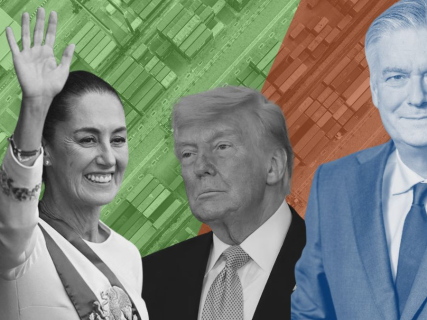
Brussels presents the signing as a gesture that goes far beyond a technical update of the commercial relationship. The EC considers it a new-generation geopolitical instrument aimed at strengthening an alliance at a sensitive moment. The president of Mexico, Claudia Sheinbaum, and the president of the United States, Donald Trump, are renegotiating the T-MEC (trade agreement between Mexico, the US, and Canada).
“Sheinbaum maintains a discreet negotiation policy with Trump and did not want the Americans to see the agreement with the EU as something negative,” explains López-Istúriz to Demócrata; but he qualifies that there is a red line: “Everything is fine as long as it does not benefit China, and it does not benefit it at all.”
Mexico does not want Trump to see the agreement with the EU as something negative: "Everything is fine as long as it does not benefit China"
Possible resistances
The EPP MEP anticipates that there will be no resistance to the new agreement and that, if there is any, “it will be of an administrative and functional nature” rather than political or social. “Unlike Mercosur, this is not a treaty that causes controversy, quite the opposite,” he assures. In his opinion, “it is very beneficial for many sectors and creates an authority that will arbitrate between the EU, the member states, and Mexico,” so “there is a good atmosphere and I don’t think there will be problems since no one has raised complaints.” “Perhaps, when the agreement reaches some national parliament, it will cause some, but for now, none has been detected,” he concludes.
“Unlike Mercosur, this is not a treaty that causes controversy, quite the opposite”
Asked whether the US president could change his mind and raise his tone, López-Istúriz says he cannot vouch for it: “With Trump, I cannot say that the day after signing the agreement, he will come out and say something.”
In this regard, he argues that, "faced with its stridency," Europe is reacting with economic diplomacy. A policy "very effective and that is yielding results." The president of the Delegation for Relations with Mexico elaborates that from the EU "we do not respond with the grandiloquence of the North American Administration, but we are doing our work, markets are being opened for the EU in the medium and long term and it is a stabilizing effect against everything that is happening."
The fine print of the agreement and the role of Spain
The new agreement is not limited to trade. Legally, it lays the groundwork for a "new generation" partnership that articulates three main pillars: political, cooperation, and commercial.
On the political level, the text incorporates issues related to democracy, human rights, security, multilateralism, and international cooperation. In the area of cooperation, it includes matters such as energy transition, digitalization, climate change, research, and innovation.
However, the most relevant core will continue to be commercial. The agreement foresees the elimination of tariffs, improvements in public procurement, market opening, regulation of digital trade, protection of geographical indications, and cooperation on critical raw materials, in addition to clauses linked to sustainability and the fight against corruption.
Given these cards, Spain has the winning hand. "Undoubtedly, Spain benefits greatly," emphasizes López-Istúriz, especially since "our country is, for many reasons, the logical commercial gateway to Europe from Mexico."
The "split model": the formula to avoid another blockade like CETA
The great legal novelty of the agreement lies not so much in its content as in the formula chosen for its approval. The European Commission has opted for a model called "split," that is, divided into two distinct legal instruments.
On the one hand, there will be the Interim Trade Agreement, which exclusively includes matters within the exclusive competence of the European Union: trade in goods, services, public procurement, market access, or customs rules. This part will only require the approval of the Council of the EU and the European Parliament, without going through national parliaments.
On the other hand, the Modernised Global Agreement will be processed, considered a mixed agreement because it incorporates matters of shared or national competence, such as political cooperation and certain institutional elements. That text will indeed have to be ratified in the national parliaments of each Member State.
The decision responds directly to the precedent of CETA with Canada. Although that agreement began to be applied provisionally in 2017, it has not yet fully entered into force because several European national parliaments have not yet ratified it; and Brussels wants to avoid a similar scenario. “The commercial part will enter into force immediately, and then, the phase for its adaptation will begin, both in Mexico and here, so it is a long process,” clarifies the EPP MEP.
And now what?
The signing as such does not imply that the agreement automatically enters into force, but rather it represents a formal political commitment between the parties and several stages remain to be overcome. First, the Council of the EU will have to approve the text. Then, the European Parliament will have to approve or reject it, but it will not be able to modify it or introduce amendments. Once these steps are overcome, the commercial part of the agreement could begin to be applied with relative agility, precisely, thanks to the aforementioned “split” model.
Reports Adrián Lardiez from Strasbourg.