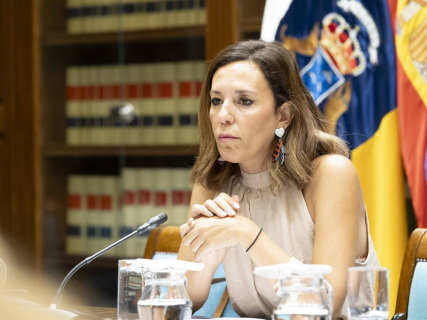

The Minister of Tourism and Employment of the Government of the Canary Islands, Jessica de León, has stated this Friday that her Executive has “set off the alarms” in the face of the reduction in air connectivity with the United Kingdom and Germany during the winter season—1.1% and 3.2%, respectively— as well as due to the increase in the price of tickets driven by the rise in the price of oil starting in March, when the coverage insurance expires.
In an appearance before a parliamentary committee, following a question from the Nationalist Group, she has defined the next winter campaign as “soft landing” because air slots tend to stabilize and, although demand remains “strong,” overnight stays are being reduced due to the impact of inflation.
At the same time, she has highlighted that, compared with other winters, the peninsular market will grow by 12% in air slots, and a “push” is being seen from new markets such as Canada, with connections for Tenerife and Gran Canaria, along with the “big news” of the return “with force” of the Nordic market, with flights from Sweden, Denmark and Norway.
Regarding the cost of tickets, she has explained that fuel prices “have been going up” since the closure of the Strait of Hormuz, but “almost without affecting” the fares for the time being because airlines set those contracts “two years in advance” and that period ends in March.
In this vein, she has pointed out that some companies expect an increase in the cost of fuel of around 30%, which will be passed on to the final price of the tourist package, so that many “are starting to talk about the end of the era of cheap travel in Europe,” she indicated.
In addition, and “at the same time,” the degree of compliance with the targets of the Carbon Offsetting and Reduction Scheme for International Aviation Plan is being “reviewed” for 2027, so the Canary Islands Government has requested that “the goals set for that year be suspended or eased,” specifically the obligation for airlines to purchase 25% of their fuel in SAF format, more sustainable, De León has specified.
“SAF is not being produced, therefore there is no SAF to buy at competitive prices, which can also be a drawback for the companies and airlines themselves that only would additionally be produced in the countries that form part of the European Union,” she has said.
In this context, he has warned that competing destinations in the Canary Islands such as Egypt, Turkey, Tunisia "and now also Morocco" are exempt from those levies, which could prompt airlines to strengthen their presence in those markets.
The councillor has emphasized that "the international context has changed" and has expressed concern about "the language" that is beginning to be used in the European Union, given that in his European Tourism Strategy "everything is based on the train," something that for the Canaries "does not work."
Therefore, he has insisted that the Outermost Regions "must be very present" in the design of that strategy, since funding to support tourist destinations will be derived from it.
In view of this new scenario, he has explained that his department is stepping up winter campaigns and that every 15 days it convenes a "crisis committee" to study the measures that could be requested from the Government of Spain and from European institutions.
Concern in CC about the competitiveness of the Canary Islands
José Manuel Bermúdez (CC) has defended the need to carry out "close monitoring" of the evolution of tourism in the Canary Islands, pointing out that it is the archipelago's main economic driver and that it determines the well-being of many families. He indicated that the projections from Istac point to 9.8 million tourists between October and March, "practically the same figure as the previous winter," but with a 12.6% drop in the German market and a 0.9% decline in the British market, while domestic tourism would increase by 9.8%.
Along the same lines, he has said that, according to Exelcan's latest outlook report, the Canary Islands "could begin to notice soon the decline in arrivals," and there are "doubts" about the impact that the increase in flight costs will have on the sector.
Bermúdez has clarified that "there is no crisis because the volume of travellers remains significant" but believes that, after six years "with record figures for arrivals and spending" following the pandemic, "some uncertainty" is now beginning.
Therefore, he has called for "coordination" between the administrations and the tourism sector to strengthen the promotion and the offer of the destination, "care for connectivity," and monitor the evolution of tourist spending, which, according to Istac, fell by 2.6% in the third quarter of the year.
"We want a good winter season that translates into greater opportunities for our small businesses, for restaurants, for our producers, for cultural and leisure companies, that be reflected in employment and that be reflected in the family economy," he added.
Bermúdez, however, has shown himself to be "concerned" because, although part of the economic situation is linked to "geopolitics," other issues "depend" directly on decisions of the European Union, so he considers it essential to work jointly with the central Government "so that the Canary Islands do not get left out of the game."
"If we set those obstacles for ourselves, we have a serious competitiveness problem with other destinations in the world that do not have them," he pointed out.