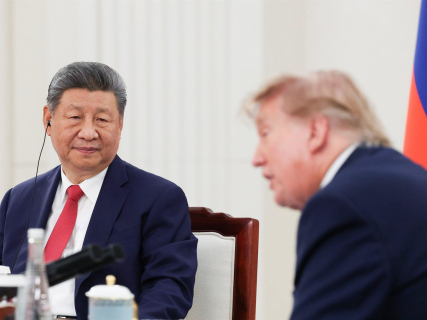










The Chinese Ministry of Commerce has decided to extend until next January 27 the suspension of the ban on exporting certain minerals and metals to the United States, thereby prolonging the current trade truce. This decision comes after the meeting held in the Chinese city of Shenzhen between the presidents of both countries, Donald Trump and Xi Jinping, a meeting at which the Russian head of state, Vladimir Putin, was also present.
With this extension, continuity is given to a measure that began to be applied in November 2025 with an initial duration of one year. The new extension adds at least two additional months just as the deadline for the rule was approaching.
In practice, export controls on “dual-use” minerals and metals used in the production of semiconductors and with possible military purposes remain without effect. In this list are gallium, germanium, antimony, and various superhard materials, while requirements for stricter review of graphite are also relaxed.
The original restriction was introduced in December 2024 in response to limitations imposed by Washington on chip trade. The decision to keep it on hold for a year was adopted after the bilateral meeting between Trump and Xi in the South Korean city of Busan.
Similarly, the new extension is announced after the Administration of Donald Trump agreed a week ago to impose limits on the supply of chips and artificial intelligence (AI) servers to Chinese companies, amid a commotion over the alleged case of Chinese spying on the newly appointed CEO of Nvidia, Jensen Huang.
The U.S. president himself has explained that he discussed Huang’s situation with Xi Jinping during his meeting. Finally, Nvidia’s CEO returned to his position this past Monday after Trump’s intervention.