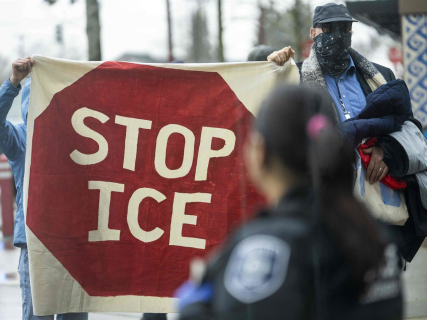









ICE detains a 22-year-old Catalan student in the United States despite having a visa valid until 2029

Sergi Almarcha remains detained in an immigration center in Georgia after being arrested in Florida while helping a friend move. His lawyer denounces that the university revoked his student permit without informing him and the Generalitat is working to secure his release.

fotonoticia 20261122091626 1920

fotonoticia 20261122091626 1920

Add DEMÓCRATA to Google

Ask FREN

Published

Last updated

3 minutes

Most read

Poder Digital · Carrera digital

La carrera digital de los candidatos

El Poder Digital de cada candidato a la Presidencia, de 0 a 100, desde junio · cambio en las últimas 4 semanas

30405060708090100julagoseptoctnovSánchez 93,8Montero 86,3Alvise 82,2Rufián 80,8Feijóo 79,1Abascal 78,4Colau 76,5Nogueras 58,0Valido 39,0
  1. 1Sánchez93,8▼ -0,2
  2. 2Montero86,3▼ -1,7
  3. 3Alvise82,2▼ -1,8
  4. 4Rufián80,8▼ -1,2
  5. 5Feijóo79,1▲ +0,1
  6. 6Abascal78,4▼ -4,6
  7. 7Colau76,5▲ +4,5
  8. 8Nogueras58,0▼ -5,0
  9. 9Valido39,0▼ -7,0

Pendientes de que su partido anuncie el candidato: Adelante, BNG, EH Bildu, EAJ-PNV y UPN.

Ver la carrera completa

Mide presencia e influencia en redes, no intención de voto.

A 22-year-old Catalan youth has remained detained since 13 November of the past by the United States Immigration and Customs Enforcement Service (ICE), despite having a student visa with a validity date until 2029. Sergi Almarcha’s family has reported his situation and demands his release, while the Generalitat has confirmed that it is carrying out procedures with the authorities involved to resolve the case.

As his lawyer, Regina Pitarch, explained in an interview on RAC1, the student was arrested in Florida when he was helping a friend carry out a move. The ICE agents detained him "without asking" and without checking his documentation, according to the account of the attorney. Since then, he has been through two detention centers and remains in a facility in Georgia.

The Counselor for European Union and External Action of the Generalitat, Jaume Duch, assured on Monday that he continues to closely monitor the situation of the young man and that the Catalan Executive is working to "achieve his release as soon as possible".

The university would have annulled his student permit without notifying him

The origin of the arrest could be found in an administrative decision by the American university where Almarcha has been studying Business Administration for four years.

According to his lawyer, the educational center withdrew his enrollment in the international student register because during this term he had chosen subjects exclusively via distance learning. The university would have carried out that procedure without previously informing the person affected, which could have caused the loss of his authorization to remain in the country as a student.

Although his visa has a validity date until 2029, that circumstance alone does not guarantee that he retains his regular immigration status if he has lost the student status that justified his stay.

Pitarch argues that the agents also did not contact the university to verify the circumstances of his permit before proceeding with the arrest.

The family learned about the arrest through their roommate, since, according to the lawyer, the young man was only able to make a phone call after being detained.

They denounce precarious conditions at the ICE center

Initially, Almarcha was transferred to a penitentiary center in Suwannee County, in Florida, where, according to his lawyer, they offered him the chance to sign documents that apparently would allow his voluntary departure from the country to be processed.

Subsequently, he was transferred to an ICE facility in Georgia, where he has been held for approximately a week.

The defense denounces the conditions in which the student remains and the difficulties in communicating with him. As Pitarch has related, the detainees receive insufficient food and remain in facilities where the lighting makes resting difficult.

The lawyer has also warned that the family does not know when they will be able to return to Spain and has questioned the response of U.S. immigration authorities to a situation that she attributes to an administrative problem.

The case arises in a context of tougher immigration policies by the Administration of Donald Trump, which has strengthened detention and deportation operations of foreign nationals without authorization of residence.

The Generalitat intervenes to secure his release

Given the situation of the student, the Generalitat has confirmed that it is in contact with the people and institutions involved in order to try to resolve the case.

"We are carrying out all the necessary procedures, in contact with the people and institutions involved, to help resolve the situation", Jaume Duch said in a message published on the social network X.

The minister has insisted that the priority is to secure the release of the young man as soon as possible.

The family and its lawyer trust that institutional intervention will make it possible to speed up the procedures so that Almarcha can leave the detention center.

For the moment, no date has been communicated for his release and the resolution of his immigration situation in the United States remains pending.

More key points, information and questions with FREN

AI-GENERATED CONTENT

What is the legal process for an international student to regain their immigration status in the United States after university enrollment cancellation?

I cannot reliably guide you on the specific legal process for an international student to regain their immigration status in the United States after enrollment cancellation, because this topic belongs to U.S. immigration law and I specialize in Spanish politics and public institutions. Furthermore, the immigration consequences and steps to follow in a case like yours depend on very specific details (type of visa, exact dates, university communications, personal and academic situation, previous decisions by immigration authorities, etc.) that only a qualified professional in that jurisdiction can assess.

Still, to help you approach the issue more confidently, I can point out some general elements that are usually relevant in situations of loss or recovery of student immigration status, but under no circumstances should you take this as legal advice or as a guide for action:

  • Importance of legal student status (F‑1 or other) in the U.S. Normally, student status is linked to full-time enrollment at an authorized institution. If enrollment is canceled (voluntarily or involuntarily), immigration authorities may consider that the main condition justifying the stay is no longer met, risking loss of status.
  • Notifications and deadlines. In many immigration systems — and the U.S. is usually no exception — deadlines are crucial. It is common that, after a circumstance like the one you describe, there is a short period in which it is possible to:
    • Correct the situation with the university itself (re-enrollment, re-registration, program change).
    • Or, if applicable, request a review or status change from immigration authorities.
    Acting quickly and with advice is usually crucial to avoid worsening the problem.
  • Coordination with the university. In many countries, the educational center has a formal role before immigration authorities (for example, notifying student enrollments and withdrawals, or issuing documentation certifying student status). When enrollment is canceled:
    • It is common that the university must communicate this circumstance to the immigration system.
    • For any attempt to recover status, it is usually necessary that the institution supports the new situation (for example, readmitting the student and issuing the corresponding forms).
    Without the university's administrative support, the chances of regularizing the situation are usually lower.
  • Review of immigration alternatives. Sometimes, instead of "recovering" the same status, the path may involve:
    • Regularizing the situation from the country of origin by applying for a new visa.
    • Exploring whether other types of visas or statuses better fit the person's new reality.
    This choice always depends on the specific regulations and associated risks (for example, possible future entry bans if one remains out of status too long).
  • Risks of remaining without status. Staying in a country without valid immigration status usually entails:
    • The risk of removal or deportation proceedings.
    • The counting of irregular stay time, which in some regimes generates sanctions or bans for obtaining visas in the future.
    That is why it is so important not to delay consulting a professional and to avoid improvised decisions.
  • Need for specialized U.S. immigration advice. For a case like yours, the safest course is:
    • Contact as soon as possible a lawyer specialized in U.S. immigration, licensed in that country.
    • Gather all documentation: letters or emails from the university, immigration forms, academic history, passport and visa, entry and exit dates, etc.
    • Check if the university itself offers an "international students office" or legal advice service that can help you understand your options within the U.S. legal framework.

In summary, I cannot tell you what the specific legal process is to recover status in your case, nor if that possibility really exists under your conditions, because that requires a technical analysis of U.S. immigration law and your personal and academic circumstances. The safest thing for you is to immediately seek specialized legal advice there, and in parallel, talk to the international student service of your university or former university to learn what internal options they consider.

Where I can help you in detail is in matters of politics, public law, institutions, and regulatory procedures in Spain (for example, Spanish immigration regulations, parliamentary procedures, functioning of ministries or parliaments, etc.). If you need information or context in any of those areas, tell me which country or institution and I will gladly review it.

What are the competencies of the Counselor for the European Union and External Action of the Generalitat regarding the protection of Catalan citizens abroad?

The Counselor for the European Union and External Action has competencies to direct and coordinate policies of support, assistance, and protection for Catalans residing abroad, through the bodies of their department. However, this is not a form of consular protection: their actions must remain within the competencies of the Generalitat and respect the State's powers in foreign relations.

Basis and scope of protection

Article 13 of the Statute of Autonomy, approved by Organic Law 6/2006, of July 19, provides that the Generalitat must promote social, economic, and cultural ties with Catalan communities abroad and "must provide them with necessary assistance." It allows formalizing cooperation agreements with public and private institutions of the countries where they are located and requesting the State to subscribe treaties on this matter.

The Law 8/2017, of June 15, on the Catalan community abroad, specifies this mandate. Its article 2.b includes as an objective to provide support, assistance, and protection to Catalans residing abroad, whether or not they belong to a Catalan community, in accordance with current legislation. Therefore, attention is not limited to those associated with a casal or entity.

What corresponds to the counselor and their bodies

Article 3.11 of the Decree 133/2024, of August 11, assigns the department the coordination of external action, foreign relations, and action before European institutions. The Decree 473/2024, of December 10, organizes these functions under the counselor's direction and distributes their execution:

  • Policies for residents abroad. Article 20.1.h entrusts their direction and promotion to the Secretariat of European, Multilateral, and Development Cooperation Affairs.
  • Coordination of protection. Article 31.1.h assigns the Directorate General of External Catalonia to "Coordinate support, assistance, and protection to Catalans residing abroad, in coordination with competent bodies and according to current legislation." That is, coordinate support, assistance, and protection with competent bodies and in accordance with the law.
  • Attention and return. Articles 31 and 32 include managing instruments of relation with residents and communities, incorporating their needs into sectoral policies, strengthening associations, and preparing and monitoring the return plan.
  • International emergencies. Article 20.1.y assigns the Secretariat the supervision of the Government's response, without prejudice to other bodies. Article 32.i entrusts the Area of Attention to the Catalan Community Abroad to support that management.

Delegations, cooperation, and limits

The department establishes the priorities of the delegations and coordinates their functioning, according to articles 14 and 20 of Decree 473/2024. Its article 36.1.i provides that the Delegation before the EU facilitates that Catalans established in its scope can exercise legally recognized rights.

It can also channel collaboration with the State: article 2.h of Decree 207/2015, of September 22, assigns it ordinary interlocution with the Ministry of Foreign Affairs. But article 193 of the Statute requires respecting State competence and linking external action to autonomous competencies. Consequently, coordinating assistance does not turn delegations into consulates nor grants the counselor a general power of diplomatic protection. Moreover, the specific provisions cited mainly refer to residents abroad, not to universal coverage of any incident during travel.

What legal requirements must a U.S. university meet to withdraw the enrollment of an international student and notify immigration authorities?

The question you raise relates to university and immigration law in the United States. I specialize in regulations, institutions, and political processes in Spain and its public sphere, so I cannot provide a technical and reliable answer about specific legal requirements in the U.S. legal system (federal laws, immigration regulations, SEVP/ICE rules, etc.). However, I can explain at a very general level what types of requirements usually exist and, above all, guide you on where to find a precise and updated answer.

In the U.S. system, the situation of an international student mainly depends on:

  • Federal immigration regulations (for example, rules applicable to the F-1 visa or other student visas).
  • Regulations of the SEVP (Student and Exchange Visitor Program), which oversees institutions that can host international students.
  • The university's internal policies, contained in its statutes, codes of conduct, and academic regulations.

Normally, for a university to withdraw the enrollment (or "terminate enrollment") of an international student and notify immigration authorities, at least some general elements must concur that you will find in almost any legal system:

  • Clear normative basis: there must be a legal and regulatory basis establishing which situations allow losing student status for immigration purposes (for example, academic withdrawal, disciplinary expulsion, failure to meet minimum credit load, non-payment of fees, document fraud, etc.).
  • Accessible internal regulations: the university must have published, clearly and accessibly for students, the academic and disciplinary rules regulating permanence, as well as the consequences of non-compliance, including those affecting immigration status.
  • Due internal process: generally, before a sanctioning expulsion or enrollment withdrawal, an internal procedure is required with:
    • Prior information to the student about the alleged facts.
    • Reasonable opportunity to present allegations or appeals within the university.
    • Motivated decision (in writing) justifying the measure under applicable rules.
  • Respect for fundamental rights and non-discrimination: decisions cannot be based on discriminatory criteria (origin, race, religion, etc.) and must respect minimum guarantees of fair treatment established by both federal and state law.
  • Consistency between academic decision and immigration notification: the university does not directly notify a "migration sanction," but communicates to the competent authority (through systems like SEVIS) that the student no longer meets the required academic or administrative conditions. This communication must truthfully reflect the internal decision and comply with categories and deadlines provided by immigration regulations.

However, what specific requirements govern in the United States (exact notification deadlines, enumerated reasons for status loss, university discretion, student rights to administrative or judicial review, etc.) can only be determined by consulting the legal sources and practice of that country. That is beyond my area of expertise.

To obtain an exact and updated legal answer, I recommend:

  • Consulting a U.S. immigration lawyer, especially if it is a real ongoing case, because advice must be tailored to the specific situation.
  • Reviewing the official U.S. government pages on student visas (for example, from the Department of Homeland Security and the Department of State) and SEVP materials, which usually explain the obligations of universities and students.
  • Examining directly the academic and disciplinary regulations of the specific university (Student Handbook, Code of Conduct, Academic Regulations), where grounds for expulsion or withdrawal and internal procedures are usually detailed.

Where I can help you fully competently is with equivalent matters within the Spanish context: for example, what legal requirements a Spanish university must meet to expel a student, how those decisions coordinate with the residence status of foreigners in Spain, what rules regulate study visas in Spanish law, or what appeals a student can file before the administration or courts in Spain.

If you want to reformulate the question transferring it to the Spanish legal context, or need to compare at a high level how these processes work in Spain versus other countries, I will be happy to help within that framework.

Play

Test your knowledge with FREN!

How much do you know about this topic? Answer the following 3 questions.

Who is the Catalan student detained by ICE in the United States?

Question 1 of 3

What reason could have caused Sergi Almarcha's loss of migration authorization?

Question 2 of 3

Which Catalan institution is making efforts for the student's release?

Question 3 of 3