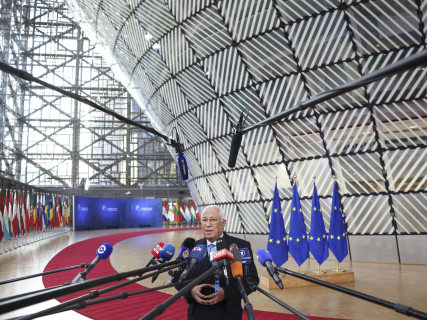

The President of the European Council, António Costa, has on this Thursday called on the heads of state and of government of the European Union to be "open-minded" and to "listen to each other" in order to overcome the clash between those who support further spending cuts and those who demand more ambition in common spending, with the aim of sealing a deal on the next multiannual budget framework before the year ends.
"This is the moment for all leaders to take part in this debate with open minds, a constructive approach and a willingness to compromise. We need to approve this budget on time, that is, before the year ends, and to do that it is essential to achieve unanimity," the former Portuguese prime minister said in a statement without questions upon his arrival at the extraordinary meeting of the 27 in Brussels.
At this summit, which the president of the Government, Pedro Sánchez, does not attend, having delegated his vote to the President of France, Emmanuel Macron, European leaders will for the first time examine the latest compromise proposal on the distribution of the Multiannual Financial Framework (MFF, by its English initials) for the period 2028-2034, submitted by Costa to the capitals last Saturday.
The plan includes an additional cut of just over 10% compared with the European Commission’s initial proposal, so that the overall size of the budget is reduced to €1.58 trillion compared with the €1.76 trillion that Brussels initially proposed.
The initiative—which concentrates much of the adjustment in the chapters on competitiveness, security and defense, while leaving the Common Agricultural Policy (CAP) and cohesion funds practically untouched—has been rejected both by the so-called frugal countries, such as the Netherlands, and by those who advocate preserving spending on traditional policies, including Spain and Italy.
In this scenario, on his arrival Costa emphasized that the discussion about the budget is the "most important" matter for the leaders this Thursday, because the Union needs a long-term financial framework "that is suitable for financing the bloc’s main priorities."
"We must support our farmers, as well as our cities and regions; we need to invest more in security and defense; we must boost our competitiveness; we have to respond to the expectations of our citizens with regard to energy and housing prices; and, for that, we need a budget that is up to these goals", he reasoned, before insisting that the final agreement must also keep national contributions at a "reasonable" level.
To this end, Costa trusts that the leaders will narrow their positions this Thursday both on the overall volume of the budget and on the distribution of funds among the different priorities, and that they can reach a "consensus" around a set of "balanced and effective" new own resources, which will make it possible to preserve national contributions at that "reasonable" level.
The Portuguese socialist leader has emphasized that this negotiation differs from that of national budgets, because it is not enough with a majority to carry an agreement forward, but rather "unanimity" is required. For this reason, he called for European heads of State and Government to "listen to one another" and to take into account the positions of the rest of the partners "in order to find a point of understanding".