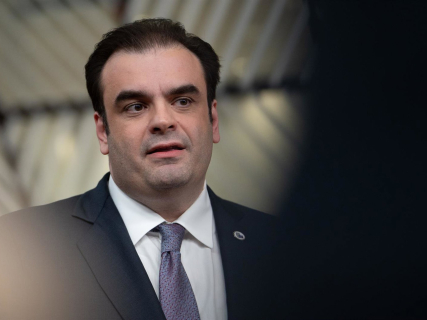

The President of the Eurogroup, Kyriakos Pierrakakis, stated this Thursday that "at the moment there is no consensus" among the finance ministers of the euro area regarding the creation of a European safe asset through joint debt issuance, as proposed by Spain. He does, however, see general agreement on the need to strengthen investment across the bloc.
"As President of the Eurogroup, I can only comment on areas where there is consensus. Historically, the debate on the safe asset has not been one of those areas," he said upon arriving at the meeting held in Brussels.
The Greek official explained that euro countries share the diagnosis that it is necessary to raise "investment priorities and ambitions in Europe," although he admitted that there is no common vision on how to finance this investment effort. "In general terms, we agree that we have greater investment priorities and greater investment ambitions. We do not necessarily always agree on the means that will finance these investments," he remarked.
Pierrakakis made it clear that the Eurogroup is willing to address the Spanish proposal during the meeting, but he cooled expectations of immediate support from the other partners. "Of course, we plan to discuss any relevant issue of this type within the Eurogroup, but right now there is no consensus on this matter," he concluded.
Opposition from the Netherlands and Finland to joint debt
The Minister of Finance of the Netherlands, Eelco Heinen, has categorically rejected the Spanish initiative, which he framed as an "old debate" to which his answer "is always the same: no." In his opinion, the priority to strengthen the single currency is to clean up national accounts. "If we want to strengthen the role of the euro, we must start with the fundamentals: that the economy and public finances are in order. More debt does not lead to a stronger position for the euro," he argued.
The Minister of Finance of Finland, Riikka Purra, expressed similar views, emphasizing that the correct path involves "credible public finances," improved productivity, a genuine single market, and deeper capital markets. "No to common debt. No to new common debt at the EU level. It is not a solution and it is not an option for Finland," she stated.