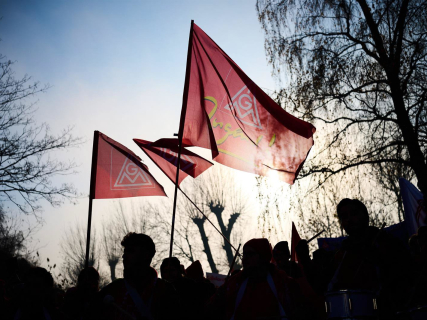

The German union IG Metall has announced the signing of a new agreement with the employers' association of the German industrial sector that sets a wage increase of 4.3% until 2028, below the 5% initially demanded, in addition to a one-time payment of up to 450 euros in benefits. With this agreement, the dispute that had led to the calling of 24-hour strikes in the metalworking and electronics industry is considered concluded.
Specifically, the regional sections of IG Metall in Baden-Wurtemberg and North Rhine-Westphalia have sealed this pact with the employers' associations Südwestmetall and Metall NRW, and the union now urges the rest of the negotiating tables to adhere to the same terms.
The agreement establishes two permanent wage increases of 2%, effective from May 1, 2027, and 2.3%, from April 1, 2028, in addition to an extraordinary payment of between 150 and 450 euros, linked to the net profit margin of each company.
"This collective agreement represents an important contribution to investments in the future of Germany as an industrial hub. Companies that meet the requirements of the new collective agreement will receive temporary financial flexibility and their employees will get job security. Now there is no excuse for relocations or layoffs," said IG Metall President Christiane Benner.
Despite this, the final outcome remains below IG Metall's original demand, which called for a 5% increase in wages.
The new collective framework also includes a strong role for the union and works councils in investment decisions, the prohibition of workforce cuts, and commitments to allocate resources to facilities. In return, companies will be able to use the profits agreed with the workforce up to a clearly set cap.
If companies do not respect the conditions set out, they will be required to repay the contributions agreed collectively.
In addition, IG Metall members will retain the preferential right to receive an additional bonus on top of the benefits payments.
The understanding comes after two rounds of worker protests. First, partial work stoppages were carried out and, last week, full-day strikes were held, in which more than 956,000 employees took part.
"The determined strikes at the factory gates made it possible to reach an agreement at the negotiating table. We thank the members of IG Metall for their commitment," Nadine Boguslawski has said, a member of the Executive Council for Collective Bargaining of the union.
Employers call the compromise result acceptable
For their part, Südwestmetall and Metall NRW, business organizations in the sector, have pointed out that, after more than 26 hours of talks, the outcome of the agreement is "acceptable," even though the wage increases represent an additional burden for many companies in an "exceptionally" complex context.
The employers have specified that the agreement maintains the mechanism of automatic differentiation for companies with financial difficulties, so that those that meet these conditions are not required to fully apply the demands of the agreement. As it is an automatic system, they are not even required to notify the unions or the authorities.
"Despite the exceptionally difficult situation our sector is going through, we have managed to achieve a compromise acceptable to both parties. Concessions on wages are nothing easy for many companies. Thanks to the automatic differentiation, we were able to agree on a solution for all companies that cannot bear further increases in costs," said Peter Sebastian Krause, president and chief negotiator of Südwestmetall.
"If company representatives and employers work together, this instrument can help contribute to renewed dynamism within companies. Automatic differentiation was agreed on once again, thereby firmly consolidating it within the full set of collective bargaining tools," Arndt Kirchhoff, president and chief negotiator of Metall NRW, has said.