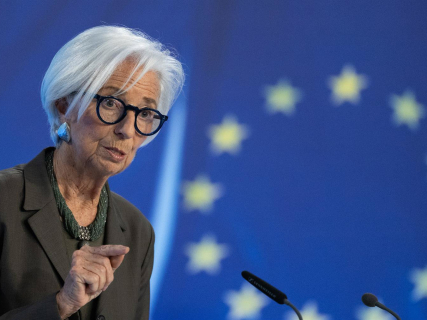

The president of the European Central Bank (ECB), Christine Lagarde, argues that strengthening the euro’s international role is essential for the institution’s monetary policy and can boost both the growth and the sovereignty of Europe in the current global setting.
In her speech at a banking conference held in Frankfurt, the ECB official recalled that the issuing bank has moved from maintaining a neutral stance on the international projection of the single currency to adopting a clearly more favorable view.
"A more prominent international role for the euro is important for our monetary policy and can support the growth and sovereignty of Europe in today’s world," she said.
For the French leader, who is often described as the 'guardian of the euro', having an attractive currency for global investors lowers Europe’s financing costs at a time when the region is facing strong investment needs, ranging from the defense sector to key technologies for its strategic autonomy.
In an environment of more frequent disruptions, Lagarde has emphasized that the greater the share of European trade that is billed in euros, "the less we will be exposed to exchange-rate fluctuations".
With the aim of extending the use of the euro beyond Community borders, the ECB has launched various initiatives, including the interconnection of the TIPS, the instant payment system, with fast-payment infrastructures from other regions of the world, as well as strengthening the ECB’s international liquidity lines as a safety net.
At the same time, the central bank is working to ensure that its currency exchange lines ('swap') continue to function effectively in a more fragmented financial context, and Lagarde has said that "they will be more accessible".
In this regard, she clarified that although the main purpose of these agreements is to safeguard the transmission of monetary policy in crisis situations, reducing contagion coming from outside to European markets, "they also support the euro’s global role".
"A reserve manager who knows that euro-denominated securities can be converted into euro liquidity without a forced sale has more reasons to hold them in normal times," he said.