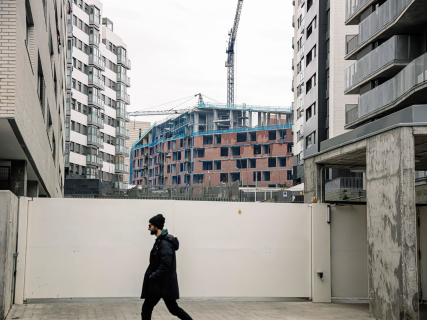

The Community of Madrid continues to move forward with the processing of its new Regulation on Publicly Protected Housing, a rule that aims to simplify administrative procedures, facilitate the promotion of new homes, and expand access routes for citizens, including the recovery of the formula for rent with the option to buy.
This Wednesday, the Governing Council has decided to request from the Legal Advisory Commission the mandatory report on the draft, the final step before its definitive approval. The new text will replace the regulation in force since 2009, as explained by the Minister of Housing, Transport and Infrastructure, José María García Gómez.
The current initiative updates the regulatory framework for protected housing to reflect market reality and sets more precise criteria for developers, owners, and awardees regarding access requirements, the terms of allocation, and the rules for use of the properties.
"Not all people need the same housing solution. The update seeks modalities that have a clear fit and whose conditions can be known from the outset. This regulatory update adds to the region's supply of protected housing," the minister has defended.
Responsible statement to speed up procedures
Among the changes planned, various procedures are simplified and may be carried out through a responsible statement, that is, a document in which the interested person affirms that they meet the legal conditions required.
This route will affect certain files linked to the definitive recognition of the qualification as protected housing, access to it, the rent scheme, and transfers of ownership. In any case, the regional Administration will retain its powers of subsequent verification and inspection.
Indefinite protection for the public stock
The text also establishes that homes promoted directly by the regional Executive, or that are owned by it, will maintain indefinitely their protected qualification. This provision will extend, in certain cases, to other public-owned properties in order to ensure that they continue to be intended for protected residential use.
Likewise, the regulation specifies the requirements for housing reserved for large families and incorporates new residential formulas with shared or community areas. It also includes temporary accommodation for students and other groups, as well as models of use transfer that allow living in a home without acquiring its ownership.
Greater requirement for rootedness and new access assumptions
The future regulation will toughen the requirement for rootedness by setting a minimum of ten years of registration in the Community of Madrid in order to be able to opt for developments under a sale regime or intended for own use. In the case of certain rental modalities, such as the Plan Vive, the requirement will be reduced to five years.
In addition, access to protected housing is excluded for those who have been convicted in the last five years for unlawful entry or squatting in properties.
At the same time, the assumptions under which it will be allowed to apply for protected housing even if the applicant is the holder of another home are expanded, covering situations such as separations or divorces, gender-based violence, disability, dependency, accessibility problems, or greater space needs in large families.
Management of the public residential stock
The Agencia de Vivienda Social (AVS) currently manages more than 25,300 homes distributed across 119 municipalities in the region. On the other hand, the Plan Vive adds up to now to 16,448 protected homes: 6,530 have already been delivered, 5,329 are under construction, and 4,589 are pending for the next tendering.
In the coming months, the transfer of 1,840 homes in Torrelodones, Aranjuez, Arganda del Rey, Colmenar Viejo, Daganzo de Arriba, Moralzarzal, Navalcarnero, Velilla de San Antonio, and Villalbilla is expected. In addition, 3,489 homes are being built in Alcobendas, Arroyomolinos, Colmenar Viejo, Loeches, Madrid, Móstoles, San Sebastián de los Reyes, Torrejón de la Calzada, Torrejón de Velasco, Tres Cantos, and Valdemoro.
After the request for the report to the Comisión Jurídica Asesora, the regional Executive will continue with the necessary steps for the definitive approval of the regulation.
Tarifa Cero for new self-employed workers in 2027
At the same time, the Community of Madrid will allocate in 2027 a total of 7 million euros to the Tarifa Cero, which covers the social security contributions of new self-employed workers, after the Council of Government has agreed to advance the procedures to finance this program next year.
The aid, managed by the Ministry of Economy, Finance and Employment, assumes these contributions during the first twelve months of activity. Coverage may be extended one more year for those who have annual income equal to or less than the minimum interprofessional wage (SMI), a disability of 33% or who are in a situation of vulnerability, as has been stated by the spokesperson for the regional Government, Miguel Ángel García Martín.
Women who have interrupted their work activity due to birth or adoption and resume it within the following two years may also benefit, provided that they enjoy reduced contributions.
On the other hand, people over 52 years of age who start a business project and stop receiving unemployment benefits may receive an amount equivalent during a maximum of twelve months.
Interested people can consult all the information and the requirements to access these grants through the Digital Administration of the Community of Madrid.