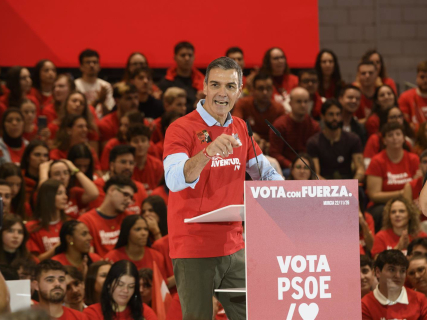










The president of the Government, Pedro Sánchez, defended his tax strategy this Tuesday against the discourse of "the right and the far right," which argues that money must remain mainly in citizens' pockets.
In this way, Sánchez highlighted the redistributive function of taxes to finance the Welfare State and recalled the high cost that an ICU bed had for public healthcare during the pandemic or an oncology treatment.
"All this discourse from the right, from the far right, that the money is better in citizens' pockets—I disagree with that. I am the president of the pandemic Government. I know what an ICU bed costs per day during the pandemic. It costs 3,000 euros a day. A cancer treatment in our country, in public healthcare, costs 50,000 euros," he said in an interview on RNE, collected by Europa Press.
Along these lines, the head of the Executive raised how many people could afford those amounts on their own and stressed that polls indicate that six out of every ten households in Spain receive more from the Welfare State than they contribute through taxes.
At the same time, he said that, despite the years of economic crisis, his administration has applied tax cuts to about 10 million middle-class taxpayers, mentioning, among others, reductions in VAT on food, on gas, and on electricity.
Bank tax and debate on the ultra-rich
During the interview, Sánchez also referred to the approval this Tuesday, by the Council of Ministers, of the extension of the bank tax, with which it is expected to raise 1,400 million euros. He also regretted that, in a very fragmented Congress, the Government's proposal on the levy on energy companies did not move forward, despite, as he stressed, these companies are obtaining large profits with the "energy shock."
Therefore, he called not only to "stop the right and the far right," but to achieve a progressive majority in the next legislature that will make it possible to accompany the promotion of housing with regulatory measures and to open in Spain "the big debate on the ultra-rich," which, he recalled, is already taking place in countries such as France or the United States.
In this context, he pointed out that Spain was one of the first States to move forward with the tax on financial transactions (Tobin tax) and the levy on large digital platforms, a decision which, he acknowledged, caused it “some displeasure” with the US Administration.
Housing, the Land Law, and the regularization of migrants
Asked about the possibility of removing VAT on the purchase of housing for young people or reducing the Corporate Tax for developers of protected housing, the president explained that the Government has already put in place instruments through the Instituto de Crédito Oficial (ICO) to guarantee developers and young families, as well as loans of up to 50,000 euros at zero interest for the first home, included in Real Decreto-Ley MariCarmen, which was ratified by the Diputación Permanente after being rejected by the Plenary and prompting the early elections.
In terms of housing, Sánchez defended a combination of new protected construction, refurbishment, and regulation of the market to avoid imbalances between supply and demand caused by vulture funds and large owners.
At this point, he criticized the PP, Vox and Junts for voting against tax bonifications for rent aimed at tenants, small property owners, homeowners’ associations, and vulnerable groups such as dependent elderly people.
Likewise, the president said he was in favor of reforming the Land Law in order to shorten the periods for urban planning processing. He admitted that he still has differences with “the left at my left,” with which he has not reached agreements on this matter, and he criticized the PP for overturning the reform in Congress despite, as he said, the fact that their own mayors are the ones asking for it.
Lastly, he highlighted that, after the financial crisis, 300,000 jobs in the construction sector have been recovered and he linked the availability of labor to the regularization of migrants approved this year, emphasizing that many workers who previously were in the underground economy now pay into Social Security with all their rights.