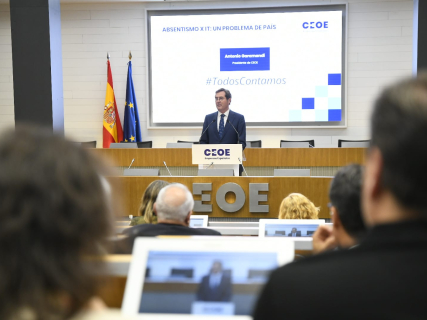


The rate of absenteeism in Spain continues to rise. According to the latest data provided by the employers' association CEOE, chaired by Antonio Garamendi, around 1.4 million people do not go to their workplace each day.
The economic impact is also significant: the cost of absenteeism amounts to 33 billion euros annually, of which about 17 billion falls directly on companies.
Furthermore, Spain has one of the highest absenteeism rates in the European Union. While in our country it stands between 7% and 8%, the EU average ranges between 4% and 5%.
The most relevant aspect, as highlighted this Tuesday by Lorenzo Amor, vice-president of CEOE and president of the Asociación de Trabajadores Autónomos (ATA), is that this rate—based on data from the INE—reduces the effective working day in Spain to the equivalent of 32 hours per week.
A calculation prepared by the CEOE's Labor Relations Commission, led by Rosa Santos, which takes the concept of effective working hours as a reference. It includes variables such as vacations, holidays, leaves of absence, medical leave, reduced working hours, part-time contracts, and other non-worked hours.
These figures were presented at the business meeting held this Tuesday at the national headquarters of CEOE in Madrid, under the title “Todos contamos. Absentismo x IT, un problema de país” (Everyone Counts. Absenteeism x Temporary Incapacity, a National Problem).
During the event, Lorenzo Amor also warned that, in addition to the impact of absenteeism, the bureaucratic burden of the labor market is added. According to his presentation, self-employed workers bear around 10 billion euros annually associated with this phenomenon, to which about 3,000 euros per self-employed worker on average are added for costs derived from compliance with labor and fiscal obligations.
CEoe proposals to reduce absenteeism
1. Increase the number of health professionals and inspectors
2. Strengthen the powers of the Mutual Societies and provide them with resources
3. Advance controls for employees on sick leave by their medical inspection, incorporating evaluations every 3, 6, and 9 months, with the participation of the mutual societies.
4. That the INSS medical inspection assume control of IT processes whose reiteration represents the usual frequency in annual terms, regardless of whether they originate from the same or a different pathology.
5. That Social Security assume the full unemployment for the first 15 days of IT processes due to common contingencies.
6. Exempt companies from employer contributions for common contingencies in all processes lasting more than 365 days, given that they have doubled in the last six years due to the INSS bottleneck.
7. Exempt 100% of employer contributions for fixed-term contracts that are signed to replace individuals with contracts suspended due to temporary incapacity.
CEOE brings together sectors and territories to analyze the impact of absenteeism
Antonio Garamendi led an unprecedented initiative this Tuesday —followed by DEMÓCRATA— to give a voice to companies, self-employed individuals, and organizations from all over the country in the face of one of the main health, social, and economic challenges.
The president of CEOE brought together in Madrid representatives from the main productive sectors, territorial organizations, SMEs, self-employed individuals, mutual societies, and experts, with the aim of jointly analyzing the increase in temporary incapacity leave due to common contingencies and its impact on economic activity and the healthcare system.
The event allowed for the quantification of a phenomenon that now affects society as a whole. In 2025 alone, around 1.4 million people did not show up for work even for a single day, while the cost of absenteeism reached 33 billion euros, a figure that has tripled in the last decade.
At the closing of the meeting, Antonio Garamendi stated that “absenteeism is a health problem, with social and economic consequences, and of a magnitude that affects us all”, and stressed that behind every medical leave there is a person who requires attention and an effective response from the system.
The president of CEOE thanked the participation of business organizations, productive sectors, self-employed workers, and experts, and defended the need to advance measures that correct the system's inefficiencies, including the exemption of contributions for common contingencies in long-term processes and in substitution contracts.
Essential Sectors, Economic Engines, and Territorial Analysis
Tuesday's session included three discussion panels in which representatives from different areas of the productive fabric participated.
The first panel, moderated by Juan Roca (AMAT), focused on essential services and included Ignacio Gamboa (ASADE), José Manuel Baltar (ASPE), Santiago García (CECE), Eduardo Cobas (APROSER), Ignacio Silva (FIAB), and Juan Ignacio Beltrán (ASPEL and CEOE's Commission for Personnel-Intensive Services).
The second panel, moderated by Teresa Rasero (CEOE and FEIQUE), analyzed the impact on the economy's driving sectors with the participation of Ignacio García Magarzo (ASEDAS), José Luis Álvarez Almeida (Hostelería de España), Pedro Fernández Alén (CNC), Rafael Barbadillo (CONFEBUS), José Miguel Guerrero (CONFEMETAL), and Andreu Cruañas (ASEMPLEO).
The third panel, led by Arantxa Campos (Confederation of Employers of Ceuta), addressed the territorial dimension of the phenomenon with Josep Sánchez Llibre (Foment del Treball), Manuel Piquer (CEN), Tamara Yagüe (Confebask), José Cristóbal García (CCE), Laly Escudero (CEIM and AEDHE), and Ángel Nicolás (CECAM).
With this initiative, CEOE highlighted the need to address absenteeism as a structural phenomenon that requires a coordinated response among public administrations, social agents, and the business community.