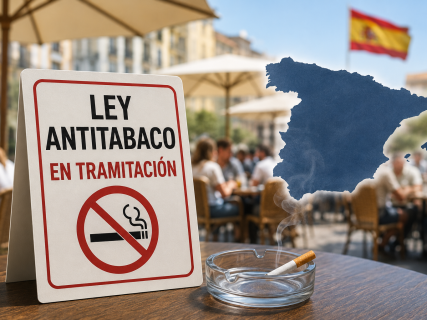

Will foreign tourists stop coming to Spain if Parliament finally approves the Anti-Tobacco Law of the Government?
More than a question, it is a reflection that has already begun to appear in the foreign press and that worries several economic sectors, especially hospitality, where income from terraces represents between 30% and 40% of the revenue of many establishments.
British, Germans, and French constitute one of the main pillars of Spanish tourism: millions of visitors a year that generate a decisive economic volume. Hence, the possibility that some of those tourists —explains this Tuesday Euro Weekly News— choose other Mediterranean destinations with fewer restrictions has raised alarms in the national hospitality and tourism sector.
Already in September of last year, when the Government's proposal began to take shape with a first draft, several foreign media collected the doubts of potential visitors British, some of whom claimed they would stop traveling to Spain if the new regulations were finally approved. "I will go somewhere else," summarized one of those testimonies.
An opinion that, according to the consulted sectors, does not seem to have been taken into account by the Executive. Not only that of tourists but also the economic impact that, in their opinion, a proposal could have that would place Spain among the European countries with the most restrictive regulation on tobacco consumption in open spaces.
Spain prohibits smoking
Currently, Spain does not maintain a general prohibition on smoking in all terraces of bars and restaurants or on beaches. There are specific restrictions established by some establishments or by certain regional and local administrations.
The reform promoted by the Ministry of Health aims to prohibit the consumption of conventional cigarettes, electronic cigarettes, nicotine pouches, herbal smoking products, shisha pipes, and devices for heating tobacco or other substances in open spaces such as beaches, terraces of bars and restaurants, stadiums, sports facilities, playgrounds, public transport shelters, and educational centers.
However, for this new regulatory framework to come into force, the Minister of Health, Mónica García, must first overcome a complex parliamentary process.
And it will not be easy. First of all, because any bill requires months of processing. Secondly, because the Government does not have a stable parliamentary majority, as evidenced by the fact that it continues to govern with the General State Budgets of 2023. Furthermore, the next general elections are scheduled for the summer of 2027, unless an early election occurs.
The reaction of the hospitality industry
The hospitality industry is, probably, one of the sectors that observes the reform with the greatest concern. Not only because of the possible economic impact on a business where terraces constitute an essential part of the revenue, but also because it believes that the regulation would turn waiters and managers of establishments into a sort of law compliance monitors.
Hostelería de España, the employers' association that represents more than 300,000 bars, restaurants, cafes, and leisure establishments, has expressed outright rejection of the reform promoted by the Government to prohibit smoking on terraces. However, it reminds that the approval of the project by the Council of Ministers only marks the beginning of its parliamentary processing, so the measure will still have to overcome debate and voting in the Cortes.
The organization questions the effectiveness of the prohibition considering that it could displace tobacco consumption to private spaces, such as homes, or concentrate it in the vicinity of the terraces, with the consequent increase in waste and coexistence problems.
In addition, it argues that the majority of citizens prefer information and awareness campaigns rather than new prohibitions and asserts that this restriction is not among the main social demands.
José Luis Álvarez Almeida“Terraces are a key space for the social and economic life of the country and any decision must seriously assess its impact on employment, business activity, tourism competitiveness, and customer experience”
The employers also warn of the possible impact on hospitality and tourism. In their opinion, a regulation of these characteristics could harm Spain's competitiveness as a tourist destination, generate confusion among international visitors, and transfer to workers control functions that do not correspond to them. Therefore, they demand that during the parliamentary processing, the effect that the regulation could have on employment, economic activity, and the competitiveness of the sector be evaluated.
In this regard, the president of Hospitality of Spain, José Luis Álvarez Almeida, reiterates the willingness to dialogue with the administrations and urges all political forces to assess the consequences of the reform: «Coexistence, respect, and common sense must continue to mark the relationship between our clients. Terraces are a key space for the social and economic life of the country, and any decision must seriously consider its impact on employment, business activity, tourist competitiveness, and the experience of clients».
THE MOST RESTRICTIVE COUNTRIES
- Bhutan 🇧🇹
- For years it almost completely prohibited the sale of tobacco.
- Although some restrictions were relaxed during the pandemic, it remains one of the toughest countries on tobacco.
- Smoking in many public places is highly restricted.
- New Zealand 🇳🇿
- It has very high taxes on tobacco.
- Extensive smoke-free areas.
- It has promoted policies to drastically reduce the number of smokers.
- Australia 🇦🇺
- Among the most expensive cigarettes in the world due to taxes.
- It was a pioneer in plain packaging (without brand logos).
- Very broad prohibitions on smoking in public spaces.
- Singapore 🇸🇬
- High fines for smoking in prohibited places.
- Very strict restrictions on advertising and sales.
- Prohibition of products such as electronic cigarettes.
- Ireland 🇮🇪
- First country to ban smoking in all enclosed workplaces (2004).
- Very strict legislation in hospitality and public spaces.
- United Kingdom 🇬🇧
- Ban on smoking in public indoors.
- High taxes.
- Measures to gradually reduce consumption.
- Canada 🇨🇦
- Strong restrictions on advertising.
- Large health warnings.
- Prohibitions on smoking in numerous public spaces.
- Uruguay 🇺🇾
- One of the pioneers in Latin America.
- Extensive prohibitions on advertising and indoor consumption.
- Faced and won a lawsuit against a major tobacco company for its public health policies.
The consumers
The position of the Spanish Consumers Association is also critical of the legislative project. The organization believes that the reform should focus its efforts on combating the illegal sale of tobacco and nicotine products, especially to minors, instead of tightening restrictions on legal marketing channels.
Furthermore, it questions the possibility of sanctioning the parents of underage smokers, understanding that the real problem lies in the irregular access of young people to these products.
The association also rejects that the future regulation equates the treatment of conventional tobacco with that of alternative products, such as heated tobacco or electronic cigarettes. It asserts that a significant portion of consumers considers these alternatives less harmful and warns, relying on its own survey, that restricting them could lead many users back to traditional cigarette consumption, with the consequent harm to health.
Finally, it maintains that the majority of consumers do not support a widespread ban on smoking in terraces and open spaces. It argues that limitations should be confined to particularly sensitive environments, such as healthcare centers, educational institutions, or places frequented by minors, and warns that extending restrictions to terraces could unnecessarily harm the hospitality industry without guaranteeing an effective reduction in the number of smokers.

The stress of transporters
Among the groups that have also shown their rejection of the reform is the road freight transport sector. The National Federation of Transport Associations of Spain (Fenadismer) considers the prohibition of smoking in work vehicles disproportionate when applied to professional drivers, as the vast majority carry out their workday completely alone in the truck cabin and, therefore, do not expose third parties to tobacco smoke.
The organization maintains that the measure, far from improving safety, could increase the stress and anxiety of smoking drivers during long driving hours, a circumstance that, in its opinion, could end up negatively impacting road safety.
Fenadismer also denounces discriminatory treatment by understanding that the future regulation would prevent professional drivers traveling alone in their trucks from smoking, while private drivers could continue to do so in their vehicles, even when transporting other occupants. Therefore, it demands that the reform take into account the particularities of the transport of goods before completing its parliamentary processing.
The forgetfulness of farmers and tobacco producers
The Interprofessional Organization of Tobacco in Spain (Oitab) has also reacted to the initiative of the Executive. In its case, it laments that, once again, a reform with a significant impact on the rural environment is being promoted without consulting or listening to farmers.
The organization considers that the modification of Law 28/2005 adds to a long list of decisions that, in its opinion, ignore the reality of the Spanish countryside and put at risk the sustainability of a strategic crop like tobacco.
Oitab recalls that the production of tobacco leaf, concentrated mainly in Extremadura, constitutes an essential activity for the economy of numerous localities in northern Cáceres, where it generates employment, contributes to retaining population, favors the incorporation of women into the labor market, and helps maintain the economic fabric of the area. Therefore, it demands that during the parliamentary processing, the economic and social consequences that the reform could entail for these rural regions be taken into account.
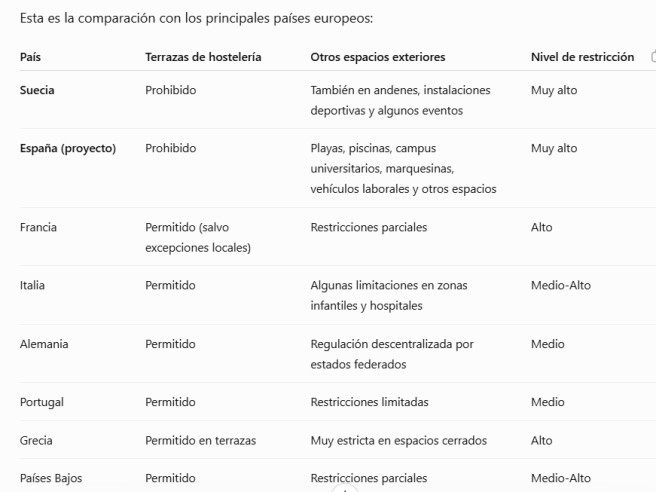
Looking at Europe
All sectors consulted by DEMÓCRATA start from the same premise: the protection of public health and the fight against smoking deserve the utmost respect and any reform of the Anti-Tobacco Law must be addressed with responsibility, common sense, and moderation. No one questions the health objective of the initiative. What they ask is that, during its parliamentary processing, its possible economic, social, and territorial consequences be rigorously evaluated, avoiding decisions that may produce unwanted effects.
Precisely for this reason, several of the consulted organizations find it striking that the Ministry of Health has decided to promote this reform when the European Union itself is immersed in the review of the Tobacco Products Directive. In their opinion, getting ahead with a particularly restrictive regulation could force Spain to review its legislation again once the community process concludes, when it might have been more reasonable to wait for the outcome of the European debate.
The sectors also recall that the draft bill has raised objections since the beginning of its processing. The National Commission of Markets and Competition (CNMC), for example, recommended reviewing some aspects of the proposal considering the proportionality of certain measures debatable and warning that some restrictions could translate, in practice, into a de facto prohibition. This was joined by the observations made by several member states during the European TRIS procedure, which already forced a delay in part of the processing of the regulatory development.
All of this anticipates a parliamentary journey that is not expected to be straightforward. The Government will need to gather a sufficient majority to push forward a reform that, although it is born with an unequivocally health-related purpose, has opened a debate that transcends public health and also reaches the economy, tourism, employment, transport, and the rural environment.