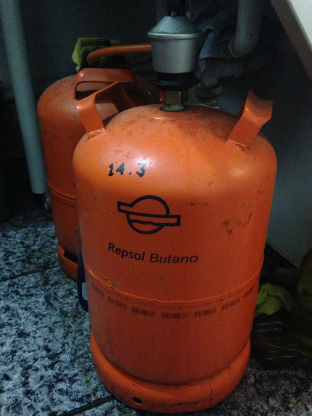

The maximum retail selling price of the butane canister will register as of this Tuesday an increase of 3.49%, reaching 19.55 euros, the limit set by the Government within the package of measures designed to mitigate the impact of the conflict in the Middle East, according to a resolution published in the Official State Gazette (BOE).
This new update takes into account, according to sources from the Ministry for Ecological Transition and the Demographic Challenge, the sharp jump in the prices of raw materials (+47.89%), the increase in the cost of freight (+7.87%), and the depreciation of the euro against the dollar (-1.29%).
In addition, what is established in Royal Decree-Law 25/26 is applied, which set at 19.55 euros the maximum price before taxes for canisters of 12.5 kilograms. This rule also provides that the difference between the resulting theoretical maximum price from the formula and the maximum retail selling price (PVP) set is accumulated in order to be recovered in future revisions.
The maximum PVP of packaged liquefied petroleum gas (LPG) in containers of between 8 and 20 kilograms (the traditional butane canister) continues to be regulated. Its amount is revised every two months, on the third Tuesday, by Resolution of the Directorate General for Energy Policy and Mines, following the formula included in Order IET/389/2015.
This bi-monthly review is determined based on the cost of the raw material (propane and butane) in international markets, the cost of freight (transport), and the evolution of the euro-dollar exchange rate, along with other factors such as commercialization costs or the contribution to the National Fund for Energy Efficiency.
Likewise, the change in price, whether up or down, is capped at a maximum of 5% per review, so that any additional deviation is accumulated for application in subsequent updates.
Packaged liquefied petroleum gas (LPG) is a mixture of hydrocarbons, mainly butane, which is used as an alternative to natural gas for energy uses through pressure containers, especially in towns or urban areas that do not have a connection to the natural gas network.
In 2025, 57 million LPG containers of different sizes were consumed. It is a fuel in decline, since since 2021 total consumption of packaged LPG has fallen by more than 12%.