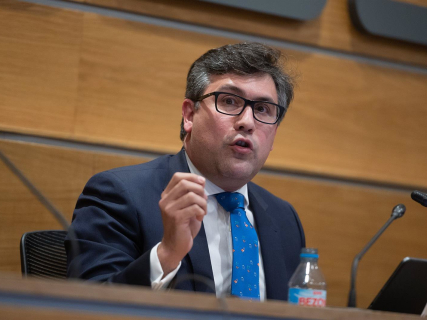

The National Confederation of Construction (CNC) has claimed this Friday that the maintenance and preservation of infrastructure should have a “permanent” place on the agenda of public officials, and not only after railway accidents such as those in Adamuz and Urda. At the same time, it has warned about the excessive use of their own resources by administrations and has urged reviewing the prices of contracts and favoring the best offer, rather than the cheapest.
Its president, Pedro Fernández Alén, has underscored the urgency of having up-to-date General State Budgets that include the real investment needs for infrastructure. In his view, these actions could be financed through public-private collaboration formulas, and he has warned that the contracting system must be improved so that the increases in investment promised in the parties’ election programs, ahead of the elections on 29 November, can be carried out on time and with guarantees.
Fernández Alén has proposed setting limits on the abusive use of 'in-house' contracting and on orders placed with the administrations’ own resources, since they can reduce “unjustifiably” the opportunities for participation of private companies, especially SMEs. Likewise, he has defended moving forward with the so-called European preference or 'Made in Europe', as the employers’ organization states in a communiqué.
He has also called for the implementation of mandatory mechanisms for reviewing prices and rebalancing the economic terms of contracts when “significant” variations in costs occur that alter the original terms of award. He has also argued for gradually moving on from a contracting model “based exclusively on price”, with the aim of recognizing the best overall proposal and not only the cheapest.
On the other hand, he referred to the negotiation between the European Parliament and the Council of the European Union of a new public procurement regulation that will replace the current legislation and will be binding on all member states. He has considered that this new framework is an opportunity to correct practices that distort competition and to raise the quality of public investments.
On this line, the president of the CNC points out that the European draft currently under discussion provides that quality, at minimum, accounts for 30% of the score of tenders, a percentage that rises to 50% in contracts with intensive use of labor.
"We have a unique opportunity ahead of us to drive changes that will enable better contracting and ensure that public investments translate into safer, more sustainable, and longer-lasting infrastructure," he said during his address at an event organized by Molins in collaboration with the Colegio de Ingenieros de Caminos, Canales y Puertos.