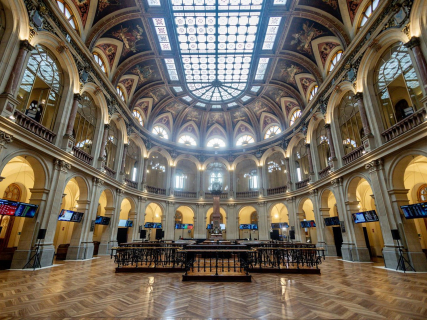

The Ibex 35 registered at midday this Friday a pullback of 1.37%, which caused the Spanish selective to give up the threshold of 17,700 points, on a day marked, again, by the escalation in oil prices.
In detail, at 12:00 noon the index stood at 17,640.8 points, while Brent, the benchmark in Europe, rallied more than 2.1%, to $107.32 per barrel.
At the same time, West Texas Intermediate (WTI), the benchmark in the United States (US), stood at around 97.61 "greenbacks" per barrel, with a rise of 1.85%.
The US decision to keep the Strait of Hormuz blocked, despite its aspirations to resume talks for a peace agreement with Iran, has driven up crude oil prices in recent days, leading Brent to close the week with a double-digit advance, close to 20%.
President Donald Trump reiterated this Thursday that the US retains control over the passage of Hormuz and that the strategic strait, through which approximately a quarter of the world's oil and gas passes, is "totally sealed". The White House tenant stressed that the US Army maintains "total control" over the Strait of Hormuz.
"No ship can enter or leave without the approval of the US Navy. It is 'completely sealed', until Iran is able to reach an agreement," he pointed out, insisting that the perimeter blockade exercised by Washington will remain in effect until Tehran accepts a pact with the United States.
The United States Army has also confirmed the deployment of a third aircraft carrier in the Middle East amid the fragile truce reached with Iran, which came into effect on April 8 after the offensive launched by the US and Israel in late February.World stocks take a breather
In this scenario, the chief investment officer of Julius Baer, Yves Bonzon, anticipates that "markets have opted to discount a temporary disruption in oil prices and the global economy".
Asian markets have shown mixed performance, although with declines during a large part of the session. The Japanese Nikkei has added 0.97%, while the Hong Kong Hang Seng index is up 0.24%. The South Korean Kospi has closed with a slight drop and the Chinese Stock Exchange Shenzhen index was down 0.35%.
On Wall Street, Dow Jones futures are currently pointing to a slightly lower opening, while the Nasdaq is leaning towards gains, after the drops of 0.3% and almost 0.6%, respectively, recorded on Thursday.
In the Spanish corporate sphere, Tubacex has communicated that it obtained a net profit of 1.3 million euros in the first quarter of the fiscal year, 84% less than in the same period of 2025, as a consequence of lower activity derived from the war in Iran and the imposition of steel tariffs by the US, "which have delayed and conditioned the purchase and investment decisions of Tubacex's clients in general".
On the other hand, TSK, the Asturian engineering company specializing in energy transition, digitalization, and critical mineral management, has announced its intention to debut on the Stock Exchange through a Public Subscription Offer (PSO) of new ordinary shares aimed at qualified investors, for an approximate amount of 150 million euros.
Likewise, Alfonso Gómez Palacio, until now president of Telefónica Hispanoamérica, will be appointed new CEO of Movistar+ replacing Daniel Domenjó, who will leave the company after reaching an agreement with the company.
On the international stage, Meta, the parent company of Facebook, WhatsApp, and Instagram, announced on Thursday that it will cut 10% of its workforce, about 8,000 employees, in order to improve its efficiency in a context of strong investments in artificial intelligence.
Within the Ibex 35, only three stocks were in the "green" at mid-session: Repsol (+0.48%), Naturgy (+0.29%), and Enagás (+0.18%). On the downside, Indra (-5.1%), Rovi (-3.95%), Arcelormittal (-3.54%), Bankinter (-2.50%), and Inditex (-2.43%) stood out.
The main European stock exchanges were also tinged with red at 12:00 p.m.: Paris's Cac 40 fell 1.12%; Milan's Mib, 0.95%; London's Ftse 100, 0.67%; and Frankfurt's Dax, 0.40%.
However, LBP AM strategist Xavier Chapard maintains that, despite the extension of the ceasefire in Iran, "the absence of new negotiations and the fact that the Strait of Hormuz continues to be blocked by both sides leave investors in a holding pattern."
In the foreign exchange market, the euro was appreciating against the dollar and was trading at 1.1687 "greenbacks". In sovereign debt, the yield on the Spanish 10-year bond was rising to 3.499%, which pushed the risk premium —the spread against the German 10-year bond— up to 46.79 basis points.