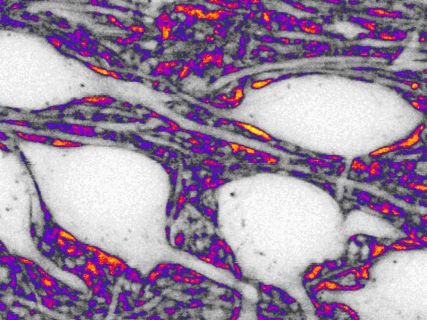

A recent work, published in the journal "Fluids and Barriers of the CNS", demonstrates that the space surrounding neurons actively participates in brain communication and does not act solely as a passive element, as was previously assumed.
The investigation, of an international nature and led by a scientist from the Spanish National Research Council (CSIC), concludes that the geometry and arrangement of the so-called extracellular space directly condition the transmission of chemical signals between neurons.
In neuronal communication, a neuron releases neurotransmitters that must travel through that space until they reach their target. Traditionally, it was considered that this environment was solely a transit channel. However, the work reveals that this space can facilitate or hinder the movement of neurotransmitters, thus modulating the speed and precision with which information exchange occurs.
The authors have verified that this effect varies according to the type of synapse, that is, the point of contact between neurons. In excitatory synapses, associated with the activation of neuronal activity and functions such as learning and memory, the configuration of the environment favors the rapid elimination of the neurotransmitter. In this way, interference with neighboring synapses is avoided, and it is guaranteed that each connection operates independently and precisely.
On the contrary, in inhibitory synapses, which contribute to slowing down and adjusting the activity of the nervous system, the environment promotes the lateral diffusion of the neurotransmitter. This phenomenon reinforces a background signal that helps sustain the balance of brain activity and prevents episodes of overexcitation.
The researchers point out that these results open new perspectives for understanding how the brain works and how factors such as aging, trauma, or different neurological pathologies can alter communication between neurons. Along these lines, the study insists on the need to conceive of the brain as a global system in which, in addition to neurons, the environment in which they communicate plays a key role.
To reach these conclusions, the team combined ultra-high-resolution microscopy techniques, capable of observing brain tissue at extremely small scales, with computational models that reproduce the movement of molecules in a real brain.
"The results show that the space between neurons is not just a gap, but an active part of the system," explained Jan Tonnesen, a CSIC researcher at the Biofisika Institute (IBF-CSIC-UPF) and leader of the study. For her part, researcher Laura Giménez, co-author of the research, adds that "the very structure of the brain contributes to signals being transmitted more efficiently."