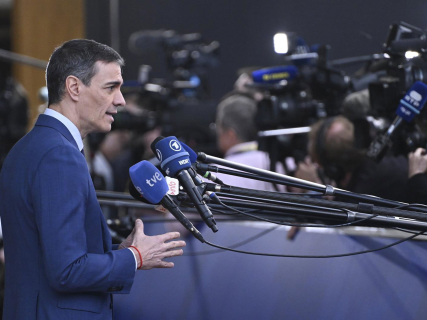

Pedro Sánchez has responded this Friday to the information about an internal Pentagon email that outlines possible measures against Spain for its position on the Iran war, including the country's suspension from NATO. The President of the Government has avoided raising the tone and has placed the Spanish position in the realm of official documents, not leaks or internal communications.
Upon his arrival at the informal meeting of European Union leaders in Cyprus, Sánchez has defended that the Spanish Government maintains a clear position regarding its international alliances, but also regarding the legal framework in which military operations must be developed.
Sánchez: "We do not work on emails"
“We do not work on emails, we work on official documents and positions taken in this case by the United States Government,” stated the President of the Government when asked about information regarding an internal Pentagon email.
With that answer, Sánchez has tried to reduce the immediate dimension of the controversy and prevent an internal communication attributed to the US Department of Defense from becoming a formal diplomatic crisis before there is an official position from Washington.
The phrase marks the axis of the Executive's reaction: Spain does not officially acknowledge being affected by a leak, but it does not renounce defending its political and legal position on the Iran war.
“Absolute collaboration” with allies, but within international legality
The president has insisted that the Spanish position does not imply a break with NATO or with allies. “The position of the Government of Spain is clear: absolute collaboration with the allies, but always within the framework of international legality,” Sánchez has defended.
That nuance is the political core of the message. Spain maintains its commitment to the Atlantic Alliance, but rejects that this commitment implies facilitating military operations that the Government considers outside the framework of international legality.
The response comes after Reuters reported on an internal Pentagon email in which formulas are studied to punish allied countries that would not have given sufficient support to United States operations in the war against Iran.
Spain, singled out by bases and airspace
Washington's unease centers on the refusal of some allies to grant access to military bases, parking permits, and overflight rights for operations linked to the Iranian conflict. In the Spanish case, the focus is on the bases of Rota and Morón, as well as the use of airspace.
According to the information published, the internal Pentagon email mentions the possibility of suspending Spain from NATO or removing countries considered "difficult" from relevant positions within the Alliance's structure.
The proposal would have, in any case, an enormous symbolic weight and uncertain legal viability. The North Atlantic Treaty does not include an ordinary mechanism for expelling or suspending a member State. It does contemplate, in its article 13, that a country may voluntarily leave the Alliance.
A high-voltage political crisis between Spain and the United States
Sánchez's reaction seeks to contain a crisis that threatens to become one of the most delicate clashes between Spain and the United States in recent years. The Spanish government is trying to separate strategic collaboration with NATO from participation in a war that it considers contrary to international legality.
The Trump Administration, for its part, is pressuring European allies to assume a more active role in the campaign against Iran and in the reopening of the Strait of Hormuz. That pressure has opened a rift within NATO and has placed Spain at the center of the debate.
Sánchez's message is prudent, but firm: Spain does not break with its allies, but it also does not accept that Atlantic loyalty obliges it to support any US military operation.