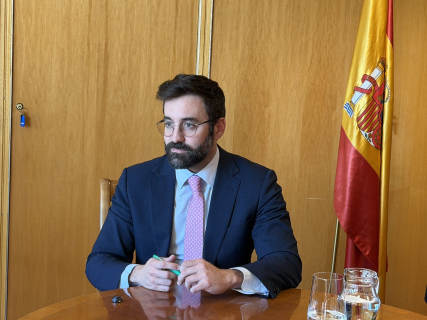

In just a few days, the first anniversary of the blackout will be reached, the energy zero that disconnected Spain and Portugal from the rest of the continent. And if that once called into question the energy model developed by the Government, the situation is very different a year later. Joan Groizard (Palma, 1989) receives Demócrata with energy markets in a schizophrenic state, reacting to every piece of news brought by the Iran war. And renewables, far from being a problem, are the consumer's lifeline to avoid the skyrocketing prices of oil and gas.
In its plan to respond to the consequences of the war, the Ministry for the Energy Transition took the opportunity to include an important package of structural reforms around electrification, grid connections, and the promotion of renewable projects. The Ministry is now preparing the corresponding regulatory developments. And, as if that were not enough, the Government is legitimized by the reports analyzing the causes of the blackout. Renewables, far from being a problem, are the solution, it maintains.
ENERGY CRISIS
Question: The war in Iran is leading the world to a new energy crisis, with a special impact on oil and gas. Four years ago, after the Russian invasion of Ukraine, the application of the gas cap was key, the so-called Iberian exception to decouple the rise in gas from the price of electricity. Can its application now be ruled out?
Answer: The Iberian exception allowed us to avoid the contagion of the skyrocketing price of natural gas on the electricity market. In this crisis, the new Iberian exception is structural and permanent, and it is all that we have advanced in renewables since 2022. The electricity bill in Spain is holding up and a price increase derived from the crisis is not being seen.
We are prepared for any eventuality and to adopt measures as soon as we see the evolution of the crisis change. For the moment, we see that it is limited to the prices of fuels and gas, and in the case of Spain, that price contamination has not reached the electricity market.
Q: Spain, along with other countries, proposed a temporary tax applied to large energy operators. Have you spoken with the operators to define what the figure might look like, or are you waiting for the European debate?
A: The proposal signed by the first vice president, Carlos Cuerpo, along with his counterparts from other countries, defends an equitable distribution of the effort in the crisis and that it does not fall solely on public coffers. If there are windfall profits, that part of that profit be socialized.
"An energy tax makes sense if it is at the European level"
This requires analyzing the different energy markets very closely. In the electricity system today, there are no windfall profits. We have strengthened the CNMC's capabilities to analyze the hydrocarbon sector. It is a measure under analysis and, in any case, a figure of this type makes sense if it is at the European level to avoid distortions in the internal market.
Q: What does the CNMC convey to you regarding the evolution of prices and margins in the hydrocarbon sector?
R: Logically, there has been an increase in fuel prices and we have also seen a slight decrease after the announcement of the truce, at the same time as the price of a barrel of Brent has fallen. They remain very high.
For the moment, no complaint has been received, nor has an abuse or an absolutely abnormal situation been detected. The CNMC analyzes a lot of data and very specific variations. We will be attentive.
"We have not received any complaints nor have we detected any abuse in the supervision of fuel prices"
Q: One of the elements to monitor is not only the price, but also business margins, and the reform contemplates, exceptionally, the possibility of intervening in prices. Is this ruled out at this time?
A: In addition to reinforcing supervision, the possibility of establishing extraordinary measures linked to the evolution of margins was introduced. We can encounter cases where margins fall because someone tries to gain market share, and that is not necessarily good for competition because it expels smaller operators. The objective, of course, is that no one gets unfairly rich due to an unforeseen situation like this.
NETWORK PLANNING
Q: In recent years, there has been a lot of concern about the lack of capacity in the electricity grid and the need for investment. Why does the Government consider it more of an administrative problem than a grid capacity problem?
A: The photo of Spain's electricity grids is a symptom of the success story of renewables in Spain. Competitive prices attract new demand such as data centers, renewable hydrogen projects, or new industries. The appetite is voracious.
"Since 2020, 40 GW in connection permits have been granted, it's as if we were to multiply the country by two overnight"
Since approximately 2020, 40 GW in grid connection permits have been granted. It is the historical peak of Spain's electricity demand. It is as if we multiplied Spain by two overnight. And the economy is doing very well, but not all activity has been multiplied by two. The vast majority of those 40 GW are not being used today.
Q: What proportion more or less is used?
R: Very small, below 5%. There may be projects that require maturation time, but there are cases that can respond to speculative behaviors. If we have to electrify to get out of gas and oil, the only way is for there to be sufficient capacity on the grid.
Q: We need to make room.
A: We need to make room for projects that are either starting to consume or, if they are not going to, should make way for the next one. That is why we have approved a capacity reservation benefit, which advances payment for reserving capacity that is not being used. Furthermore, we must specify exactly for what activity it is requested, thus avoiding the resale of the permit for a different use.
We also set up life tests, milestones to check at twelve months, three years, and four years that the projects are still advancing. If they do not meet them, the milestones lose their capacity and become available for another. A final issue is that access is no longer on a first-come, first-served basis, and priorities are set: housing, public services, and increases in existing industrial capacity.
"Investment in networks is essential but capacity that is unfairly monopolized must be freed up"
In parallel, we propose an investment of more than 13 billion to continue advancing in the planning of the electrical grid. And in this latest decree-law we have incorporated measures to streamline the processing and the possibility of adapting that planning. Investment in the grids is essential, but capacity that is inadequately or unfairly monopolized must be released while others do have the possibility to consume in the short term.
Q: Is there any estimate of how much capacity is expected to be released by being detected as potentially speculative?
A: We are waiting to see it. Of those 40 GW, only half had taken some step demonstrating that the project is still alive. Another important issue is that we have opened a three-month period, a kind of amnesty, to renounce permits without losing the guarantees provided.
SOCIAL RETURN OF Renewables
Q: The Ministry for Ecological Transition is preparing a new decree to ensure a social return from renewable plants. What aid or support mechanisms do they propose?
A: To speed up the processing of renewables, projects have to be done better. Part of the delay is due to not having worked well with the territory before or because the spaces are not adequate. We are slightly expanding the public participation processes and obliging the developer to notify the town hall and the landowners where they want to install themselves.
Regarding the economic return, in Denmark it is common for neighbors to participate in its financing and for part of this return to remain in the territory. There are also simple but potentially important issues, such as offering language classes in municipalities further from the capital, or other services that are not available. Or issues such as territorial excellence criteria when identifying locations, or subsidized electricity prices, or facilitating self-consumption facilities.
We haven't invented anything. There are municipalities in Spain that have already done these things. We are trying to make what is exceptional today the norm. We are going to process the best projects first.
SELF-CONSUMPTION AND ENERGY COMMUNITIES
Q: The Government has committed to regulatory development on self-consumption and energy communities. What measures are being studied to promote it?
A: We have already incorporated an increase in the action radius, which allows for an interesting model for electrifying industrial estates and their decarbonization. From the ceramic sector, they tell us that they see it as possible to replace gas with electricity if it is at a competitive price. What is more competitive than self-consumption with a small renewable park nearby? It is a direct signal for electrification.
"There are industries that see it as possible to substitute gas for electricity if the price is competitive. What is more competitive than self-consumption?"
In the case of energy communities, the commitment is to approve a new decree that allows priority access to auctions supporting renewable energies, to electricity grids, or to participate in different support schemes. The idea is that an energy community, that is, a neighborhood, a town, or an energy cooperative can compete on equal terms, or have more facilities in a sector dominated by companies with very high economic capacity.
Q: One of the concerns regarding self-consumption is the role of distribution companies in its installation. Has the Ministry received that concern?
A: The distribution was accustomed to very few generators, many of them not even connected to the distribution grid. We know that it has been a technical, operational, and internal standardization issue. We had received concerns about delays in the activation of collective self-consumption facilities, and we know that it is being accelerated. At the time, we approved maximum fixed deadlines and clarified the documents to be submitted by the promoter. Also a penalty for the distributor if it did not enable the installation within a certain period. That signal has allowed these processes to be streamlined, although there is still room for improvement.
STORAGE
Q: Do you see it possible to meet the storage objectives? What regulatory changes are you proposing?
A: We have a target of 22 GW of storage in 2030, which includes both new hydroelectric pumping and the deployment of electrochemical batteries.
Q: A little cheaper than years ago.
A: The price has dropped a lot and that allows its deployment. We are seeing batteries integrated into renewable parks, last year we streamlined their installation on the perimeter of already existing parks. We are also facilitating their connection to the grid. It is going to be an exponential change and we are seeing a lot of interest from all kinds of agents to participate in the deployment of storage.
Q: Is there any forecast of approving aid or incentives along the lines of support for domestic consumption, such as there is for photovoltaic panels? I don't know if the sensitivity regarding issues like self-consumption has yet reached storage.
A: It is starting. We are now processing a much broader reform of self-consumption and one of the issues we are incorporating is the regulation of distributed storage. It is about transferring to batteries the same regulation or similar ideas to those that were applied at the time to self-consumption. How to simplify the regulations as much as possible to take advantage of energy during the cheapest hours. Alongside this, the IDAE is providing aid for storage together with connective self-consumption in neighborhood communities or energy communities. A new photovoltaic panel, in general, must be linked to storage to make better use of that energy.
BLACKOUT 28-A: CAUSES AND CONSEQUENCES
Q: The Government insists that renewable energies are not at the origin of the blackout. What is your assessment of the audios from technical operators of generation plants and Red Eléctrica that attribute the voltage instability to the massive influx of photovoltaic energy?
A: Maximum respect and admiration for the operators of Red Eléctrica and any generation company. If they took our private conversations in a context of trust and out of context, surely many of them would leave us in a compromising situation. We will have to ask ourselves who leaked these conversations and with what intention. It's a few seconds out of more than 8,000 calls and 1,200 emails, it's a very partial snapshot.
"One will have to ask who is leaking the conversations about the blackout and with what intention. They are a very partial snapshot"
All that information has been part of the analysis that the different reports have made, including the panel of experts at the European level, which reached the conclusion that it was not the renewable mix. We have had similar or even higher renewable generation before and after the day of the blackout.
The panel of experts concludes that the system failed in a way that was not foreseen to be able to fail, with which the protocols on how it is addressed are not developed. If you are seeing on the fly a behavior of a matter that has not been analyzed in detail, perhaps you attribute to other matters what you are seeing and which could later be analyzed more calmly. But, I insist, the analysis that we understand makes sense is the one that has had the information to reach those conclusions.
Q: Do you think the audios or the blackout itself have been used to defend, for example, the continuity of the blackout or to question the entry of renewables?
A: An event with these characteristics can be very tempting. As an engineer, I find it very difficult to understand that on the same 28th or 29th (of April) there were those who were very clear about what the solution was and what the problem was. And curiously, they were the same recipes they defended the day before the blackout. I believe that something so serious and so grave requires a more measured analysis, without prejudice to the fact that everything can be discussed. It is one thing to defend which energy model you prefer and another thing to try to muddy issues that should remain in the technical sphere.
Q: The Government concluded that there were generators that had been disconnected before reaching the required thresholds, which implies a breach of regulations. The CNMC did not determine responsibilities in its report. What do you expect from this?
A: The most urgent thing was to try to identify at a technical level what had happened and provide a response. It was not appropriate to identify those responsible or breaches, which will be determined after a due process. That is the work that the CNMC is currently doing to identify which specific regulation of the electricity sector each installation, each operator has breached, and depending on the breach, it will be the CNMC or the Government that will be responsible for sanctioning. A sanction can be economic or, in an extreme case, lead to disqualification.
"The reinforced operation is a message to further accelerate the energy transition, not to call it into question"
Q: One of the consequences of the blackout is reinforced operation, a change in strategy when planning the daily energy mix by Red Eléctrica. What is the forecast for maintaining it?
A: Red Eléctrica carries out system operation in real time, decisions are made practically every minute based on needs and available resources. One of the issues it has raised is dynamic voltage control. It is a service to the electrical system that was in doubt on the day of the blackout and that conventional power plants, such as natural gas ones, had to provide.
There is an element of reliability. The operator has publicly stated that if these plants do not provide what he expects from them, he cannot be trusted and needs to schedule more voltage control capabilities. Renewable energies have had the technical capacity to provide this control since 2021, but the regulations did not contemplate it until a few months ago, when the CNMC updated the procedure. Since then, we have more than 75 renewable installations that are already providing dynamic voltage control
As more resources enter, the operator will have more resources and alternatives to not depend on a more expensive and inconvenient alternative, such as combined cycle. It is a purely dynamic issue. What is valid for one day or one hour has nothing to do with the next, depending on changes in consumption and generation, or on whether there are oscillations in the system.
Q: What impact does it have on the price of electricity?
R: Red Eléctrica puts the impact on the bill at around 4%, some analysts quantify it at a bit more. It is true that system management is more complex and can be more expensive in that specific section of the bill, but the final balance, what the consumer pays on the bill, is not increasing. With this reinforced system, the bill has been lower than in the first three months of 2025, before the blackout. And it can be even cheaper if we expel gas from the service, just as we have expelled it from the wholesale market. It is a message to accelerate the energy transition even more, not to call it into question.
EXTENSION OF NUCLEAR POWER PLANTS
Q: The Nuclear Safety Council (CSN) has a pending report to approve regarding the continuity of the Almaraz power plant. Will the Government facilitate its extension if it endorses its continuity?
A: The government's country bet is very clear: bet on what Spain has the best chance of winning, which is renewables. That said, if the owners of the nuclear power plants want to propose an extension of a deadline they themselves agreed to, there are three clear conditions: that it costs consumers nothing, nuclear safety, and security of supply.
"If companies want to extend nuclear life there are three conditions: that it does not cost the consumer, nuclear safety and security of supply"
There can be no selective tax cuts or a guaranteed price. The expansion of nuclear power cannot be paid for by all consumers and taxpayers.
Indeed, the CSN is analyzing that file and we do not want to make any statement that could be interpreted as interference in a job that we understand must be very technical. We do not want to anticipate events.
SOCIAL BONUS
Q: The Government advanced in a recent strategy a change in the beneficiary regime to limit its concession to truly vulnerable households. Now any large family can enjoy it, regardless of their income. Is it going to be changed in the short term?
A: The philosophy of the new energy poverty strategy is the same: that whoever needs the social bonus can access it. This means assisting vulnerable households that have difficulty making ends meet, administrative simplifications, reinforcing coverage in certain cases, and also that those who do not have that need release that resource to expand coverage to those who really need it.
The protection of large families is not exclusive to the social bonus, there are other types of benefits. Nor do I want the perception to be generated that a large family is equivalent to a high-income family. The approach is that those families that have a very high income and really do not have a need, do not have access. We want this reform to be agreed upon and worked on with the representation of large families. We will establish dialogue with them to make a proposal as soon as possible. In the coming months, we will be undertaking these improvements.
In DETAIL
The interview takes place in an office of the brutalist ministerial complex that brings together the departments of Economy and Industry. The Secretary of State for Energy does not belong to either of them, but to that of Ecological Transition, several numbers down Paseo de la Castellana in Madrid (a confusion that costs the interviewer part of the advance notice he had).
Such are the inheritances of Energy as part of these ministries in previous governments. That ended in 2018, when Teresa Ribera took the reins of a newly created ministry to promote the environmental and energy agenda of Pedro Sánchez's first government.
That year, at less than thirty years old, Joan Groizard was appointed director of Renewable Energies and Energy Market at the Institute for Diversification and Energy Saving (IDAE). He arrived in Madrid after coordinating the Climate Change Law of Francina Armengol's Government in the Balearic Islands. He was promoted to director general a year later.
As Secretary of State, he took over from the current third vice-president, Sara Aagesen, after Ribera's departure to the European Commission. His profile matches many of the replacements taking office in the economic wing of the Government.
Young, technically trained, didactic and approachable discourse. Exquisitely polite and formal. Capable of making his way without overwhelming in a minefield of technicalities like energy policy.
His communications director grants 45 minutes for the interview. The schedule is tight and there is no time for anything other than the interview.