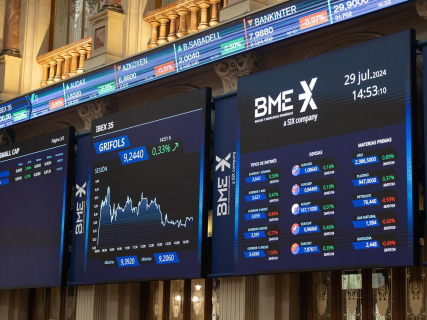

The Ibex 35 has closed the session this Wednesday with a drop of 1.59%, down to 19,412.70 points, and has moved away from the historical highs it had approached during the previous days.
The Spanish selective index has been conditioned by an intense wave of corporate results and by the return of geopolitical tensions in the Middle East, which have caused a new rise in oil prices.
The day has been marked by the quarterly accounts of CaixaBank, Telefónica, Redeia, Aena, and Endesa, to which have been added, outside the Ibex, the presentations of HBX, Azkoyen, and Deoleo. The results calendar concentrates a good part of the corporate references of the Spanish market during these days.
CaixaBank leads the declines of the Ibex
CaixaBank has been the most punished stock of the session, with a decrease of 7.12%, after presenting its results. The movement of the entity has had a particularly significant impact on the overall index due to its high capitalization and its weight within the Spanish financial sector.
Also closing with significant losses were Unicaja, which has dropped 3.99%; Acerinox, with a decrease of 3.88%; Solaria, which has lost 3.11%; and Banco Sabadell, which has retreated 3.06%.
The behavior of CaixaBank and Sabadell has increased the pressure on a banking sector that has a high presence within the Ibex and in the portfolios of many individual investors.
For the small shareholder, CaixaBank's reaction shows that it is not enough to know the profit obtained by a company. The market also compares the figures with analysts' forecasts and examines the evolution of revenues, margins, provisions, capital, shareholder remuneration, and the outlook offered by management.
Repsol benefits from the rise in oil
On the positive side, Repsol has led the increases with a rise of 3.91%, coinciding with a sharp increase in crude oil prices due to the escalation of tension in the Middle East.
The barrel of Brent, a reference in Europe, rose 7.09%, up to 90.05 dollars, while the West Texas Intermediate rose 6.69%, up to 84.56 dollars.
The escalation between the United States and Iran has returned to the market the fear of possible supply interruptions and new difficulties for energy transportation in the region. The increase in oil prices may benefit producing companies like Repsol, but it also raises costs for numerous companies and rekindles concerns about inflation.
After Repsol, the largest gains in the Ibex have corresponded to Grifols, which has risen by 3.67%; Endesa, with 3.30%; Acciona Energía, with 3.13%; and Acciona, with 2.19%.
Telefónica, Endesa, and Aena present results
The session has also been marked by the accounts of several of the most well-known companies and those most participated in by retail shareholders.
Telefónica has presented its results at a time when investors are particularly watching cash generation, debt, and the evolution of its main markets. In the case of Endesa, the market has responded with a rise of 3.30%, placing it among the best values of the day.
Aena and Redeia have also reported to the market. In these companies, the small shareholder must observe not only the evolution of profit but also the planned investments, indebtedness, and the ability to maintain its dividend policy.
The immediate stock market reaction to results can be very intense, but it does not always provide a complete assessment of a company's situation on its own. A stock may fall despite increasing its profits when the figures are below expectations or future forecasts disappoint.
The Federal Reserve now focuses attention
Outside of Spain, the main reference of the day will come from the United States. The Federal Reserve will announce its decision on interest rates this Wednesday, in a context marked by rising oil prices and the risk that geopolitical tensions will again drive inflation.
Investors are also awaiting the results of Microsoft and Meta, two of the largest American technology companies. Their accounts will be examined to see if the growth of their businesses and the revenues related to artificial intelligence justify the high volume of investment made during the last quarters.
Wall Street was registering significant declines during the European session. The Dow Jones fell by 1.66%, the S&P 500 lost 0.86%, and the Nasdaq 100, especially exposed to large tech companies, dropped by 1.37%.
The European stock markets close in negative
Most European markets also ended the day with declines, although less intense than that recorded by the Ibex.
The French Cac 40 has given up 0.60%; the Italian FTSE MIB, 0.49%; and the Euro Stoxx 50, 0.65%. The German Dax ended practically flat, with a decline of 0.01%.
The exception has been the British stock market, which has advanced by 0.34%. London's better performance may be related to its greater exposure to oil companies, benefited by the strong rebound in crude oil.