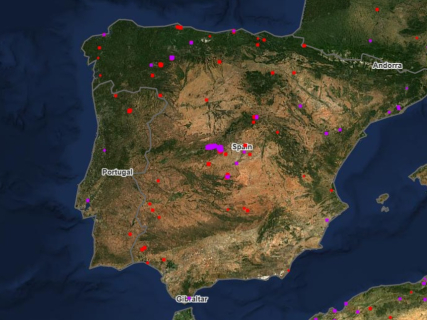
Map of active fires in Spain: where the fires are and how they evolve

The map of active fires in Spain allows locating the main fires and following their evolution through official data and satellite observations. Madrid, Ávila, and Guadalajara concentrate this Friday, July 24, some of the most serious fires.

2 minutes

WhatsApp Image 2026 07 24 at 09.48.32

WhatsApp Image 2026 07 24 at 09.48.32

Add DEMÓCRATA to Google

Ask FREN

Published

Last updated

2 minutes

Most read

The most serious situation is concentrated this Friday, July 24, in the Community of Madrid and the province of Ávila, where the Government has declared a national interest emergency. In parallel, the firefighting teams continue to work on the large fire in La Mierla, in Guadalajara.

Official map of active fires from Copernicus

The European Forest Fire Information System, EFFIS offers the most comprehensive public viewer to locate fires and burned areas in Spain and the rest of Europe.


The most serious active fires this July 24

The national interest emergency affects several simultaneous fires in Madrid and Ávila. The declaration places the State Administration at the forefront of the emergency and allows for the coordination of state, regional, and local resources.

Villa del Prado and Aldea del Fresno

Two fires are affecting the surroundings of Villa del Prado, one of them originating in Almorox, in the province of Toledo. The fire has forced the evacuation of several areas and keeps firefighters, forest agents, and members of the Military Emergency Unit mobilized.

San Martín de Valdeiglesias and Pelayos de la Presa

The fire in San Martín de Valdeiglesias began on Thursday, July 23, next to kilometer 57 of the M-501. Early on Friday, it was still not contained or controlled, according to the official information from the Community of Madrid.

The fire also affects Pelayos de la Presa. Authorities have requested to avoid travel and have sent ES-Alert notices to the residents of the San Ramón and Jaracruz urbanizations.

Burgohondo and El Tiemblo, in Ávila

The fire declared in the surroundings of Burgohondo has caused evacuations and preventive confinements in several areas of the province of Ávila, including areas of El Tiemblo. This fire is part of the national emergency declared by the Ministry of the Interior.

La Mierla, in Guadalajara

The fire in La Mierla continues to be another major focus of concern. The flames have affected numerous municipalities in Guadalajara and have forced evacuations and road closures in recent days.

How to check if there is a fire nearby 

To know the specific situation of a municipality, these sources should be used:

  • EFFIS-Copernicus: satellite location, perimeters, and heat points.
  • Civil Protection: emergencies and state deployment.
  • DGT: closed or affected roads.
  • AEMET: daily fire risk level.
  • Autonomous services of 112: official status of each fire, evacuations, and confinements.

What active, stabilized, and controlled fire mean

An active fire continues to spread and its advance has not yet been stopped. Being stabilized means that it evolves within the planned control lines, although it can still reactivate.

The consideration of controlled comes when the entire perimeter is surrounded by control lines and it is no longer expected that the fire will spread. It is only declared extinguished when there are no materials burning or possibilities of reproduction.
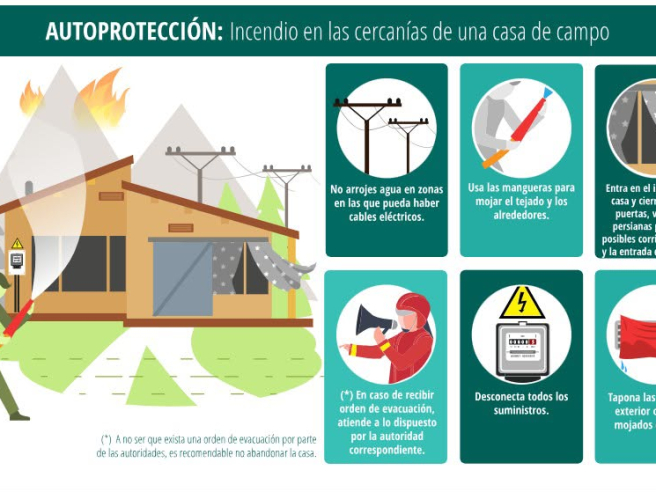
Advice in case of emergency. | Moncloa
Advice in case of emergency | Moncloa 

What to do if the fire is near

Authorities recommend avoiding any movement towards the affected areas and only following the indications of 112. If smoke approaches a home, doors and windows should be closed and air conditioning units that bring in outside air should be turned off.

In the event of an evacuation order, it is advisable to prepare documentation, medication, and basic items. In case of immediate danger, one should call 112 and move away in the opposite direction of the smoke and wind.

More key points, information and questions with FREN

AI-GENERATED CONTENT

What legal requirements must be met for the Government to declare a national interest emergency due to a fire in Spain?

In Spain, the declaration of a national interest emergency due to a fire (forest or large-scale urban/industrial) is not regulated by a special fire regime, but by the general civil protection regulations. The basic framework is the Law 17/2015, of the National Civil Protection System, developed by the Basic Civil Protection Standard and the General State Emergency Plan (PLEGEM), approved by the Resolution of December 16, 2020. From this regulation, material criteria (what type of fire can be considered of national interest) and formal requirements (who declares it and with what effects) can be clearly distinguished.

Material criteria: when a fire can be considered “of national interest”

Law 17/2015 defines what is considered a national interest emergency, a category that applies to any risk, including large-scale fires. National interest emergencies are:

  • Application of Organic Law 4/1981: when it is necessary to apply the law on states of alarm, exception, or siege to protect people and property. This would imply a fire with absolutely extraordinary consequences.
  • Affecting several autonomous communities: emergencies where coordination of various administrations must be foreseen because they affect several autonomous communities and require a contribution of resources at a supra-autonomous level. In the case of fires, this would be a scenario where the fire spreads or can spread to more than one community, or requires intense and combined use of means from various administrations.
  • Dimensions requiring national direction: those which, due to their actual or foreseeable dimensions, require a national-level direction. This would include large fires that, even if concentrated in a single community, clearly exceed the autonomous and local capacity, forcing the mobilization of extraordinary State means and coordination of numerous resources from different administrations.

The PLEGEM specifies that, in the phase of national interest emergency, the situation “requires national direction and the mobilization of extraordinary means and resources from all Public Administrations, including those mobilizable by the State Administration through the European Civil Protection Mechanism or other countries” (according to the Resolution of December 16, 2020).

Formal requirements: competent body and procedure

Law 17/2015 establishes that the declaration of national interest emergency corresponds to the head of the Ministry of the Interior. Specifically:

  • The declaration can be made on the Minister of the Interior’s own initiative.
  • It can also be agreed at the request of the affected autonomous communities or the Government delegates in them.
  • When the initiative comes from the Ministry of the Interior itself, a prior communication with the affected community or communities is required in any case, using means that do not harm the speed of the declaration or the effectiveness of the response.

Furthermore, Law 17/2015 itself includes among the Minister of the Interior’s powers the ability to “declare the national interest emergency and its termination”, as well as to assume the functions of direction and coordination in that situation. The Government, as such, retains other related powers (for example, declaring a zone seriously affected by a civil protection emergency), but the strict decision on the national interest of the emergency is ministerial.

Legal effects of the declaration

Once the national interest emergency is declared, Law 17/2015 foresees very significant consequences:

  • The Minister of the Interior assumes direction of the emergency, which includes the ordering and coordination of actions and the management of all state, autonomous, and local resources in the affected territorial area.
  • He can require the collaboration of other administrations that have mobilizable resources, even if the emergency does not directly affect their territory.
  • In the case of a national interest emergency, the Military Emergency Unit (UME) assumes operational direction, acting under the direction of the Minister of the Interior.
  • The PLEGEM establishes that direction in this phase corresponds to the head of the Ministry of the Interior, who assumes the management and mobilization of the means and resources of the National Civil Protection System, and that the end of the national interest emergency is agreed when the circumstances that motivated its declaration cease.

In summary, for the Government (through the Ministry of the Interior) to declare a national interest emergency due to a fire, the material assumptions of Law 17/2015 (dimension, territorial affectation, or need for national direction) must concur and the formal procedure must be followed: proposal from the Ministry itself or from autonomous communities/government delegates, prior communication with the affected communities, and assumption, after the declaration, of the comprehensive state direction of the emergency and coordination of all involved resources.

How does a large autonomous community fire practically differ from one declared a national interest emergency? What specific role do autonomous communities have when the Ministry of the Interior assumes direction due to a national interest emergency? What mechanisms does Law 17/2015 provide to financially assist areas affected by a fire declared of national interest?

What are the specific competencies of the Ministry of the Interior in managing emergencies caused by forest fires?

The Ministry of the Interior, through the National Civil Protection System, has the key competence to coordinate and, where appropriate, direct the State's joint response to emergencies caused by forest fires when they severely affect people and property or reach the category of national interest emergency. Autonomous communities retain ordinary competence for prevention and extinction, but the Ministry of the Interior articulates basic planning, inter-administrative coordination, mobilization of extraordinary state means (including the UME), and relations with the European Union. All this is mainly regulated in Law 17/2015 of the National Civil Protection System, the Basic Civil Protection Standard, the State Plan for Emergencies due to Forest Fires, the Forestry Law amended in 2015, and the Royal Decree-law 15/2022.

1. General framework of competencies

Law 17/2015 configures civil protection as a public service integrated into state public security (art. 149.1.29.ª CE) and establishes a National Civil Protection System in which:

  • Interior ensures general coordination, defines strategies, and manages the National Information Network and the National Center for Monitoring and Coordination of Civil Protection Emergencies.
  • Autonomous communities exercise their competencies in prevention, planning, and ordinary emergency management.
  • Local entities deploy prevention and extinction services within their scope.

The Basic Standard develops this scheme, setting the risk catalog, types of plans, and operating principles (single emergency direction, coordination, and orderly succession of operational phases).

2. Specific competencies of the Ministry of the Interior

2.1. Planning and strategic framework
  • Proposal and submission to the Council of Ministers of the State Civil Protection Plan for Emergencies due to Forest Fires, approved in 2014 at the proposal of the Minister of the Interior, according to the Resolution of October 31, 2014.
  • Promotion of general state planning (PLEGEM) and the National Civil Protection Strategy (published by ministerial order and linked to Law 17/2015).
  • Definition, in the Basic Standard, of the minimum contents and common scheme of civil protection plans that other administrations must prepare.
2.2. Coordination and national interest emergencies

Law 17/2015 and the State special plan for forest fires establish that Interior:

  • Declares and directs national interest emergencies, assuming coordination of all administrations when the severity of the fire requires it.
  • Activates the structure of the State Plan to “foresee the organizational structure that allows the direction and coordination of all Public Administrations” in these situations and “foresee mechanisms and procedures to coordinate the contribution of means and resources” when those of the autonomous communities are insufficient or they request it (basic functions of the Plan included in the 2014 Resolution).
  • Operates the State Coordination Committee (CECO) and the integrated operational coordination centers (CECOPI) where State and autonomous community officials sit.
2.3. Operational direction and mobilization of state means

The State Plan for fires details command instruments promoted from Interior:

  • Integrated Operational Command, formed by action group leaders and commanders of the UME and security forces, for coordinated emergency management.
  • Single Extinction Command in fires affecting several autonomous communities, especially when “extraordinary means of state ownership” are required (UME, means of the then MAGRAMA/MITECO outside their preferred zone, or other state and international means channeled by the State Plan).

The Basic Standard reinforces the idea of single emergency direction and expressly empowers the Ministry of the Interior to issue necessary provisions within its scope of competence.

2.4. Information, prevention, and international cooperation
  • Management of the National Civil Protection Information Network and the National Monitoring Center, which integrate data from all administrations for anticipation and decision support.
  • Channeling, through the State Plan, of the request and reception of means from the EU Civil Protection Mechanism and bilateral agreements, coordinating their integration into the operation.

3. Role of other ministries and autonomous communities

3.1. Ministry for the Ecological Transition and the Demographic Challenge (MITECO)

According to Law 21/2015 and Royal Decree-law 15/2022:

  • MITECO assumes basic forestry regulation (Forestry Law) and coordination of technical aspects of prevention and extinction at the national level (Forest Fire Fighting Committee).
  • RDL 15/2022 strengthens autonomous plans for prevention, surveillance, and extinction and consolidates the state support device (aerial means, helitranported brigades, etc.), which are operationally integrated through the civil protection system when there is an impact on people and property.
3.2. Defense, AEMET, and other actors
  • Defense provides the Military Emergency Unit and other Armed Forces means as “extraordinary means,” mobilized and coordinated under the umbrella of the Interior State Plan.
  • The State Meteorological Agency (AEMET) provides critical meteorological information that, according to RDL 15/2022, serves to activate prohibitions and measures for very high or extreme risk.
3.3. Autonomous communities and local entities

Autonomous communities retain the main competence in:

  • Prevention, planning, and ordinary management of forest fires (special autonomous and local plans, foreseen in the 2014 State Plan).
  • Initial activation of means and declaration of emergencies in their territory, requesting state support when their resources are insufficient.

4. Competence distribution scheme

  • Interior: basic and strategic planning, declaration of national interest emergencies, political and operational coordination, activation of State Plan, single command, and channeling of state and international means.
  • Other ministries (MITECO, Defense, etc.): forest prevention, technical extinction means, UME, meteorological information, and post-fire restoration, integrated and coordinated through the civil protection system.
  • Autonomous communities and local entities: daily prevention and extinction, own plans and first response, with state support when the emergency overwhelms them.
What exactly does a “national interest emergency” consist of in terms of forest fires and who declares it? What does the State Civil Protection Plan for Emergencies due to Forest Fires foresee about the role of the UME and aerial means? What specific obligations does Royal Decree-law 15/2022 impose on autonomous communities in their prevention and extinction plans?

Which other autonomous communities have declared similar emergencies in recent years due to large forest fires?

In recent years, practically all communities most exposed to fire have had to declare formal emergency phases or high activation levels of their forest fire plans. Especially notable are Andalusia, Galicia, Aragon, Castilla-La Mancha, Community of Madrid, Region of Murcia, Asturias, Cantabria, Basque Country, and Canary Islands, with decisions ranging from “operational situation 1 or 2” to the request or declaration of national interest emergency. Below I summarize the clearest documented cases in official notes and information from the newspaper Demócrata. It is not an exhaustive list of the entire decade, but of the most relevant episodes recorded in recent sources.

Andalusia

Andalusia is one of the territories that has formally elevated the emergency due to large fires most times:

  • In 2025, the Junta raised the Infoca Plan to emergency phase, operational situation 1, due to a fire in Tarifa, with evacuations of a campsite and closure of the N-340, according to the Junta de Andalucía (note about Tarifa).
  • In 2026, it was also raised to emergency phase, situation 1, due to the Santa Elena (Jaén) fire, with evacuations and road closures (Santa Elena fire).
  • The large fire in Andévalo, Huelva (Los Turbios) led to activating operational situation 2 and requesting the UME, according to Demócrata (UME request in Huelva and keys to the Huelva fire).
  • The devastating fire of Los Gallardos (Almería) was managed in operational situation 2 and then 1 as it improved, with thousands of hectares burned and dozens of victims, according to several Demócrata pieces (Juanma Moreno’s assessment, fire evolution and operational situation 2).
  • More recent fires, such as those in Grazalema and Árchez (Málaga), have also motivated operational situation 1 of the Infoca Plan (Grazalema, Árchez).

Galicia

Galicia has recurrently resorted to Situation 2 of emergency in its autonomous plan (PEIFOGA):

  • Declaration of Situation 2 due to fire proximity to inhabited nuclei in Boborás (Moreiras), according to the Xunta (situation 2 in Boborás and later deactivation).
  • In 2025, Situation 2 was decreed in the Vilardevós-Terroso fire, with about 570 ha and UME participation (fire report).
  • That same summer, Situation 2 was declared at the provincial level in Ourense, due to multiple large fires, including Oímbra-A Granxa, which exceeded 23,000 hectares, classified as a Large Forest Fire (situation 2 in Ourense and judicial piece on Oímbra).

Aragon and Castilla-La Mancha

Aragon has maintained Operational Situation 2, level 2 of the PROCINFO plan in several large fires:

Castilla-La Mancha has declared level 2 emergency in the gigantic La Mierla fire (Guadalajara), which exceeds 26,000 hectares, with dozens of evacuated municipalities, according to Demócrata (La Mierla 16,000 ha and La Mierla 26,000 ha).

Community of Madrid and national emergency

The Community of Madrid has intensively used its INFOMA Plan:

Murcia, Asturias, Cantabria, Basque Country, and Canary Islands

Other communities with relevant emergencies are:

  • Region of Murcia: level 2 of the INFOMUR Plan and UME activation due to a fire in the districts of Los Garres and Lages (Murcia fire).
  • Asturias: INFOPA activation in situation 1 due to the large Areo mountain fire in Gijón (Areo mountain).
  • Cantabria: level 2 of the device throughout the community in an especially bad 2026, with more than 12,000 hectares burned (level 2 in Cantabria and fire balance).
  • Basque Country: Situation 1 of the emergency phase of the Forest Fire Plan due to high risk and heat wave (Basque Government note).
  • Canary Islands: declaration of alert situation due to forest fire risk on several islands (alert in Canary Islands).

State and fiscal framework

At the state level, Interior has declared pre-emergency phases before waves of fires in several communities (PLEGEM pre-emergency, Interior version and coordination of state means). Additionally, the Government has considered tax exemptions for aid in “Zones seriously affected by a Civil Protection Emergency” linked to the 2025 fires (2025 tax key points). Demócrata has also explained the legal fit of the “national interest emergency” and the role of the UME and the state budget in fighting fires (who mobilizes the UME).

In summary, emergencies due to large forest fires have forced multiple autonomous communities to activate the highest levels of their own plans and, in several cases, to escalate to the state level 3, confirming that the problem is already structural and of national scope (fire map in Spain, active fires July 9, status of large fires, fire latest news, fires July 13, evacuations and train suspensions, heat wave and risk, La Mierla, King’s message, national panorama).

How exactly do levels 1, 2, and 3 of forest fire emergency in Spain differ and who declares them? What aid and tax exemptions have been approved for zones declared “seriously affected by a Civil Protection Emergency” after these fires? What recent legislative proposals exist in the Cortes (state or autonomous) to strengthen forest fire prevention and management?

Play

Test your knowledge with FREN!

How much do you know about this topic? Answer the following 3 questions.

What is the main consequence of declaring a national interest emergency in the fires of Madrid and Ávila?

Question 1 of 3

Which municipalities have been especially affected by the fires in the Community of Madrid?

Question 2 of 3

What should the population do if smoke from a fire approaches their home?

Question 3 of 3

Hola, soy Fren. ¿Cómo te ayudo?