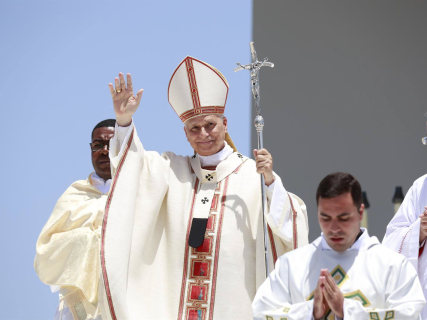










Pope Leo XIV has concluded his journey through several countries in Ibero-America, after his trips to Spain, Peru, Argentina, and Uruguay, which have resulted in more than 570 million euros in combined economic return and the participation of more than 9.5 million people in the various scheduled events.
Within this route, Argentina has been the country that benefited the most in economic terms, with an impact of 256 million euros. It has also been the territory that drew the largest crowds to receive Leo XIV, surpassing 6 million attendees between November 8 and 11.
At the opposite end, Uruguay has recorded the most modest economic effect, with 2.7 million euros generated during the events held from November 6 to 8, a figure explained in part by the smaller population of the country compared with Argentina.
Spain, for its part, has been the setting with the highest number of celebrations during the visit of the bishop of Rome, with 21 events over six days. The organization involved an outlay close to 29 million euros, but a study by the consulting firm EY puts the positive economic return at 139 million.
As for Peru, the "tour" developed between November 11 and 16 generated close to 181 million euros, in addition to bringing together more than 1 million people in the events held in Lima, Chiclayo, Cuzco, Pucallpa, and Santa Cruz de Succhabamba.
Visit of Leo XIV in Spain
The data released by the Spanish Episcopal Conference (CEE) indicate that the organization of the visit has been closed with some "sound accounts", without "deficit or indebtedness".
In total, the spending by the responsible entities amounted to 29.3 million euros. Of that amount, 55.6% was assumed by the Archdiocese of Madrid (16.3 million euros); 15.7% by that of Barcelona (4.6 million); 8.9% by the Diocese of the Canary Islands (2.6 million); 9% by that of Tenerife (2.63 million), and the remaining 10.8% by the Spanish Episcopal Conference (CEE), with 3.2 million.
By spending blocks, the main item, of 7.1 million euros, was allocated to audiovisual production, lighting, and sound; another 6.7 million was used for the preparation and adaptation of the spaces, and 6.1 million went to professional and security services.
In the revenue chapter, 44.7% of the resources to cover the visit, almost half, came from companies and civil entities (13.1 million euros); 31% came from various Church entities (9.1 million); 20% from the Public Administrations (5.9 million) and 4.3% from collections and donations (1.3 million).
The impact in Argentina
According to data from the Confederación Argentina de la Mediana Empresa (CAME), cited by Forbes Argentina, the mix of faith, domestic tourism, and extraordinary holidays drove the movement of more than 6 million domestic and international travelers, generating an impact of 256 million euros in accommodation, dining, commerce, and short- and long-distance transportation.
In the City of Buenos Aires, the central Mass on Monday 9 brought together 2.5 million people, becoming the most widely attended celebration of the pontificate of León XIV. The capital recorded 1.24 million visitors, of whom 77,000 were foreign tourists and 165,000 were domestic.
In Córdoba, the ceremony on Tuesday 10 November brought together more than 650,000 attendees, with hotel occupancy in the provincial capital close to 60% and 100% in high-end establishments.
Luján, for its part, was organized to receive 2 million faithful people, with prior hotel occupancy above 90%. Demand for accommodations surged, with increases of 1,800% on Booking and of more than 500% on Airbnb.
Projections surpassed in Peru
According to the Ministry of Foreign Trade and Tourism (Mincetur) of Peru, the results of the visit have exceeded the initial projections, which estimated 850,000 attendees and spending of 300 million soles (79.8 million euros) in hotels, restaurants, transportation, commerce, and tourism services.
Of the total number of visitors, 58.7% were Peruvians (642,200), 21.2% were foreigners (231,900), and 20% were day-trippers (219,100), that is, people who came only for the day without staying overnight.
Colombia was the main country of origin of the foreign tourists, with 23.9%, followed by Ecuador (15.2%), Spain (12.3%), the United States (10.1%), Mexico (9.4%), Chile (6.5%), Argentina (5.1%), and Brazil (2.9%), among other source markets.
As for spending, the Peruvian tourists paid out 375.9 million soles (100 million euros) and foreign visitors 260.5 million soles (69.3 million euros).
Within Peru, the city of Chiclayo concentrated the greatest influx, with 737,428 visitors (67.5% of the total), and the highest economic impact, with 502.8 million soles (133.8 million euros).
A profitable visit in Uruguay
The passage of Pope Leo XIV through Uruguay also left a positive balance for the public accounts, and the budget surplus will be directed to support programs for people and families in situations of vulnerability.
According to the Uruguay Episcopal Conference (CEU), cited by Región en Libertad, during the visit the launch of the Beca León XIV was announced, a program intended to finance the studies of young people from disadvantaged sectors, together with other social initiatives.