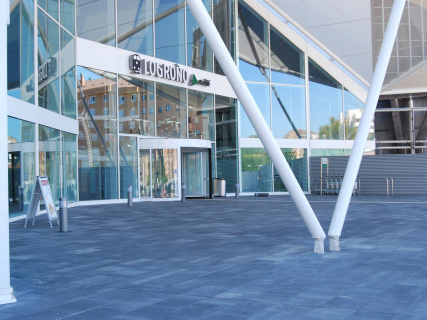

The Ministry of Transport and Sustainable Mobility has contracted, for a value of 828,850 euros, VAT included, the preparation of the information study for improving the rail corridor between Logroño and Miranda de Ebro (Burgos). This contract, tendered last July, already appears as awarded on the Public Sector Contracting Platform.
As the Ministry has indicated in a statement collected by Europa Press, the main objective of the study is to define various alternatives that will allow reducing travel times between the two towns and preserving mixed traffic, for both passengers and goods.
At present, the Logroño–Miranda de Ebro section is included in the line of the General Interest Railway Network (RFIG) 01-700, included in the corridor that links the Mediterranean with the Cantabrian Sea and which is configured as one of the most relevant cross-cutting rail axes on the peninsula.
The solution that will be evaluated in this new work is based on the alternatives already studied in the feasibility analysis prepared by the Ministry itself, which the Advisory Council for Transport and Sustainable Mobility approved on April 28, 2026.
That prior document established that, in the information study phase, three of the six alternatives initially considered would be explored further, in addition to considering the possibility of maintaining the current situation without intervention.
The contract now awarded will serve as the technical basis for the subsequent public information procedure and for the hearing of the affected administrations, steps necessary until the approval of the public information file and the final validation of the information study are achieved.
This initiative aligns with the objectives of the Sustainable, Safe and Connected Mobility Strategy 2030, aimed at strengthening social cohesion, promoting economic development, and responding to real mobility needs.
At the same time, the action will allow the residents of Logroño, Haro (La Rioja) and Miranda de Ebro to have a faster, more efficient and more comfortable rail connection, better integrated into Spain’s high-speed rail network, which will help reduce the use of private vehicles and, consequently, road congestion and polluting emissions.