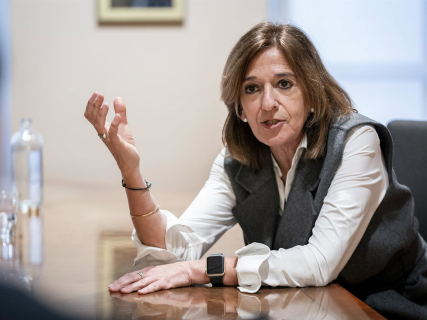

The president of Unespa, Mirenchu del Valle, has urged the insurance sector to pay attention to the “vertiginous changes” that the risks are experiencing, in order to better anticipate their impact and strengthen companies’ ability to respond.
“We are living through a moment of enormous transformation, of vertiginous changes, that go from the immediate to the structural, from local to global, and everything has to do with the transformation of risks that have an impact that until now we did not know,” the top executive of the employers’ association stressed at the 33rd edition of the insurance sector meeting organized by Deloitte.
In her address, Del Valle identified as priority areas for the industry mobility, climate change, digitalization, and the implementation of Artificial Intelligence (AI), as well as the demographic challenge linked to the increase in life expectancy.
When addressing mobility, she recalled the recent rail accident in Urda (Toledo) and highlighted the sector’s response: “in those very painful moments, insurance has been there, accompanying those affected.” She asserted the role of compulsory passenger insurance and mentioned other coverage, such as life and accident insurance, as well as civil liability that protects the operating companies and the infrastructure managers.
In relation to digitalization applied to transport, Unespa’s president pointed out that innovations such as the pilot projects of autonomous, driverless taxis are modifying the scheme of responsibilities. As she explained, responsibility shifts from the operator to the “software” and to the vehicle manufacturer, although the “first layer” of insurance, focused on protecting the victim, remains intact and covered.
Within this field, the new means of urban transport are also included, such as electric scooters. “We have presented in 2026 an insurance policy to cover these vehicles and as of today there are already 200,000 insured scooters,” Del Valle highlighted, alluding to the rapid expansion of this type of policies.
In parallel, the head of the employers’ association has indicated that 9 out of every 10 insurers already use AI in processes such as claims management, fraud detection, or improving customer service. However, she has warned that this technology entails “a higher risk” due to exposure to cyberattacks, which forces the sector “to rethink itself and for the European Commission (EC) to put forward a legal framework for protection,” as she has explained.
On climate change, Del Valle has reiterated that Spain is the second most “exposed” European country to extreme weather phenomena. “We have very recent experiences, such as the 2024 DANA in Valencia, wildfires or the latest episodes of torrential rains in the Mediterranean,” she recalled. In this context, she pointed out that the EC estimates losses associated with climate events at 200 billion euros and has positively assessed community initiatives to strengthen prevention and mitigate their impact.
In this vein, she has explained that the alliance for climate insurance promoted by the European Union (EU) will work as a common workspace where all actors in the sector will participate: “What we are going to see is how we can close that protection gap to have a Europe more resilient in the face of climate events.”
Long-term savings and the challenge of longevity
Regarding population aging, the representative of Unespa has noted that average life expectancy in Spain is already around 84 years and that there are about 10 million people over the age of 65. Against this backdrop, she has asked “how to guarantee financial security to all people who are going to live more years” and has argued that greater longevity requires stable, long-term policies and with greater scale.
“We have to add millions of savers to the system [private]. It is essential to incorporate young people into this; they have a key asset, time. Longevity is not prepared when one retires, but when one starts their professional career. In Spain we have seen how agreements like the Toledo Pact can be reached and we believe that it is necessary to add a pact within this one, which encourages contributions and improves tax incentives,” she argued.
As an international reference, Del Valle has focused on the United Kingdom case, where the proportion of employees with a pension plan has risen from 47% to nearly 90% thanks to an automatic enrollment affiliation model in which the company incorporates the worker into the system at the time of hiring.
"In Spain we set the goal of reaching 50% in the year 2030, but we would have to do much better. We represent around 8%/9% of the European Union’s Gross Domestic Product (GDP); we should contribute around 70,000 million euros to the savings of the Community bloc," the president of Unespa has concluded.