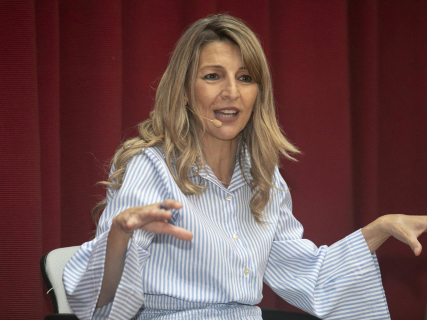

The Second Vice President and Minister of Labor and Social Economy, Yolanda Díaz, has advocated this Thursday at the University of Oxford (United Kingdom) for the urgency of establishing clear rules for the use of Artificial Intelligence (AI) in the labor market and in all labor relations.
Her speech took place at the conference "Reimagining the Future of Work: Towards the Right to Shape AI," organized by the British university center, where she argued that, far from "being afraid of data," it is necessary to use it for the benefit of all citizens.
In Díaz's words, "AI can destroy everything or it can change everything," so the central debate consists of how to regulate this new business tool so that it is subject to current labor legislation and fully respects human rights.
During her speech in Oxford, the vice president criticized the delay in the application of the provisions on high risks linked to employment included in the European Union's AI Regulation, which will begin to apply on August 2nd.
"Coincidentally, the part of the text that has to do with high-risk systems – hiring algorithms, performance evaluation, task assignment, monitoring, and dismissal – linked to work, they postpone for 16 more months," she denounced.
According to her explanation, this delay was agreed upon after about a hundred companies based in the EU formally lobbied to obtain that moratorium.
"What they don't explain is that, when the deadline passes, in December 2027, countries have the obligation to regulate. This is very serious. There is an explicit incentive for companies to deploy now, quickly, before the regulation comes into effect. This is a deliberate strategy to give all the power to very few tech companies that today rule the world, concentrate power in capitalist terms in a questionable way, and do not distribute wealth," she warned.
Díaz pointed out that currently 42 million people in Europe work under algorithmic management and are still awaiting specific regulations. "Today, everything that defines labor relations, from entry into the labor market, selection processes, job retention, contract modifications, promotions, departures, pensions, everything is done through AI and algorithms, therefore, all of this must be regulated," she reiterated.
For the minister, this is a debate typical of a change of era that "is not about likes and dislikes, but about a reality 'that is already here'". "Technology, AI, algorithms, robotics, mathematics design today the world of work and business at an accelerated pace, therefore, this discussion should not exist, it accompanies us and as it is already in the present, the debate now is how to organize this new business matter that must respect, on the one hand, human rights and, on the other, labor regulations," she clarified.
Díaz also recalled that Spain anticipated this in this area with the approval of the so-called Rider Law, "a necessary and consensual law that was passed with great effort and work," drafted with the conviction that "all information related to the scope of labor relations of workers must be transparent and accessible to unions so that they can defend the working population."
Clash with the deregulation promoted by the United States
In the vice president's opinion, technological advancement should not be understood as an apocalyptic scenario, but as a field of possibilities. "AI can destroy everything or it can change everything," she reiterated, insisting that the fundamental issue is "whether we put AI at the service of the common good."
She contrasted her vision with that of Washington and the attitude of Brussels: "The proposal to deregulate AI that the United States and also the European Commission passively defend today is a political proposal. Mine is not to fear data; we can benefit from AI, which is why my firm commitment is to regulate all aspects related to the labor relationship," she remarked.
Díaz admitted that AI is already replacing jobs, but argued that this technology should be used to eliminate jobs that harm employees' health, are highly polluting, or cause various types of harm.
In this regard, she stressed that there is a window of opportunity linked to scientific and technological development, provided that current societies "take responsibility." "It will be in our hands to use AI to generate a multitude of new jobs, which also have added value because they are ecological, going hand in hand with green public policies," she indicated.
The Minister of Labor has also rejected the most pessimistic discourses about the future of employment in the midst of the expansion of generative AI. "I do not share the IMF's dystopian vision. I walk towards utopias knowing that they are not an end, but a process, and I say this because what some want is to tell us that there is no power to change history, but of course there is, and we would be irresponsible if we did not do it," she concluded.