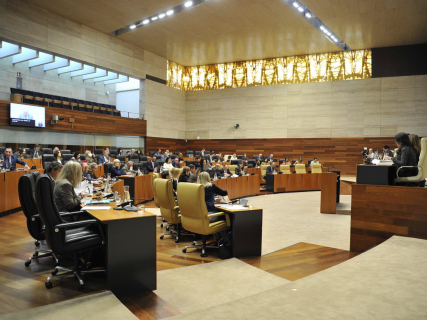

The Assembly of Extremadura has rejected this Thursday an initiative that urged the European Parliament to preserve, strengthen and ensure "sufficient funding" for Leader and for participatory local development, as well as to recognize and strengthen the Local Action Groups within the financial and regulatory framework of the European Union for the period 2028-2034.
The proposal, which has received support only from the PSOE and Unidas por Extremadura, was included in a statement defended in the plenary session by the Socialist Group and was ultimately rejected by PP and Vox.
The Socialist MP Gonzalo Romero Barba has broken down some of the points of the text, including maintaining and strengthening, for 2028-2034, the explicit recognition of Leader and of Participatory Local Development (CLLD) as "essential instruments" of the EU rural and territorial development policy.
It was also proposed that the European financial framework 2028-2034 set aside a specific allocation for Leader, with at least a volume of funds similar to that of the current period, and that Participatory Local Development (CLLD) be a mandatory component of the territorial programming of the Member States, with its own and sufficient funding.
Another of the defended points was that Leader may be applied in all rural areas of the European Union, without being limited only to areas defined by criteria of disadvantage or vulnerability.
It also called for the recognition of the Local Action Groups, with full powers to decide at the local level, as allies in the coordination and implementation of policies and strategies adapted to each territory, as well as the implementation of an "effective and proportionate" administrative simplification.
Romero Barba has stressed that the statement responds to a "vital issue" to ensure the future of the rural areas of Extremadura.
"To talk about Leader in Extremadura is to talk about a way of understanding rural development from within the territory itself. The 24 Local Action Groups (GAL) are present in 384 municipalities and cover 89 percent of the region's land area," he emphasized.
He recalled that, across the entire region, the effect of Leader over the last 30 years translates into more than 683 million euros mobilized in 14,500 projects, with more than 24,000 jobs created and more than 4,000 companies supported.
Currently, he has indicated, with a charge to PEPAC 23-27, that the local action groups manage 72 million euros already available for the territories, channeled through 45 aid calls published during the last year.
He has also pointed out that negotiations for the next multiannual financial framework are underway, in which the Government of Spain has placed itself among the 17 Member States that are calling for a "broader" budget and defending the weight of the Common Agricultural Policy in the future framework.
In this context, he has asserted the "strategic role" of the Local Action Groups due to their direct knowledge of the territory and their condition as a "fundamental structure" to address challenges such as depopulation and the lack of opportunities in the rural environment of Extremadura.
"A large part of the future of our rural environment depends on political will in the negotiations on the future CAP. The Government of Spain has already made its position clear. What is the Government of the Regional Government of Extremadura going to do?" the socialist has asked.
Position of the parliamentary groups
During the round of speeches by the groups, PP deputy Manuel Lozano Martínez defended a substitution amendment registered by his party to the socialist proposal, which ultimately did not move forward.
In his address, Lozano acknowledged the work that Local Action Groups have been carrying out for 35 years in favor of the survival of the rural world, of the towns, and of their productive fabric.
However, he insisted that, in the view of the PP, the priority must be to secure first the new European financial framework, which must have "fair" and "sufficient" funding. "That and no other is the real debate. And that should be our first demand at a decisive moment for the future budget of the Union," he said.
For this reason, he stated that budget negotiations remain open and has rejected setting the needs of farmers against those of rural municipalities.
"Nor can we commit to a financial allocation before knowing the resources that are available. First, we must secure sufficient funding for everyone. After that, it will have to be distributed using criteria of balance, effectiveness, and responsibility," he assured.
On Vox’s part, the MP Eva María García Alegre has stated that her group does not oppose the rural world, but rather advocates for a "living rural world, with a real population and real activity", and she has clarified that her disagreement with the PSOE lies in the "model".
In her view, the socialist model entails "more spending, more structures, more obligations and, in the end, few results and opaque management".
She has also pointed out that the initiative talks about reinforcing Leader but, in her opinion, the PSOE’s statement is actually aimed at shielding "funding without requiring verifiable results".
"We wonder why the money should be protected, whatever happens. It’s like signing a blank check, without conditioning objectives, assessment and consequences. And it is, in reality, giving up knowing whether those funds reach our towns or whether they are left with the intermediaries, in the management", she has ruled.
Finally, the MP for Unidas por Extremadura Juan Alessandro Schirinzi Pareés has defended that Leader funds constitute one of the main tools of the European Union to drive rural areas that require more investment.
Schirinzi Pareés has emphasized that the debate should not be limited to deciding where "a little more or a little less money" is placed, but rather to set the EU’s real priorities.
"Against an Europe that what it always proposes when there are problems on our continent are budget cuts, against the Europe that has been advocating and has been establishing as economic policy the policy of the men in black, the one from the IMF, we continue to defend an Europe that thinks about its towns", he has stressed.
Therefore, he has reiterated his group’s support for the socialist proposal, understanding that the money must be directed to those who need it the most and that European funds must be allocated to Europe’s development.