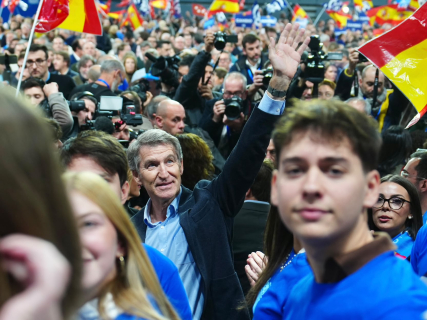

With 80% counted, Genoa was shouting at 22:34: The Partido Popular has won the elections.
It has been the chronicle of a triumph announced in the polls, in the debates. And this afternoon, on the faces, because of the atmosphere on the street, because of the calm with which the popular leaders arrived at the party’s national headquarters, and for that joy that, from the first hours of the afternoon, they were trying to contain.
This time, the polls, the majority, have not been wrong in anticipating a majority of PP and Vox. Three years after winning a general election without managing to reach La Moncloa, Alberto Núñez Feijóo once again prevails at the ballot box with a parliamentary arithmetic that allows him to face the investiture. PP and Vox provisionally add up to 186 seats, ten above the absolute majority.
Before eight o’clock in the evening, the Genoa street began to fill with supporters stationed in front of the national headquarters of the Partido Popular. The first leaders to arrive did so with a serene expression, without big fireworks, but with a satisfaction that was difficult to disguise. Optimism was in the air long before the first results were known.
At half past eight, the general secretary of the PP, Miguel Tellado, appeared before the media to thank everyone who had contributed to the electoral day unfolding normally. He spoke about huge turnout, long lines at the polling stations, entire families who had gone to vote, and a town mobilized in the face of what, in his opinion, were the most important elections in Spanish democracy.
If faces are the mirror of the soul, the faces of some of the leaders who accompanied Tellado, including Alma Ezcurra, Juan Bravo and Cayetana Álvarez de Toledo, said it all without the need to utter a single word. There was joy. Contained, still, but joy.
A frenzy-struck street
Outside the national headquarters of the PP there hasn’t been such restraint. Since half past eight in the evening, Genoa is a chorus. The number of young people who have gathered to follow an election night that they are celebrating point by point, seat by seat, draws special attention. Each advance by the PP in the count triggers a new ovation. The shouts of "Long live Spain!" follow one another on a frenzy-struck street.
And what has marked the development of the election night has been the decisiveness of the trend. When barely half of the votes had been counted, the count was already showing a comfortable absolute majority for PP and Vox and a significant setback for the left.
With 70.41% counted, the PP reached 136 deputies, compared to 117 for the PSOE, 50 for Vox, and 13 for Frente Amplio. But the political dimension of the result goes beyond the sum of seats. There are substantial changes in the Spanish electoral map that the conservatives particularly celebrate this night.
The PP prevails in Seville, where Sánchez kicked off the campaign
Among the data that generates the most satisfaction in Génova is that of Seville. Pedro Sánchez chose this province to kick off his electoral campaign and it is precisely there where the conservatives manage to impose themselves on the PSOE by a difference of two percentage points in the counting.
Also in Fuenlabrada, one of the working-class municipalities in southern Madrid traditionally linked to the left, the Partido Popular becomes the leading political force.
These are not two minor results for the conservatives. Party sources consulted by DEMÓCRATA place the emphasis on the ability of their electorate to mobilize and on the progress recorded in territories historically favorable to the PSOE.
During the campaign, the conservative candidates told this newspaper that they had found the warmth of the street. They spoke about citizens who were highly mobilized, eager for change, and willing to go to the polls. This night, in Génova they claim that perception in light of the results yielded by the count.
Feijóo’s campaign and Vox’s growth
Conservative sources congratulate what they consider a great electoral campaign by Alberto Núñez Feijóo, in which the PP has managed to expand its electoral space and contain Vox’s growth.
They recognize the magnitude of the result for the formation of Santiago Abascal, which notably improves the 33 seats it won in the 2023 general elections. However, the conservatives highlight that Vox has lost strength compared to the expectations that some polls had generated during the campaign.
In Génova they attribute part of that development to the work carried out by Feijóo in the last few weeks. They believe they have managed to contest votes with Vox and, at the same time, expand their presence in territories traditionally linked to the left.
The paradox of the election-night is that the PP celebrates both having contained Vox’s growth and the strength of a party whose parliamentary backing Feijóo needs in order to reach La Moncloa.
A victory very different from that of 2023
In Génova, the memory of July 23, 2023 weighed heavily. Alberto Núñez Feijóo won those general elections, but the combined total of PP and Vox proved insufficient to have him invested as president of the Government. Pedro Sánchez managed to remain in La Moncloa after reaching, among other things, an agreement with the party of Carles Puigdemont.
More than three years have passed since then. Feijóo wins the elections again, but this time he has a parliamentary arithmetic that allows him to negotiate his investiture without needing to seek support beyond Vox.
From now on, it will be necessary to see how that understanding is articulated, what conditions Santiago Abascal proposes, and how Pedro Sánchez wants to manage the political and institutional transition that the result of the ballot boxes opens up.
Just two days ago, in his exclusive interview with DEMÓCRATA, Feijóo summarized his aspirations: "Sánchez is very worried about how he will pass into history. I am worried about Spain and how we are going to rebuild it after eight years of lies."
He then laid out the priorities of a possible PP Government, the legislative reforms he wanted to recover, and the first decisions he would adopt if he achieved investiture.
This morning, after casting his vote, he urged the Spanish to go to the polls "without fear, with memory, and with conviction." He claimed the illusion and hope. And, in conversation with the mayor of Madrid, he recalled that it was the seventh time he voted for his own candidacy. "Let’s see if we win now," he said.
As he told Plex on the Jarama circuit during the election campaign, one thing is to do well and another, very different, is to have reached the finish line. Alberto Núñez Feijóo has won the general elections again. This time, the ballot boxes offer him a way to reach the finish line he has been chasing for three years: the Palacio de La Moncloa.