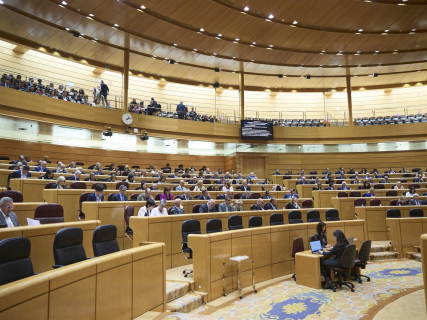
PP and Vox achieve an absolute majority in the Senate, but fall far short of the three-fifths needed to renew the Constitutional Court

The first advancement of the scrutiny in the Upper House places the right-wing bloc above the 134 senators needed to control the institution, although it still does not reach the 161 required to elect judges of the Constitutional Court without negotiating with other forces

fotonoticia 20261128074951 1920

fotonoticia 20261128074951 1920

Add DEMÓCRATA to Google

Ask FREN

Published

Last updated

2 minutes

Most read

Resultados de las elecciones generales del 29N en directo

Elecciones generales del 29 de noviembre de 2026 · Congreso de los DiputadosSenado

Escrutado: 80,78 %Votantes: 23.113.499Participación: 79,57 % (+12,98 pts vs 2023)

Datos de las 22:27 · Avances de participación: 14:00: 45,73 % (40,48 % en 2023) · 18:00: 68,15 % (53,12 % en 2023)

Votos

PartidoEscañosVotosPorcentaje
PP135 −27.486.90332,74 %
PP: 135 escaños. Se presenta con estos nombres:
  • PARTIDO POPULAR (PP)125 escaños
  • PARTIT POPULAR / PARTIDO POPULAR (PP)8 escaños
  • UNIÓN DEL PUEBLO NAVARRO EN COALICIÓN CON EL PARTIDO POPULAR (UPN-PP)2 escaños
PSOE117 −46.660.85329,13 %
PSOE: 117 escaños. Se presenta con estos nombres:
  • PARTIDO SOCIALISTA OBRERO ESPAÑOL (PSOE)81 escaños
  • PARTIT DELS SOCIALISTES DE CATALUNYA (PSC-PSOE)15 escaños
  • PARTIDO DOS SOCIALISTAS DE GALICIA-PSOE (PSdeG-PSOE)8 escaños
  • PARTIDO SOCIALISTA DE EUSKADI-EUSKADIKO EZKERRA (PSOE)7 escaños
  • PARTIDO SOCIALISTA DE LAS ISLAS BALEARES (PSIB-PSOE)2 escaños
  • PARTIDO SOCIALISTA DE NAVARRA-PSOE (PSN-PSOE)2 escaños
  • PARTIDO SOCIALISTA DE HUELVA (PSOE)2 escaños
Vox51 +183.633.66315,89 %
Frente Amplio13 −181.494.2776,53 %
Frente Amplio: 13 escaños. Se presenta con estos nombres:
  • FRENTE AMPLIO (FA)5 escaños
  • COMPROMÍS: FRONT VALENCIÀ (COMPROMIS-EUPV-PODEM-ERPV)3 escaños
  • COMUNS-FRONT AMPLI3 escaños
  • CHUNTA ARAGONESISTA-FRENTE AMPLIO ARAGÓN (CHA-IU-MS-FRENTE AMPLIO)1 escaño
  • FRENTE AMPLIO ANDALUZ (FA)0 escaños
  • FRENTE AMPLIU POR ASTURIES (FA)0 escaños
  • ARAMÉS-FRONT AMPLI (ARAMÉS-EU-MS)1 escaño
  • UNIDAD DEL PUEBLO CANARIO UPC (NC-BC, PODEMOS, IU, SUMAR)0 escaños
  • FRENTE AMPLIO-FRONTE ZABALA0 escaños
  • FRENTE AMPLIO-FRONTE AMPLA0 escaños
  • FRENTE AMPLIO - FRONTE AMPLA0 escaños
ERC11 +4723.6193,16 %
EH Bildu7 +1485.4122,12 %
Junts5 −2368.7131,61 %
Adelante4 +4445.4321,95 %
EAJ-PNV3 −2246.2191,08 %
BNG2 +1233.7741,02 %
CCa2 +136.5980,16 %
CCa: 2 escaños. Se presenta con estos nombres:
  • MUNICIPALISTAS PRIMERO CANARIAS-COALICIÓN CANARIA (1.ºCAN-CCa)1 escaño
  • COALICIÓN CANARIA-MUNICIPALISTAS PRIMERO CANARIAS (CCa-1ºCAN)1 escaño
SALF0360.6951,58 %
SALF: 0 escaños. Se presenta con estos nombres:
  • SE ACABÓ LA FIESTA (SALF)0 escaños
  • SE ACABO LA FIESTA (SALF)0 escaños
FO0 =72.3640,32 %
Podemos071.6610,31 %
PACMA0 =64.6530,28 %
PACMA: 0 escaños. Se presenta con estos nombres:
  • PARTIDO ANIMALISTA CON EL MEDIO AMBIENTE (PACMA)0 escaños
  • PARTIT ANIMALISTA AMB EL MEDI AMBIENT (PACMA)0 escaños
ALHORA046.5590,20 %
D21037.2390,16 %
PCTE0 =25.7820,11 %
PCTE: 0 escaños. Se presenta con estos nombres:
  • PARTIDO COMUNISTA DE LOS TRABAJADORES DE ESPAÑA (PCTE)0 escaños
  • PARTIT COMUNISTA DELS TREBALLADORS DE CATALUNYA (PCTE)0 escaños
  • PARTIDO COMUNISTA DOS TRABALLADORES DA GALIZA (PCTE)0 escaños
  • PARTIDO COMUNISTA DE LOS TRABAJADORES DE EUSKADI/EUSKADIKO LANGILEEN ALDERDI KOMUNISTA (PCTE)0 escaños
  • EUSKADIKO LANGILEEN ALDERDI KOMUNISTA/PARTIDO COMUNISTA DE LOS TRABAJADORES DE EUSKADI (PCTE)0 escaños
MUNDO+JUSTO017.4440,08 %
MUNDO+JUSTO: 0 escaños. Se presenta con estos nombres:
  • POR UN MUNDO MAS JUSTO (MUNDO+JUSTO)0 escaños
  • POR UN MUNDO MÁS JUSTO (MUNDO+JUSTO)0 escaños
  • POR UN MUNDO MAIS XUSTO (MUNDO+JUSTO)0 escaños
ESCAÑOS EN BLANCO0 =11.6910,05 %
ESCAÑOS EN BLANCO: 0 escaños. Se presenta con estos nombres:
  • ESCAÑOS EN BLANCO PARA DEJAR ESCAÑOS VACÍOS (ESCAÑOS EN BLANCO)0 escaños
  • ESCANOS EN BRANCO PARA DEIXAR ESCANOS BALEIROS (ESCAÑOS EN BLANCO)0 escaños
  • ESCAÑOS EN BLANCO PARA DEJAR ESCAÑOS VACIOS (ESCAÑOS EN BLANCO)0 escaños
TERUEL EXISTE063500,03 %
FE de las JONS0 =61190,03 %
FE de las JONS: 0 escaños. Se presenta con estos nombres:
  • FALANGE ESPAÑOLA DE LAS J.O.N.S. (FE de las JONS)0 escaños
  • FALANGE ESPAÑOLA DE LAS JONS (FE de las JONS)0 escaños
GBAI0 =52880,02 %
IE043400,02 %
NEX042060,02 %
SY0 =36740,02 %
VLC024690,01 %
PREPAL0 =24640,01 %
PARTIDO AUTÓNOMOS0 =20010,01 %
AGENDA VALENCIANA018870,01 %
D.R.G018760,01 %
PH0 =15820,01 %
3e0 =14080,01 %
29011900,01 %
FIA011350,00 %
LIB06240,00 %
RRB05490,00 %
P. ALANTRE05430,00 %
PANCAL-URCI04800,00 %
PCPC03670,00 %
EGUZKILORE03550,00 %
PUEDE0 =3050,00 %
CNV02110,00 %
PFAC01480,00 %
P.D.S.J.E.01190,00 %

Los partidos que se presentan con varios nombres van juntos: pasa por encima del ? para ver el detalle. Porcentajes sobre votos válidos. Junto a los escaños, la diferencia con el 23J (en los votos, cuando termina el escrutinio).

Escaños (350)

Mayoría: 176
PP: 137 escaños en 2023PSOE: 121 escaños en 2023Vox: 33 escaños en 2023Sumar: 31 escaños en 2023ERC: 7 escaños en 2023EH Bildu: 6 escaños en 2023Junts: 7 escaños en 2023EAJ-PNV: 5 escaños en 2023BNG: 1 escaño en 2023CCa: 1 escaño en 20231371213331PP: 135 escaños en 2026 (PARTIDO POPULAR: 125; PARTIT POPULAR / PARTIDO POPULAR: 8; UNIÓN DEL PUEBLO NAVARRO EN COALICIÓN CON EL PARTIDO POPULAR: 2)PSOE: 117 escaños en 2026 (PARTIDO SOCIALISTA OBRERO ESPAÑOL: 81; PARTIT DELS SOCIALISTES DE CATALUNYA (PSC-PSOE): 15; PARTIDO DOS SOCIALISTAS DE GALICIA-PSOE: 8; PARTIDO SOCIALISTA DE EUSKADI-EUSKADIKO EZKERRA (PSOE): 7; PARTIDO SOCIALISTA DE LAS ISLAS BALEARES: 2; PARTIDO SOCIALISTA DE NAVARRA-PSOE: 2; PARTIDO SOCIALISTA DE HUELVA: 2)Vox: 51 escaños en 2026Frente Amplio: 13 escaños en 2026 (FRENTE AMPLIO: 5; COMPROMÍS: FRONT VALENCIÀ: 3; COMUNS-FRONT AMPLI: 3; CHUNTA ARAGONESISTA-FRENTE AMPLIO ARAGÓN: 1; FRENTE AMPLIO ANDALUZ: 0; FRENTE AMPLIU POR ASTURIES: 0; ARAMÉS-FRONT AMPLI: 1; UNIDAD DEL PUEBLO CANARIO UPC: 0; FRENTE AMPLIO-FRONTE ZABALA: 0; FRENTE AMPLIO-FRONTE AMPLA: 0; FRENTE AMPLIO - FRONTE AMPLA: 0)ERC: 11 escaños en 2026EH Bildu: 7 escaños en 2026Junts: 5 escaños en 2026Adelante: 4 escaños en 2026EAJ-PNV: 3 escaños en 2026BNG: 2 escaños en 2026CCa: 2 escaños en 2026 (MUNICIPALISTAS PRIMERO CANARIAS-COALICIÓN CANARIA: 1; COALICIÓN CANARIA-MUNICIPALISTAS PRIMERO CANARIAS: 1)13511751132026202620232023
  • PP 135 −2
  • PSOE 117 −4
  • Vox 51 +18
  • Frente Amplio 13 −18
  • ERC 11 +4
  • EH Bildu 7 +1
  • Junts 5 −2
  • Adelante 4 +4
  • EAJ-PNV 3 −2
  • BNG 2 +1
  • CCa 2 +1

Fuera, el reparto del 29N; dentro, el del 23J de 2023.

Simulador de Pactos

Pulsa los partidos para sumar sus escaños.Abrir el Simulador de Pactos

Los escaños más ajustados

Quién tiene el último escaño, quién le sigue y los votos que le faltan
  1. AsturiasPSOEyFA175 votos

    El último escaño de Asturias (el 7.º) es para el PSOE. Le sigue FA, que necesitaría 175 votos más para quitárselo. Ver Asturias ›

  2. CuencaVOXyPP303 votos

    El último escaño de Cuenca (el 3.º) es para VOX. Le sigue el PP, que necesitaría 303 votos más para quitárselo. Ver Cuenca ›

  3. AlmeríaPPyVOX413 votos

    El último escaño de Almería (el 6.º) es para el PP. Le sigue VOX, que necesitaría 413 votos más para quitárselo. Ver Almería ›

  4. Santa Cruz de TenerifeVOXyPSOE608 votos

    El último escaño de Santa Cruz de Tenerife (el 7.º) es para VOX. Le sigue el PSOE, que necesitaría 608 votos más para quitárselo. Ver Santa Cruz de Tenerife ›

  5. BurgosPSOEyVOX678 votos

    El último escaño de Burgos (el 4.º) es para el PSOE. Le sigue VOX, que necesitaría 678 votos más para quitárselo. Ver Burgos ›

Ver todas las provincias y el mapa

Provincias donde el último escaño cambiaría de manos con menos votos, con lo escrutado hasta ahora. Pulsa una para ver el detalle.

Senado

14,55 % escrutado
PartidoSenadores
PPPP: 117 senadoresSe presenta con estos nombres:
  • PP116
  • UPN-PP1
117 −3
Senado de ProgresoSenado de Progreso: 78 senadoresSe presenta con estos nombres:
  • SDP (PSOE, IU, MS, MM, COMPROMIS, CHA, BATZARRE)56
  • PSC10
  • PSOE4
  • SDP (PSOE-IUN NEB-MS-BATZARRE)3
  • SDP (PSOE-MS)3
  • PSIB-PSOE-MÉS PER MALLORCA-SUMAR-EUIB1
  • PSOE-MS1
78 +5
EH Bildu5 +1
ERC5 +2
Junts1 =
EAJ-PNV0 −4
UPN0 −1
A.H.I.0 −1
ASG0 −1

Junto a los senadores, la diferencia con el 23J. Los partidos que se presentan con varios nombres van juntos: pasa por encima para ver el detalle. Baleares y Canarias eligen sus senadores por islas.

Senadores (209)

Elegidos en las urnas
PP: 120 senadores en 2023PSOE: 73 senadores en 2023 (PSOE: 48; PSC: 12; PSdeG-PSOE: 4; PSE-EE (PSOE): 4; PSN-PSOE: 3; PSIB-PSOE: 1; PSOE-SUMAR-EUIB-ARA EIVISSA: 1)EH Bildu: 4 senadores en 2023EAJ-PNV: 4 senadores en 2023ERC: 3 senadores en 2023 (ERC-ESQUERRES PER LA INDEPENDÈNCIA: 2; ERC: 1)Junts: 1 senador en 2023UPN: 1 senador en 2023A.H.I.: 1 senador en 2023ASG: 1 senador en 202312073PP: 117 senadores en 2026 (PP: 116; UPN-PP: 1)Senado de Progreso: 78 senadores en 2026 (SDP (PSOE, IU, MS, MM, COMPROMIS, CHA, BATZARRE): 56; PSC: 10; PSOE: 4; SDP (PSOE-IUN NEB-MS-BATZARRE): 3; SDP (PSOE-MS): 3; PSIB-PSOE-MÉS PER MALLORCA-SUMAR-EUIB: 1; PSOE-MS: 1)EH Bildu: 5 senadores en 2026ERC: 5 senadores en 2026Junts: 1 senador en 2026117782026202620232023
  • PP 117 −3
  • Senado de Progreso 78 +5
  • EH Bildu 5 +1
  • ERC 5 +2
  • Junts 1 =

206 de 209 senadores asignados. Fuera, el reparto del 29N; dentro, el del 23J de 2023. Los senadores designados por los parlamentos autonómicos no se eligen esta noche.

Mapa

Ganador por provincia

    CanariasCeutaMelillaAraba/Álava: PSE-EE (PSOE) 29,5 %Albacete: PP 40,6 %Alicante/Alacant: PP 36,3 %Almería: PP 39,2 %Ávila: PP 45,4 %Badajoz: PP 38,9 %Illes Balears: PP 34,5 %Barcelona: PSC 29,6 %Burgos: PP 40,4 %Cáceres: PSOE 38,2 %Cádiz: PP 31,7 %Castellón/Castelló: PP 33,7 %Ciudad Real: PP 42,5 %Córdoba: PP 36,8 %A Coruña: PP 41,9 %Cuenca: PP 39,5 %Girona: PSC 28,6 %Granada: PP 34,5 %Guadalajara: PP 36,5 %Gipuzkoa: EH BILDU 38,9 %Huelva: PP 34,0 %Huesca: PP 38,0 %Jaén: PP 36,3 %León: PP 39,7 %Lleida: PSC 27,4 %La Rioja: PP 39,1 %Lugo: PP 50,5 %Madrid: PP 40,0 %Málaga: PP 35,6 %Murcia: PP 40,3 %Navarra: PSN-PSOE 31,8 %Ourense: PP 50,5 %Asturias: PP 33,8 %Palencia: PP 42,7 %Las Palmas: PSOE 29,4 %Pontevedra: PP 39,1 %Salamanca: PP 47,5 %Santa Cruz de Tenerife: PSOE 29,7 %Cantabria: PP 43,3 %Segovia: PP 43,6 %Sevilla: PP 31,9 %Soria: PP 44,4 %Tarragona: PSC 29,6 %Teruel: PP 36,3 %Toledo: PP 37,5 %Valencia/València: PP 33,0 %Valladolid: PP 43,6 %Bizkaia: PSE-EE (PSOE) 28,5 %Zamora: PP 44,5 %Zaragoza: PP 36,4 %Ceuta: PP 44,1 %Melilla: PSOE 53,8 %

    Pulsa una provincia para ver sus resultados y elegir municipio.

    Mapa

    Partido con más senadores por provincia

    CanariasCeutaMelillaAraba/Álava: Senado de Progreso, 3 de 4 senadoresAlbacete: PP, 3 de 4 senadoresAlicante/Alacant: PP, 2 de 4 senadoresAlmería: PP, 3 de 4 senadoresÁvila: PP, 3 de 4 senadoresBadajoz: PP, 2 de 4 senadoresIlles Balears: PP, 4 de 6 senadoresBarcelona: PSOE, 3 de 4 senadoresBurgos: PP, 3 de 4 senadoresCáceres: PP, 3 de 4 senadoresCádiz: PP, 3 de 4 senadoresCastellón/Castelló: PP, 3 de 4 senadoresCiudad Real: PP, 3 de 4 senadoresCórdoba: PP, 2 de 4 senadoresA Coruña: PP, 3 de 4 senadoresCuenca: PP, 3 de 4 senadoresGirona: PSOE, 2 de 4 senadoresGranada: PP, 2 de 4 senadoresGuadalajara: PP, 3 de 4 senadoresGipuzkoa: EH BILDU-ERC, 3 de 4 senadoresHuelva: Senado de Progreso, 3 de 4 senadoresHuesca: PP, 2 de 4 senadoresJaén: PP, 2 de 4 senadoresLeón: PP, 3 de 4 senadoresLleida: ERC-EH BILDU, 2 de 4 senadoresLa Rioja: PP, 3 de 4 senadoresLugo: PP, 3 de 4 senadoresMadrid: PP, 3 de 4 senadoresMálaga: PP, 3 de 4 senadoresMurcia: PP, 3 de 4 senadoresNavarra: Senado de Progreso, 3 de 4 senadoresOurense: PP, 3 de 4 senadoresAsturias: Senado de Progreso, 2 de 4 senadoresPalencia: PP, 3 de 4 senadoresLas Palmas: PP, 3 de 5 senadoresPontevedra: PP, 3 de 4 senadoresSalamanca: PP, 3 de 4 senadoresSanta Cruz de Tenerife: PP, 2 de 6 senadoresCantabria: PP, 3 de 4 senadoresSegovia: PP, 3 de 4 senadoresSevilla: Senado de Progreso, 3 de 4 senadoresSoria: PP, 3 de 4 senadoresTarragona: PSOE, 3 de 4 senadoresTeruel: PP, 3 de 4 senadoresToledo: PP, 3 de 4 senadoresValencia/València: PP, 3 de 4 senadoresValladolid: PP, 3 de 4 senadoresBizkaia: Senado de Progreso, 3 de 4 senadoresZamora: PP, 3 de 4 senadoresZaragoza: PP, 2 de 4 senadoresCeuta: PP, 2 de 2 senadoresMelilla: Senado de Progreso, 2 de 2 senadores

    Pulsa una provincia para ver sus senadores y candidatos.

    Escrutinio provisional del Ministerio del Interior; se actualiza cada minuto. Mapas: Instituto Geográfico Nacional (es-atlas, CC BY 4.0). Demócrata.

    The absolute majority that PP and Vox have achieved in the Congress of Deputies also extends to the Senate. The first results of the general elections of 29N place the right-wing bloc above the threshold needed to control the Upper House, although still far from gathering the three-fifths that would allow intervention in the renewal of the Constitutional Court without needing to reach agreements with other parties.

    With 7% of the votes counted, the PP obtained 109 directly elected senators, according to the first update released during the election night. To these are added the 23 representatives of autonomous designation with which the party already has, as well as Vox’s five autonomous senators. The total reaches 137 seats, three more than the 134 needed for the absolute majority, even without incorporating the possible directly elected senators that Vox may achieve.

    The recount in the Senate, however, is progressing at a considerably slower pace than that of the Congress. While the Lower House already exceeds widely 75% of the votes counted, in the Upper House many constituencies are still pending to be tallied, including some island ones. For this reason, the allocation of seats may experience significant changes as the night goes on.

    The three-fifths majority, the other Senate battle

    Beyond the absolute majority, the election result opens another institutional question: whether PP and Vox will manage to reach the three-fifths of the Senate, a qualified majority that is decisive for the renewal of different constitutional bodies.

    To elect the four magistrates of the Constitutional Court that the Senate is required to propose, the support of three-fifths of its members is needed. With a chamber of 267 senators, that threshold stands at 161 votes, a figure that the right-wing bloc still does not reach with the first known results.

    The election of the members of the General Council of the Judiciary that corresponds to be designated by the Upper House also requires a three-fifths majority. If the distance from that threshold is maintained, PP and Vox would need to negotiate with other parties to push through these appointments.

    The weight of autonomous senators

    Unlike the Congress, the Senate is not fully renewed in a general election. Part of its members is directly elected by citizens, and the other part comes from appointments made by the regional parliaments, whose mandates follow their own electoral calendars.

    In these elections, 209 senators are chosen by direct suffrage, while the regional representatives complete the composition of the Chamber. This particularity allows parties, by adding their new seats, to also include the representatives designated by the autonomous communities that continue in office.

    The territorial distribution also introduces differences with respect to the Congress. The Peninsular provinces elect four senators each, regardless of their population, while the islands and the autonomous cities of Ceuta and Melilla have specific representation rules.

    The reform that separates the senatorial constituencies of Ibiza and Formentera also raises to 209 the number of representatives elected directly in these elections, compared with the 208 from the 2023 general elections.