
There is, however, one final week for the surprises: the decision of those who are still hesitating and a mobilization higher than expected could alter the distribution of the last seats. Participation above 76% would open a different scenario from the one analyzed, but it would not guarantee a reversal. The key would be who moves away from abstention, which parties that additional vote leans toward, and in which provinces it is concentrated.
# The poll of the polls of the 29N: Feijóo would beat Sánchez and would add 191 with Vox
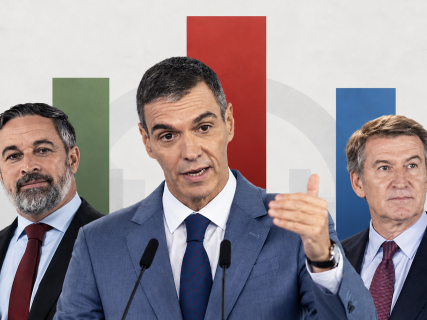
A difference of 1.54 points between PP and PSOE would produce a Congress with a majority of 191 deputies for PP and Vox. That is the central scenario of Demócrata’s poll of the polls for the general elections on November 29: a relatively tight contest between Alberto Núñez Feijóo and Pedro Sánchez, accompanied by a greater distance between their arithmetic possibilities of gathering support.
The projection places the PP at 30.96% of valid votes and 128 seats; the PSOE at 29.42% and 116; and Vox at 17.61% and 63. The popular figure includes the UPN-PP candidacy of Navarre, an grouping that remains in the comparisons of this piece.
The calculation incorporates a participation scenario of 75% among voters residing in Spain. It is a hypothesis of the model, not observed participation nor a piece of data that would allow the additional vote to be automatically attributed to any one formation.
## Feijóo would win by twelve seats and could build a majority with Vox
The first piece of data of the election night would be who comes first. The second, which parties can gather the necessary support. In this projection, Feijóo would beat Sánchez by twelve deputies, while the combined vote of PP and Vox would reach 191, compared with the 176 that mark the absolute majority.
Popular Party and Vox would gather 48.57% of the valid vote and 54.57% of the seats. The provincial distribution and the votes of candidacies that fail to secure representation contribute to the fact that a sum of less than half the vote becomes a majority of deputies.
The other parties would gather 159 seats. That sum includes formations with different positions and objectives: by itself, it does not constitute an investiture alliance. Even by adding them all together, there would be seventeen deputies below 176.
## Vox would provide the growth that changes the majority compared to the 23J
The difference with the general elections of July 2023 is concentrated in Vox. The party of Santiago Abascal would go from 33 to 63 deputies: thirty more and almost double representation. Its percentage of valid votes would rise from 12.38% to 17.61%, an advance of 5.23 points.
The PP and UPN, grouped to make the calculation comparable, would retreat from 138 to 128 deputies. The PSOE would also lose representation, though to a lesser extent: from 121 to 116.
Thus, PP, UPN and Vox would jointly go from 171 to 191 seats. Vox’s growth would offset the loss of the popular aggregate and leave the bloc with twenty more deputies than in the last general elections. Feijóo’s dependence on Abascal would remain decisive: the 128 popular seats would be 48 short of the absolute majority.
## Sánchez would draw closer to the PP in votes, but his possible support would be insufficient
The PSOE would surpass 29% and would be a little more than a and a half points behind the PP. That proximity would not translate into a parliamentary tie. The socialists would obtain 116 deputies and Frente Amplio and its confluences, ten: a total of 126.
ERC would reach nine seats; EH Bildu, eight; Junts, five; PNV, four; BNG, two; and Coalición Canaria, one. Adelante Andalucía would add four more. The complete result of all different candidacies of the PP and Vox would be 159; discounting Junts and Coalición Canaria, it would be 153.
These figures describe arithmetical combinations. The model does not calculate whether those parties would make agreements with each other, what conditions they would require, or how they would vote in an investiture.
## Frente Amplio would concentrate its ten deputies in six constituencies
The projection attributes to Frente Amplio and its confluences 6.81% of the valid vote and ten deputies. It would concentrate them in Madrid, with three; Barcelona and Valencia, with two each; and Alicante, Baleares and Las Palmas, with one per constituency.
The contrast with the 31 seats obtained by Sumar in 2023 makes it possible to appreciate the reduction in representation of that space, although the candidate lists are not identical. Podemos ran then within Sumar, while the current scenario distinguishes several lists and territorial groupings.
Adelante Andalucía would achieve four deputies: two for Sevilla, one for Cádiz and another for Málaga. The separate Podemos candidate lists would have no seats in the central scenario, with a 1.12% national vote; that does not make it possible to automatically identify how many members of that party would enter through other coalitions.
SALF would obtain 1.86% and would also not reach representation. The contrast with territorial forces with a lower national percentage and a presence in Congress shows why the place where the vote is concentrated matters as much as its total volume.
## Andalusia, Madrid, Comunitat Valenciana and Castilla y León would provide 101 seats to PP and Vox
Four communities would bring together more than half of the parliamentary force projected for PP and Vox. Andalusia would contribute 37 deputies; Madrid, 24; Castilla y León, 21; and the Comunitat Valenciana, 19. Taken together, they would be 101 of their 191 representatives.
Andalusia would have the greatest individual weight. Of its 60 seats, the PP would win 23; the PSOE, 19; Vox, 14; and Adelante Andalucía, four. The popular sum with Vox would exceed by fourteen deputies the combined total of the PSOE and Adelante.
In Madrid, the distribution would be 16 for the PP, eleven for the PSOE, eight for Vox and three for Frente Amplio. In Castilla y León, the PP would reach 16, the PSOE ten and Vox five.
The Comunitat Valenciana would leave a smaller difference between the top two: twelve for the PP, eleven for the PSOE, seven for Vox and three for Frente Amplio and its confluences.
## Catalonia and the Canary Islands would support the PSOE; EH Bildu would lead in the Basque Country
Catalonia would offer the main socialist counterweight. The PSOE would reach 19 of its 48 deputies, compared with seven for the PP. ERC would obtain nine; Vox, six; Junts, five; and Frente Amplio, two.
The twelve-seat socialist advantage over the populars in this community would be equivalent to the national distance between the two, although with the opposite sign.
The Canary Islands would also place the PSOE in the lead, with six deputies. The PP would obtain four; Vox, three; Frente Amplio, one; and Coalición Canaria, another.
In the Basque Country, EH Bildu would lead the distribution with seven seats, followed by the PSOE with five, PNV with four and PP with two. EH Bildu’s eighth national deputy would come from Navarre. The model does not assign representation to Vox in the Basque Country or in Galicia.
Galicia would leave thirteen deputies for the PP, eight for the PSOE and two for the BNG. The Galician nationalists would double the seat obtained in 2023.
## Vox would tie with the PSOE in Aragón and Murcia
Aragón would distribute five seats to the PP, four to the PSOE and four to Vox. In Murcia, the populars would win four, while socialists and Vox would tie at three. Castilla-La Mancha would raise the sum of the PP and Vox to fourteen of its 21 seats: eight popular, six Vox and seven socialists.
Extremadura would provide four to the PP, three to the PSOE, and two to Vox. In the Balearic Islands, the distribution would be three, two, and two, respectively, with the remaining deputy for Frente Amplio.
Asturias would leave three seats for each of the two major parties and one for Vox. Cantabria would repeat the PP-PSOE tie, this time at two, with another deputy for Abascal. Navarra would assign two to UPN-PP, two to the PSOE, and one to EH Bildu.
In La Rioja, the PP would get two, the PSOE one, and Vox another. The two individual seats of Ceuta and Melilla would go to the PP. In votes, the model places the popular vote first in 43 of the 52 constituencies; for the PSOE, in seven; and for EH Bildu, in two.
## The last seats: not all changes would alter the majority
The sixteen last deputies that are most tightly contested in the model are separated from the next candidate by between 0.19 and 1.31 points of provincial vote. These are arithmetic distances within the scenario, not a measurement of what will happen with that precision at the ballot box.
Ten of those contests would change the combined total of PP and Vox versus the rest of the candidacies. The other six would reorganize seats within those aggregates.
Segovia, Palencia, and Zamora pit the PP against Vox; Málaga presents the reverse dispute. Any of those changes would modify the relationship between Feijóo and Abascal, while keeping their combined sum.
Madrid, Valencia, and Barcelona place the PSOE as the next candidate for a seat attributed to the PP. La Rioja and the Balearic Islands would allow it to contest a deputy for Vox. In Lugo, the candidate for the last popular seat would be the BNG.
The possible moves also go in the opposite direction. A Coruña leaves Vox close to a seat attributed to the PSOE, which would open up its representation in Galicia. Almería and Gipuzkoa place the PP behind a final Socialist deputy; Seville pits the popular party against Adelante Andalucía.
Tarragona presents a dispute between the PSOE and ERC, and Bizkaia between EH Bildu and the PSOE. The Excel identifies twenty constituencies with margins below 1.5 points; the chart selects the sixteen most tightly contested.
## What the alternative scenarios and simulations show
The variants included in the document place the combined total of PP and Vox between 188 and 193 seats. If the campaign trend used by the model were extended in full, the PSOE would rise to 119, Vox would fall to 60, and the PP would maintain 128: the popular total with Vox would be 188.
If the additional voters were distributed the same way as the starting electorate as a whole, PP and Vox would reach 193. With the same weight for all the polling firms, the sum would remain at 190. These are tests on specific calculation decisions; they do not cover all the errors that an electoral projection may have.
The document declares 20,000 simulations. In 94.8% of them, PP and Vox would reach an absolute majority; in 76.8%, PP would obtain more seats than the PSOE. The central 80% interval for the PP-Vox sum runs from 179 to 199 seats.
Those frequencies are results declared by the model. They do not equate to a verified probability of forming a Government, and the files provided do not include the original simulations or the code needed to reproduce them.
## Methodology: weighted average, 75% turnout, and provincial allocation
The base used brings together twenty institutes with national estimates of voting intention. The calculation applies weights based on the recency of the fieldwork and a quality assessment defined in the model. The weighted average extends half of the calculated campaign trend and adds a turnout hypothesis of 75% of the census of residents in Spain.
The shift from a starting turnout of 72% to 75% incorporates around 1.08 million additional voters. The model assigns them a specific vote distribution, more favorable to the PSOE than that of the starting electorate. That assumption explains part of the narrowing of the distance between the top two: it does not automatically result from increasing turnout.
Before those adjustments, the average yields 31.43% for the PP, 28.38% for the PSOE, and 18.36% for Vox. The final result moves to 30.96%, 29.42%, and 17.61%. The distribution of seats applies D'Hondt by constituency to a territorial estimate based on 2023 results, vote transfers, and references from territorial polls.
The published intervals are the 10th and 90th percentiles declared by the simulations: they delimit their central 80% and should not be confused with 95% confidence intervals. The extremes for different parties cannot be added together as if they could occur simultaneously.
This version reproduces the central scenario of the reviewed documents and is pending recalculating the incidences detected in the audit: SocioMétrica update of November 22, homogenization of PP and UPN, and replacement of previous Frente Amplio data in Data10. Also still to be documented in full are the territorial correction of ERC, the assumptions for blank votes and overseas voting, and the generation of the simulations.