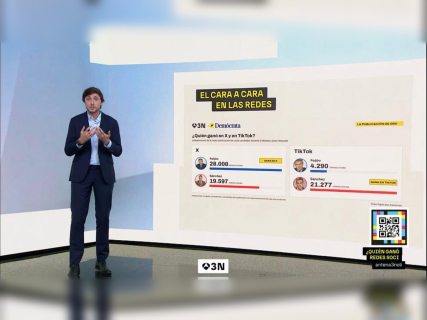
DEMOCRAT on Atresmedia analyzes on social media the face-to-face between Feijóo and Sánchez

The analysis by DEMÓCRATA at Atresmedia collects the reaction to the face-to-face between Sánchez and Feijóo on X, TikTok and Instagram in order to identify the best received moments, the interventions that generated the most conversation, and the publication with the greatest impact

atresmedia democrata 1200x900

atresmedia democrata 1200x900

Add DEMÓCRATA to Google

Ask FREN

Published

Last updated

2 minutes

Most read

Elecciones 29N · Encuestas

La media de las encuestas

Media a 20 de noviembre de 2026 · 19 institutos

  • PP31,0 %
  • PSOE27,8 %
  • Vox19,1 %
  • Frente Amplio6,2 %
  • ERC2,5 %
01020304050ene 2024jul 2024ene 2025jul 2025ene 2026jul 2026

Media del último estudio de cada instituto en 30 días y su evolución semanal desde el 23J. Partidos con al menos un 2 %.

Todas las encuestas

Elecciones generales del 29 de noviembre · Demócrata

The analysis by DEMÓCRATA at Atresmedia examines how social networks reacted to the face-to-face between Pedro Sánchez and Alberto Núñez Feijóo this Thursday. Based on 42,053 posts on X, TikTok and Instagram, the study shows greater acceptance for the PP candidate, who accounted for 35% of favorable posts compared with 24% for the President of the Government.

The research makes it possible to follow minute by minute the digital conversation of this debate taking place just a few days before 29N. Feijóo obtained 176,769 interactions with his interventions, compared with Sánchez’s 125,644, and he achieved a better reception during 74 minutes of the debate, compared with the socialist’s 19.

The differences also appear when examining the issues addressed. Feijóo obtained a higher proportion of favorable posts on corruption and pacts, while Sánchez achieved better results in social policy and the economy. On housing, both tied with 29% of favorable messages.

That’s how the networks reacted to the debate, minute by minute

The Poder Digital tool developed for this coverage allows you to consult the interventions that caused the most conversation, the changes in trend during the debate, and the best and worst moments for each candidate.

Among the phrases that generated the most reactions are Feijóo’s reproach about political responsibility, with 18,702 interactions, and his proposal to lower taxes for workers, with another 18,084.

The gold post from the head-to-head was from the PP on TikTok

The second analysis by DEMÓCRATA on Atresmedia examines the posts of the two candidates and of the official accounts of the PP and the PSOE that achieved the most interactions on the three platforms. The highest-impact post was a video disseminated by the Partido Popular on TikTok after the debate, accompanied by three silence emojis and the tags #FeijóoGana, #SanchezMiente and #CaraACara26.

The content accumulated 106.069 interactions and 561.281 views, a response thirty times higher than usual on the party account. Among the candidates’ personal profiles, Feijóo achieved more interactions on X, with 28.008, while Sánchez obtained the best results on TikTok, with 21.277, and on Instagram, with 34.531.

Both tools allow exploring the digital impact of the debate held on November 19, with data updated at 10:21 a.m. the following day. The analysis uses artificial intelligence to classify posts according to their reception toward each candidate. The results reflect the conversation on the platforms studied, not a representative survey of viewers nor an estimate of voting intention.

More key points, information and questions with FREN

AI-GENERATED CONTENT

What are the competencies and functions of the President of the Government of Spain according to the Constitution?

The President of the Government directs the action of the Executive and coordinates its members, but does not concentrate all the powers of the Government nor exercise the headship of State, which corresponds to the King. The Constitution distinguishes between the personal powers of the president and decisions that correspond to the Government as a whole, subject to parliamentary control.

1. Direction and coordination of the Government

Article 98.2 establishes his main function: "The President directs the action of the Government and coordinates the functions of the other members thereof, without prejudice to their direct competence and responsibility in their management."

Therefore, he sets the political orientation of the Executive and coordinates the ministers, without replacing them in all their decisions. Article 97 attributes to the Government collectively the direction of domestic and foreign policy, of the civil and military Administration and of the defense of the State, in addition to the executive function and regulatory power: to approve rules subordinate to laws.

2. Formation of the Executive and continuity

According to Article 100, he proposes to the King the appointment and dismissal of the other members of the Government. The formal decision corresponds to the monarch, but the proposal corresponds to the president.

His authority is supported by the confidence of the Congress: according to Article 99, the candidate presents his program and requests investiture, that is, parliamentary support to form a Government. Article 101 provides that the resignation or death of the president causes the cessation of the Government; the outgoing Executive continues in office until the new one takes office.

3. Relations with the King

Article 64 allows him to countersign the acts of the King, that is, to formally endorse them and assume responsibility for them; competent ministers may also do so. His own appointment is not countersigned by him, but by the president of the Congress.

In addition, he may request that the King preside over a session of the Council of Ministers to be informed of matters of State, according to Article 62.g. These relations do not make the president the head of State.

4. Parliamentary confidence and responsibility

Article 112 allows him to raise a question of confidence before the Congress on his program or a declaration of general policy, after deliberation of the Council of Ministers. It is approved by simple majority: more favorable votes than contrary. If he loses, the Government must present its resignation to the King, according to Article 114.

The Congress may also replace him through a constructive vote of no confidence: it must include an alternative candidate and obtain an absolute majority. If it succeeds, the Government resigns and the candidate is understood to have the parliamentary confidence —Articles 113 and 114—. The Government is jointly responsible for its management before the Congress, according to Article 108.

5. Dissolution of the Chambers and referendum

Article 115 allows him to propose to the King the dissolution of the Congress, the Senate or both Chambers, after deliberation of the Council of Ministers and under his exclusive responsibility. He cannot do so while a motion of no confidence is pending. Nor is another dissolution allowed before one year, except in the case of Article 99.5.

Likewise, he proposes to the King a consultative referendum on political decisions of special importance, with prior authorization from the Congress —Article 92—.

6. Constitutional guarantee and exceptional situations

He is entitled to file appeals of unconstitutionality —Article 162.1.a—. However, exceptional states are not a personal power of his: according to Article 116, the Government declares the alarm and, with prior authorization from the Congress, the exception; the Congress declares the siege by absolute majority, at the exclusive proposal of the Government. During these states the Congress cannot be dissolved.

What legal requirements must be met for a social media post by a political party to be considered electoral propaganda?

A post by a political party on social media can be considered electoral propaganda when its purpose is to attract votes for a political option, jointly assessing the message and its context. It does not need to literally include "vote for...", be a paid advertisement, or reach a certain number of people. Also, being electoral propaganda does not mean being illegal: its legality depends on the timing, the means used, and other applicable obligations.

1. Electoral purpose and content

The starting point is Article 50.4 of the Organic Law of the General Electoral Regime (LOREG), which defines the electoral campaign by activities aimed at attracting votes. To apply this criterion to a post, the following must be examined, especially:

  • The request for vote: it can be explicit or inferred from the overall message, for example, by requesting electoral support or continuity for a candidacy.
  • The promotion of an identifiable option: presentation of candidates, dissemination of proposals with electoral purpose, or mobilization against another candidacy.
  • Campaign elements: posters, videos, slogans, rally calls, images, and tags linked to the elections.
  • The context: proximity to the vote, repetition, coordination with other messages, and relation to an organized campaign.

These elements are indications, not cumulative requirements. A logo, criticism of an opponent, or a management report alone are not enough to turn any post into propaganda. Its electoral purpose must be appreciated through a joint assessment.

2. Difference from ordinary political communication

Parties can express opinions, explain positions, and participate in public debate without every intervention constituting an electoral campaign. The distinction matters because political freedom of expression does not disappear during an electoral process.

The STC 96/2010 explains that not even the reflection day prevents all manifestations related to political debate that may indirectly influence voters. Therefore, political influence does not automatically equate to electoral propaganda: an intention to attract votes must be identified.

3. Authorship and form of dissemination

On an official party account, the connection with the organization is usually clear. If a candidate's personal account is used or a third party intervenes, their link, instructions received, coordination, or financing must be assessed. The label of a personal account does not exclude the electoral nature of the content.

Payment is not necessary: an organic post can also be propaganda. Sponsorship, contracting, or targeting can reinforce indications of electoral purpose and add obligations on spending, transparency, and data protection, but do not replace the analysis of the message.

4. Timing determines restrictions

The date alone does not change the content of the message, but it does affect the conditions of its dissemination:

  • Before the campaign: ordinary political activity must be distinguished from premature propaganda and advertising contracting must be especially examined. Not all party communication is prohibited.
  • During the campaign: electoral messages may be disseminated, respecting legal limits on contracting, spending, and other obligations.
  • After the campaign: Article 53 prohibits disseminating propaganda and carrying out campaign acts. Republishing or promoting electoral content again must be differentiated from the mere passive permanence of previous posts.
5. Identification and public resources

Article 58 bis requires prominently identifying the electoral nature of electronic propaganda and providing an easy and free way to oppose it. These are dissemination obligations: hiding its electoral character does not prevent it from being propaganda.

Also, an institutional account is subject to neutrality: it cannot use public resources to favor a candidacy. The STC 25/2022 confirms this duty. Ultimately, the decisive question is whether the message seeks electoral support; then it is determined whether its dissemination respects the applicable rules.

What were the results of the last general elections in which Pedro Sánchez and Alberto Núñez Feijóo ran?

The last general elections held in which Pedro Sánchez and Alberto Núñez Feijóo ran were on July 23, 2023. Feijóo's PP obtained more votes and seats: 137 deputies, compared to the 121 of Sánchez's PSOE. However, neither reached the absolute majority of 176 deputies alone, and Sánchez ended up being invested president in November 2023.

The results of the two main candidates

The People's Party obtained 8,160,837 votes, equivalent to 33.06% of the national vote, and 137 seats. The PSOE, including the PSC-PSOE candidacies, gathered 7,821,718 votes, 31.68%, and 121 deputies. The PP's advantage was therefore 339,119 votes, 1.38 percentage points, and 16 seats. These are the definitive results recorded in the official BOE publication.

The difference between both results allows distinguishing two issues: who came first at the polls and who later obtained parliamentary support to govern. Feijóo led the most voted candidacy, but that first place did not automatically provide him with a sufficient majority in Congress.

The full distribution of Congress

The candidacies that obtained representation distributed the 350 seats as follows. The percentages correspond to the whole of Spain and are calculated over valid votes, according to the Congress results:

  • PP: 137 seats; 8,160,837 votes; 33.06%.
  • PSOE, including PSC-PSOE: 121 seats; 7,821,718 votes; 31.68%.
  • Vox: 33 seats; 3,057,000 votes; 12.38%.
  • Sumar: 31 seats; 3,044,996 votes; 12.34%.
  • Esquerra Republicana de Catalunya: 7 seats; 466,020 votes; 1.89%.
  • Junts per Catalunya: 7 seats; 395,429 votes; 1.60%.
  • EH Bildu: 6 seats; 335,129 votes; 1.36%.
  • EAJ-PNV: 5 seats; 277,289 votes; 1.12%.
  • Bloque Nacionalista Galego: 1 seat; 153,995 votes; 0.62%.
  • Coalición Canaria: 1 seat; 116,363 votes; 0.47%.
  • Unión del Pueblo Navarro: 1 seat; 52,188 votes; 0.21%.

An important clarification when reading this distribution: Podemos ran integrated within Sumar, not as a separate candidacy. That is why it does not appear with its own figure in the list. This circumstance must also be taken into account when comparing those results with later candidacies, as Demócrata notes in its comparison.

What the results meant for forming a Government

The absolute majority was set at 176 of the 350 deputies. The PP lacked 39 seats to reach it alone; the PSOE, 55. The sum of PP and Vox gave 170 deputies, six less than that threshold. The sum of PSOE and Sumar reached 152, so it was also not enough without support from other candidacies.

These sums describe only the arithmetic of the electoral result: they do not by themselves equate to a majority for investiture. The distribution forced negotiations for additional support. Feijóo's investiture attempt did not succeed and Sánchez ended up gathering the necessary support to be invested in November 2023. The role of other formations in that legislature is explained in this Demócrata analysis.

In short, if the question is who won in votes and seats, the answer is Feijóo's PP. If it is who managed to form a Government afterwards, it was Pedro Sánchez. These are two different results of the same process: first, the distribution decided by the voters; then, the formation of a parliamentary majority.

Play

Test your knowledge with FREN!

How much do you know about this topic? Answer the following 3 questions.

On which platform was the video with the greatest impact published after the debate between Feijóo and Sánchez?

Question 1 of 3

How many interactions did the Popular Party's video receive on TikTok after the debate?

Question 2 of 3

In which topics did Sánchez achieve better results in favorable posts during the debate?

Question 3 of 3