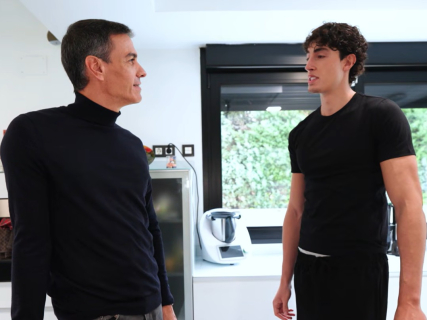
This was Pedro Sánchez’s conversation with Plex: "I’m a big fan of Andorra, but on vacation, not to live there"

The president spoke about taxes, housing, social networks and depopulation, and also reviewed his personal hobbies during the visit to the home of the content creator.

Plex sánchez

Plex sánchez

Add DEMÓCRATA to Google

Ask FREN

Published

Last updated

1 minute

Most read

Hasta el día de las elecciones (29 de noviembre) se muestran los resultados de las elecciones generales anteriores, las del 23 de julio de 2023.

Resultados de las elecciones generales del 29N en directo

Elecciones generales del 23 de julio de 2023 · Congreso de los DiputadosSenado

Escrutado: 100,00 %Votantes: 24.952.447Participación: 66,59 %

Votos

PartidoEscañosVotosPorcentaje
PP1378.160.83733,06 %
PSOE1217.821.71831,68 %
Vox333.057.00012,38 %
Sumar313.044.99612,33 %
ERC7466.0201,89 %
Junts7395.4291,60 %
EH Bildu6335.1291,36 %
EAJ-PNV5277.2891,12 %
BNG1153.9950,62 %
CCa1116.3630,47 %
UPN152.1880,21 %
PACMA0169.2370,69 %
CUP-PR099.6440,40 %
FO046.2740,19 %
NC-bc045.5950,18 %
PDeCAT-E-CiU032.0160,13 %
RECORTES CERO023.4210,09 %
PUM+J023.2900,09 %
U.P.L.023.2010,09 %
EXISTE020.4400,08 %
PCTE013.3820,05 %
GBAI099380,04 %
SY096970,04 %
Adelante091910,04 %
JM+082930,03 %
ESCAÑOS EN BLANCO079860,03 %
XAV073620,03 %
BQEX058070,02 %
CJ056200,02 %
FE de las JONS046830,02 %
PAR041730,02 %
PCTC038750,02 %
ESPAÑA VACIADA031580,01 %
PH029020,01 %
ASTURIAS EXISTE EV023140,01 %
XH019310,01 %
VP019170,01 %
Zsi018430,01 %
VB017740,01 %
POR MI REGIÓN016980,01 %
AHORA CANARIAS-PCPC016740,01 %
PARTIDO AUTÓNOMOS014460,01 %
EVB014420,01 %
CpM012980,01 %
JxG012180,00 %
EV-PCAS-TC011840,00 %
PREPAL09640,00 %
Somos Cc09630,00 %
ALM08740,00 %
PCTG07020,00 %
F.I.A.05060,00 %
3e04840,00 %
Ud.Ca04630,00 %
ESCONS EN BLANC04620,00 %
GITV03660,00 %
PUEDE02690,00 %
EVC02650,00 %
LB02630,00 %
PCTE/ELAK02590,00 %
UNIDOS SI02530,00 %
+RDS+01650,00 %
CCD01530,00 %
FUERZA CÍVICA01150,00 %

Porcentajes sobre votos válidos. Resultados definitivos del 23J de 2023.

Escaños (350)

Mayoría: 176
PP: 137 escaños en 2023PSOE: 121 escaños en 2023Vox: 33 escaños en 2023Sumar: 31 escaños en 2023ERC: 7 escaños en 2023Junts: 7 escaños en 2023EH Bildu: 6 escaños en 2023EAJ-PNV: 5 escaños en 2023BNG: 1 escaño en 2023CCa: 1 escaño en 2023UPN: 1 escaño en 2023137121333120232023
  • PP 137
  • PSOE 121
  • Vox 33
  • Sumar 31
  • ERC 7
  • Junts 7
  • EH Bildu 6
  • EAJ-PNV 5
  • BNG 1
  • CCa 1
  • UPN 1

Pactómetro

Pulsa los partidos para sumar sus escaños.

Los escaños más ajustados

Quién tiene el último escaño, quién le sigue y los votos que le faltan
  1. GironaJxCAT - JUNTSyPP285 votos

    El último escaño de Girona (el 6.º) es para JxCAT - JUNTS. Le sigue el PP, que necesitaría 285 votos más para quitárselo. Ver Girona ›

  2. CantabriaVOXyPP403 votos

    El último escaño de Cantabria (el 5.º) es para VOX. Le sigue el PP, que necesitaría 403 votos más para quitárselo. Ver Cantabria ›

  3. TarragonaJxCAT - JUNTSyPSC1247 votos

    El último escaño de Tarragona (el 6.º) es para JxCAT - JUNTS. Le sigue el PSC, que necesitaría 1247 votos más para quitárselo. Ver Tarragona ›

  4. AlbacetePSOEyVOX1412 votos

    El último escaño de Albacete (el 4.º) es para el PSOE. Le sigue VOX, que necesitaría 1412 votos más para quitárselo. Ver Albacete ›

  5. SalamancaPPyPSOE1495 votos

    El último escaño de Salamanca (el 4.º) es para el PP. Le sigue el PSOE, que necesitaría 1495 votos más para quitárselo. Ver Salamanca ›

Provincias con al menos el 30 % escrutado donde el último escaño cambiaría de manos con menos votos. Pulsa una para ver el detalle.

Senado

100,00 % escrutado
PartidoSenadores
PP120
PSOEPSOE: 73 senadoresSe presenta con estos nombres:
  • PSOE48
  • PSC12
  • PSdeG-PSOE4
  • PSE-EE (PSOE)4
  • PSN-PSOE3
  • PSIB-PSOE1
  • PSOE-SUMAR-EUIB-ARA EIVISSA1
73
EH Bildu4
EAJ-PNV4
ERCERC: 3 senadoresSe presenta con estos nombres:
  • ERC-ESQUERRES PER LA INDEPENDÈNCIA2
  • ERC1
3
Junts1
UPN1
A.H.I.1
ASG1

Los partidos que se presentan con varios nombres van juntos: pasa por encima para ver el detalle. Baleares y Canarias eligen sus senadores por islas.

Senadores (208)

Elegidos en las urnas
PP: 120 senadores en 2023PSOE: 73 senadores en 2023 (PSOE: 48; PSC: 12; PSdeG-PSOE: 4; PSE-EE (PSOE): 4; PSN-PSOE: 3; PSIB-PSOE: 1; PSOE-SUMAR-EUIB-ARA EIVISSA: 1)EH Bildu: 4 senadores en 2023EAJ-PNV: 4 senadores en 2023ERC: 3 senadores en 2023 (ERC-ESQUERRES PER LA INDEPENDÈNCIA: 2; ERC: 1)Junts: 1 senador en 2023UPN: 1 senador en 2023A.H.I.: 1 senador en 2023ASG: 1 senador en 20231207320232023
  • PP 120
  • PSOE 73
  • EH Bildu 4
  • EAJ-PNV 4
  • ERC 3
  • Junts 1
  • UPN 1
  • A.H.I. 1
  • ASG 1

Los senadores designados por los parlamentos autonómicos no se eligen en las urnas.

Mapa

Ganador por provincia

    CanariasCeutaMelillaAraba/Álava: PSE-EE (PSOE) 27,7 %Albacete: PP 39,9 %Alicante/Alacant: PP 36,7 %Almería: PP 40,9 %Ávila: PP 43,3 %Badajoz: PSOE 39,2 %Illes Balears: PP 35,6 %Barcelona: PSC 35,7 %Burgos: PP 40,6 %Cáceres: PSOE 38,9 %Cádiz: PP 34,8 %Castellón/Castelló: PP 35,2 %Ciudad Real: PP 40,5 %Córdoba: PP 37,9 %A Coruña: PP 43,1 %Cuenca: PP 39,8 %Girona: PSC 28,9 %Granada: PP 37,0 %Guadalajara: PP 36,3 %Gipuzkoa: EH Bildu 31,2 %Huelva: PP 36,4 %Huesca: PP 38,2 %Jaén: PP 37,3 %León: PP 36,9 %Lleida: PSC 29,5 %La Rioja: PP 45,6 %Lugo: PP 50,2 %Madrid: PP 40,6 %Málaga: PP 38,3 %Murcia: PP 41,2 %Navarra: PSN-PSOE 27,4 %Ourense: PP 50,0 %Asturias: PP 35,7 %Palencia: PP 42,0 %Las Palmas: PSOE 33,2 %Pontevedra: PP 39,7 %Salamanca: PP 46,9 %Santa Cruz de Tenerife: PP 35,4 %Cantabria: PP 42,1 %Segovia: PP 45,0 %Sevilla: PSOE 36,6 %Soria: PP 37,2 %Tarragona: PSC 32,9 %Teruel: PP 35,0 %Toledo: PP 37,8 %Valencia/València: PP 33,6 %Valladolid: PP 40,8 %Bizkaia: EAJ-PNV 26,9 %Zamora: PP 44,7 %Zaragoza: PP 36,0 %Ceuta: PP 38,8 %Melilla: PP 49,2 %

    Pulsa una provincia para ver sus resultados y elegir municipio.

    Mapa

    Partido con más senadores por provincia

    CanariasCeutaMelillaAraba/Álava: PSOE, 3 de 4 senadoresAlbacete: PP, 3 de 4 senadoresAlicante/Alacant: PP, 3 de 4 senadoresAlmería: PP, 3 de 4 senadoresÁvila: PP, 3 de 4 senadoresBadajoz: PSOE, 2 de 4 senadoresIlles Balears: PP, 3 de 6 senadoresBarcelona: PSOE, 3 de 4 senadoresBurgos: PP, 3 de 4 senadoresCáceres: PP, 2 de 4 senadoresCádiz: PP, 3 de 4 senadoresCastellón/Castelló: PP, 3 de 4 senadoresCiudad Real: PP, 3 de 4 senadoresCórdoba: PP, 3 de 4 senadoresA Coruña: PP, 3 de 4 senadoresCuenca: PP, 3 de 4 senadoresGirona: PSOE, 3 de 4 senadoresGranada: PP, 3 de 4 senadoresGuadalajara: PP, 3 de 4 senadoresGipuzkoa: EH BILDU-INDEPENDENTZIA EZKERRETIK, 3 de 4 senadoresHuelva: PP, 2 de 4 senadoresHuesca: PP, 3 de 4 senadoresJaén: PP, 3 de 4 senadoresLeón: PP, 3 de 4 senadoresLleida: PSOE, 3 de 4 senadoresLa Rioja: PP, 3 de 4 senadoresLugo: PP, 3 de 4 senadoresMadrid: PP, 3 de 4 senadoresMálaga: PP, 3 de 4 senadoresMurcia: PP, 3 de 4 senadoresNavarra: PSOE, 3 de 4 senadoresOurense: PP, 3 de 4 senadoresAsturias: PP, 3 de 4 senadoresPalencia: PP, 3 de 4 senadoresLas Palmas: PSOE, 4 de 5 senadoresPontevedra: PP, 3 de 4 senadoresSalamanca: PP, 3 de 4 senadoresSanta Cruz de Tenerife: PSOE, 3 de 6 senadoresCantabria: PP, 3 de 4 senadoresSegovia: PP, 3 de 4 senadoresSevilla: PSOE, 3 de 4 senadoresSoria: PP, 3 de 4 senadoresTarragona: PSOE, 3 de 4 senadoresTeruel: PP, 3 de 4 senadoresToledo: PP, 3 de 4 senadoresValencia/València: PP, 2 de 4 senadoresValladolid: PP, 3 de 4 senadoresBizkaia: EAJ-PNV, 3 de 4 senadoresZamora: PP, 3 de 4 senadoresZaragoza: PP, 3 de 4 senadoresCeuta: PP, 2 de 2 senadoresMelilla: PP, 2 de 2 senadores

    Pulsa una provincia para ver sus senadores y candidatos.

    Resultados definitivos de las elecciones generales del 23 de julio de 2023 (Ministerio del Interior). Mapas: Instituto Geográfico Nacional (es-atlas, CC BY 4.0). Demócrata.

    "I’m a big fan of Andorra, but on vacation, not to live". It was one of the phrases left behind by Pedro Sánchez during the conversation he held with the content creator Plex, Daniel Alonso Agúndez, after being asked about the youtubers who move their residence to the Principality in order to benefit from lower taxation.

    The Government president defended that those who achieve their professional success mainly in Spain should stay in the country and contribute to the upkeep of public services. "If the victory and success are achieved in Spain mainly, then it’s good to stay here in Spain, right? Pay taxes in Spain, also contribute to having a quality public education, healthcare," he replied.

    The talk was published on November 25 on Plex’s YouTube channel, which hosted Sánchez at his home. The meeting combined questions about the president’s career path and personal preferences with political and economic issues.

    The Lamborghini and the controversy over public transport

    Another moment from the visit came when Plex showed the president his garage and his vehicles, including a Lamborghini. The content creator then recalled Sánchez’s phrase "more public transport and fewer Lamborghinis," which had upset him because he considers luxury cars compatible with the defense of good public transport.

    The president clarified the meaning of his earlier comment and gave him credit that both things can coexist. "That if then the people want to have their Lamborghini, let them," he said during the conversation.

    A conversation about politics and personal matters

    The interview also covered housing, taxes, and the regulation of social networks. Regarding renting, Sánchez defended tax incentives for small property owners as a formula to increase the supply of housing at affordable prices, a position he contrasted with the measures he attributed to his left-wing partners.

    On the personal side, the president spoke with Plex about his interest in cycling and explained that he practices enduro. He also said that this sport allows him to release adrenaline and that wearing a helmet helps him be able to pass more unnoticed during his outings.

    More key points, information and questions with FREN

    AI-GENERATED CONTENT

    What parliamentary phase is the latest reform on the taxation of YouTubers or content creators in Spain currently in?

    As of November 26, 2026, no specific parliamentary reform on the taxation of YouTubers or content creators is identified as still being in process. The tax project related to the digital economy found in the consulted sources, concerning VAT in the digital era, expired on October 6, 2026. Therefore, it would not be correct to currently describe it as pending amendments or as a new tax law for influencers.

    The digital VAT project: expired, not pending

    This is the Draft Law modifying Law 37/1992, of December 28, on Value Added Tax, for the partial transposition of Directive (EU) 2025/516 of the Council, of March 11, 2025, on VAT rules in the digital era. It was presented by the Government on June 19, 2026, with parliamentary file 121/000101.

    During its course, it was in the Finance and Public Function Committee, in the amendment phase: the moment when groups can propose changes to the text. However, subsequent parliamentary information confirms its expiration on October 6, coinciding with the dissolution of the Cortes. This is the prevailing status over previous references to its processing. It can be consulted in the official Congress information.

    Moreover, its purpose was to adapt VAT to digitalization, not to establish a special personal income tax, tax residence, or social security regime for YouTubers. That a reform may affect digital activities does not mean it is specifically aimed at content creators.

    Another proposal with measures for digital freelancers

    There is also an initiative more directly linked to platform work: the Comprehensive Reform Draft Law on Self-Employment, published on June 26, 2026. It included a definition of economically dependent self-employed workers in the digital field, along with changes on deductible expenses and tax obligations. However, it was withdrawn on September 11, 2026, so it also does not continue its parliamentary course. (Text of the proposal; publication of the withdrawal).

    Do not confuse taxation with audiovisual regulation

    Another possible reference is the influencer regulation announced in 2024. This addresses content, advertising, and audiovisual obligations, not a specific reform of their taxes. The official explanation uses income and audience to determine which creators are subject to certain obligations; using an economic threshold to delimit its application does not equate to creating a tax. This is presented in the official Moncloa note.

    Separately, the Organic Draft Law for the protection of minors in digital environments contained changes in creators' obligations of special relevance, but it also expired on October 6, 2026. Its content was about protection and audiovisual supervision, not a tax regime for YouTubers. (Congress file).

    In conclusion: the consulted sources do not allow attributing an active parliamentary phase to a supposed "latest tax reform for YouTubers." The identified related initiatives are expired or withdrawn. To interpret news on this matter, it is essential to distinguish between a general tax proposal, audiovisual regulation, and a political announcement: they do not have the same purpose nor produce the same effects.

    What are the powers and attributions of the Prime Minister according to the Spanish Constitution?

    The 1978 Spanish Constitution establishes the Prime Minister as the highest authority of the executive power and the central figure of the parliamentary system. His powers are scattered across several provisions, mainly articles 97, 98, 99, 100, and 112 to 116 of the Constitution. Below is a summary of his essential attributions according to the Constitution, differentiating the main blocks of functions.

    1. Direction of Government action (art. 97 CE)

    Article 97 establishes the core of his position: the Government directs domestic and foreign policy, the civil and military administration, and the defense of the State; and the Prime Minister directs the Government's action and coordinates the functions of the other members. From this derive several ideas:

    • Head of the executive power: although formally the Government is a collegiate body, the Prime Minister sets the broad lines of government policy.
    • Coordination of ministers: organizes the work of the Council of Ministers, distributes tasks, resolves conflicts between ministries, and ensures the coherence of the Executive's action.
    • Political leadership: sets legislative priorities, public spending, foreign policy, and defense, in interaction with the Cortes and the King.
    2. Appointment, dismissal, and composition of the Government (art. 98 CE)

    Article 98 reinforces his role as "head of the government team":

    • Proposal of ministers: the King appoints and dismisses other Government members at the Prime Minister's proposal. In practice, the Prime Minister freely chooses his ministers.
    • Government reorganization: he can propose structural changes (create, suppress, or rename ministries) and partial or total cabinet reshuffles.
    • Joint responsibility: the Government is politically responsible jointly before the Congress, but leadership and main responsibility concentrate in the Prime Minister.
    3. Confidence relationship with the Congress of Deputies (arts. 99, 112, 113, 114 CE)

    In the parliamentary system, the Prime Minister's legitimacy depends on the Congress majority:

    • Investiture (art. 99): the Prime Minister is appointed by the King, but only after obtaining the Congress's confidence through an investiture vote. Without that confidence, there can be no effective appointment.
    • Vote of confidence (art. 112): the Prime Minister can submit his program or a general policy statement to the Congress to decide whether to maintain support. It is an exclusive initiative of the Prime Minister.
    • Motion of censure (arts. 113 and 114): although initiated by the Congress, it directly affects him: if a motion of censure passes, the Prime Minister is automatically dismissed and replaced by the alternative candidate included in the motion.
    • Political responsibility: all Government action, directed by the Prime Minister, is subject to parliamentary control (questions, interpellations, investigative commissions, etc.).
    4. Appointment and dismissal (arts. 99, 100 CE)

    The Constitution also sets the formal framework for his access and exit from office:

    • Appointment by the King: once confidence is achieved in the Congress, the King appoints the Prime Minister. It is a mandatory act: the monarch cannot choose anyone other than the invested candidate.
    • Dismissal: the Prime Minister ceases due to loss of parliamentary confidence (motion of censure or failure to pass a vote of confidence), resignation, death, or after general elections when a new Congress is constituted and another Prime Minister is appointed.
    • Continuity in office: after dismissal, the Prime Minister and Government remain in office until the new ones take office, with limited powers.
    5. Relationship with the King and other relevant functions

    Although many formal powers are attributed to the King, in a parliamentary system they are exercised at the proposal or countersignature of the Prime Minister and his ministers. From the constitutional perspective:

    • Participation in the dissolution of the Cortes (art. 115 CE): the Prime Minister can propose to the King the dissolution of the Congress, the Senate, or the Cortes Generales and the calling of elections, with certain time limits.
    • States of crisis (arts. 116 CE): it corresponds to the Government, under the Prime Minister's direction, to propose and manage the declaration of states of alarm, exception, and siege, with Congress intervention.
    • Government countersignature: the King's acts require countersignature by the Prime Minister or the competent ministers. This countersignature implies that political responsibility for such acts lies with the Government, not the monarch.
    6. Summary

    Overall, the Constitution positions the Prime Minister as:

    • Effective head of the executive power and coordinator of the Council of Ministers.
    • Political leader who sets the broad orientations of state policy.
    • Key figure in the relationship between Government and Congress, on whose confidence his continuity depends.
    • Main interlocutor of the King in ordinary political life and in the most relevant institutional decisions.

    All this configures a politically strong Prime Minister, but always subject to parliamentary confidence and the constitutional framework.

    How is the investiture procedure of the Prime Minister developed step by step according to the Constitution? What differences exist between the powers of the Prime Minister and those of the King in the Spanish constitutional system? What limitations does the Prime Minister have when acting in a caretaker capacity after general elections?

    What legal requirements must residents in Spain meet to transfer their tax residence to Andorra?

    To legally transfer tax residence from Spain to Andorra, it is not enough to just change the address with the Tax Agency or obtain an Andorran permit. A real transfer is necessary, fulfilling applicable tax conditions and proving the facts. Additionally, three issues must be distinguished: tax domicile, tax residence, and administrative authorization to live in Andorra.

    1. Cease to be a tax resident in Spain

    Article 9 of the Personal Income Tax Law establishes alternative criteria: meeting one of the first two is enough to continue being a Spanish resident. According to the Tax Agency, the following must be reviewed:

    • Presence: not staying in Spain more than 183 days during the calendar year. Sporadic absences may be counted as presence in Spain if tax residence in another country is not proven.
    • Economic interests: not maintaining in Spain the main base or center of activities or economic interests, directly or indirectly. Spending fewer days in Spain does not neutralize this criterion.
    • Family: there is a presumption, which admits proof to the contrary, when the spouse not legally separated and dependent minor children habitually reside in Spain.

    It is not mandatory to sell all Spanish assets or abandon any economic relationship with Spain: what matters is where the real center of interests is located.

    2. Comply with Andorran conditions

    The corresponding residence authorization must be obtained, depending on whether one works as an employee, carries out own activity, or requests residence without lucrative activity. Administrative requirements vary: they may include housing, economic means, health coverage, and depending on the modality, employment, business activity, or investment.

    For tax purposes, Andorra considers staying more than 183 days per calendar year or the location of the main center of activities or economic interests. The administrative minimum of approximately 90 days associated with certain passive residencies does not guarantee by itself ceasing to be taxed as a Spanish resident. The amounts required for these authorizations must be verified according to the modality and current regulations; there is no single investment applicable to any transfer.

    3. Resolve possible dual residency

    If both countries consider the same person a resident, the bilateral treaty provides successive criteria: permanent home, center of vital interests — personal and economic relations —, habitual residence, nationality, and agreement between authorities. These criteria are not options the taxpayer can freely choose.

    It is advisable to obtain the Andorran tax residence certificate and keep consistent evidence: housing, travel, consumption, professional activity, and tax declarations. The Fide explanation highlights the importance of jointly assessing economic, family, and personal ties.

    4. Communicate the change and review its consequences
    • Census communication: notify the Tax Agency of the new address and residence change using form 030 when applicable. The communication does not replace the material fulfillment of the requirements.
    • Exit tax: article 95 bis may tax unrealized gains on shares or participations if the taxpayer was a resident for at least 10 of the previous 15 years and their total value exceeds four million euros; it also covers participations of at least 25% whose value exceeds one million.
    • Subsequent Spanish obligations: may remain for rentals, sales of real estate and other assets or Spanish income, according to the non-resident regime and the treaty.

    In short, the key is to actually move and be able to prove it. Before executing the move, it is especially important to review the year of change, family situation, business participations, and obligations that remain in Spain.

    Play

    Test your knowledge with FREN!

    How much do you know about this topic? Answer the following 3 questions.

    With whom did Pedro Sánchez have a conversation that was published on YouTube on November 25?

    Question 1 of 3

    What measure did Pedro Sánchez advocate to increase the supply of affordable housing?

    Question 2 of 3

    What sport does Pedro Sánchez practice to release adrenaline and go unnoticed?

    Question 3 of 3