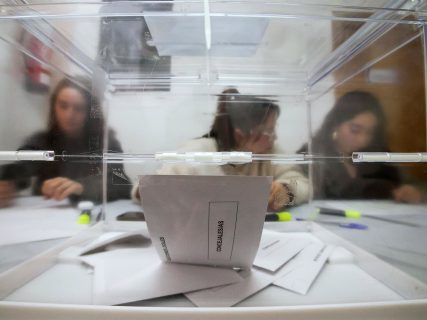

At 9:00 p.m. this Sunday, when the polling stations in the Canary Islands have closed, the first provisional results from the general elections of 29N will begin to be released. Seats will start to change hands on screens as the count progresses, but the first photograph of the ballot boxes doesn’t have to look like the last.
Three years ago, in the general elections of July 23, 2023, the PSOE was ahead of the PP in the early stages of the count. With 10% counted, the socialists obtained 129 seats, compared with the PP’s 122. We had to wait until more than half of the count had been completed for Alberto Núñez Feijóo’s candidacy to move ahead of Pedro Sánchez’s.
The order in which results are incorporated is not random. Polling tables with fewer ballots may finish before the larger ones, and the distribution of the vote is not homogeneous across different territories either. The pace at which results from each constituency arrive can substantially alter the provisional distribution of the 350 seats in the Congress.
Demócrata will broadcast live the 29N election day, with live results, the progress of the count, the allocation of seats, and possible parliamentary majorities through its special report on the general elections.
This is how the distribution of seats changed during the night of 23J
The PP and Vox added up to 153 seats when 10% of the votes had been counted in 2023. By the end of the election night they reached 169, sixteen more than in the early stages of the count.
While the PP was gaining parliamentary representation as new certificates from the polling tables were added, the PSOE reached 133 seats before it began to lose seats.
The night ended with 136 PP deputies, 122 from the PSOE, 33 from Vox, and 31 from Sumar. The final result, however, would still experience one last modification: the inclusion of the vote of Spaniards resident abroad and the general count gave the PP an additional seat for Madrid at the expense of the PSOE. The final distribution stood at 137 and 121 deputies, respectively.
Madrid, one of the keys of the count
At 9:31 p.m. on July 23, 2023, Spain had already counted 31% of the votes. However, while in the Valencian Community the count reached 40%, in Madrid it still had not reached 5%, according to the information shared at the time by EFE.
The difference is relevant because Madrid is the constituency that provides the most deputies to the Congress. Its weight in the composition of the Chamber means that the incorporation of its results can significantly alter the national distribution of seats.
At 9:53 p.m., with 53% counted, the PP overtook the PSOE. The conservatives then obtained 131 deputies and the socialists, 130.
The size of the municipalities, the number of ballots deposited in each table, and the time needed to complete and transmit the records condition the speed of the count. Not all provinces arrive at the same time, and not all have the same weight in Congress.
Differences in voting between small and large tables
The size of the polling tables also provides clues for understanding what happened in 2023. An analysis by Santiago Calvo López, prepared based on the results of the Ministry of the Interior, shows differences in electoral behavior within the cities themselves.
The author ordered the tables of the municipalities that had at least 50 polling tables according to the number of ballots deposited and grouped them into five sets.
In the 20% of tables with fewer ballots, the PP and Vox, including UPN in the grouping used by the author, obtained together 41.7% of the votes. The PSOE reached 36.8%.
On the other end, in the 20% of tables with the highest volume of votes, the total rose to 49.6%, while the Socialists stood at 29%.
The analyzed tables go from about 310 ballots on average in the first group to about 590 in the last. The vote difference between the two groups helps to understand why the order in which the tables are incorporated can modify the provisional results.
However, the analysis does not directly measure how long it took each table to transmit its results. It also does not include all Spanish municipalities. It describes a voting pattern associated with the size of the tables in 2023, not a rule that necessarily will be repeated this Sunday.
At what time will the first results of the 29N be known
The dissemination of the provisional results will begin starting at the 21.00 hours Peninsular time on Sunday, 29 November, once the polling stations in the Canary Islands have closed.
The members of the polling stations in the Peninsula, the Balearic Islands, Ceuta and Melilla will therefore have one hour’s advantage over those in the Canary Islands archipelago to begin the count.
The count is carried out manually. The Organic Law of the General Electoral Regime (LOREG) establishes that the scrutiny is public and that, in general elections, the ballot papers for the Congress are counted first and then those for the Senate.
The time difference with the Canary Islands explains why the results from the first Peninsula polling stations are not disseminated immediately. The Central Electoral Board maintains the criterion that the provisional data should not be made public while the Canary Islands polling stations remain open.
Three keys to interpret the election results
In the 2023 elections, less than an hour passed between the dissemination of the first results, which placed the PSOE ahead of the PP, and the moment when the conservatives took the lead in the distribution of seats. The final composition of the Congress would still take several days to be resolved.