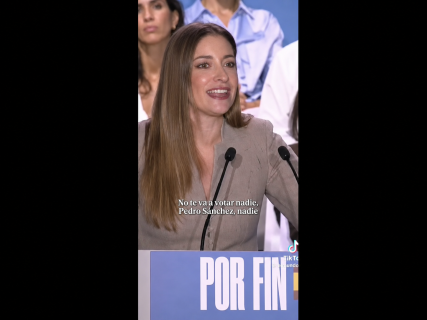
“Yo sí te voy a votar”: the viral song that has turned a PP attack on Sánchez into a campaign phenomenon

A sentence by Ester Muñoz has given rise to a trend that accumulates millions of views on TikTok, Instagram, and X. Citizens, socialist leaders, and television faces have joined a phenomenon that Sánchez himself already claims as the song of 29N

Mujer hablando en podio durante un mitin

Mujer hablando en podio durante un mitin

Add DEMÓCRATA to Google

Ask FREN

Published

Last updated

4 minutes

Most read

Elecciones 29N · Encuestas

La media de las encuestas

Media a 18 de noviembre de 2026 · 17 institutos

  • PP31,4 %
  • PSOE27,4 %
  • Vox19,0 %
  • Frente Amplio6,1 %
  • ERC2,4 %
  • SALF2,0 %
01020304050ene 2024jul 2024ene 2025jul 2025ene 2026jul 2026

Media del último estudio de cada instituto en 30 días y su evolución semanal desde el 23J. Partidos con al menos un 2 %.

Todas las encuestas

Elecciones generales del 29 de noviembre · Demócrata

What began as an attack by the PP on Pedro Sánchez has ended up turning into one of the viral phenomena of the 29N election campaign. "Yo sí te voy a votar" accumulates millions of views on social networks and has triggered a wave of videos in which anonymous citizens, PSOE leaders and well-known figures dance and respond to a line from Popular spokesperson Ester Muñoz. The success has been such that the Prime Minister himself has taken ownership of the song and proclaimed it the soundtrack of the campaign.

The formula that has conquered TikTok, Instagram and X is simple. The videos begin with a fragment of Muñoz's speech, in which she stated that no one would vote for Sánchez, and continue with a catchy-rhythm song that replicates: "Yo sí, yo sí te voy a votar, Pedro Sánchez". From there, each user adds their own dance, gesture or interpretation. The repetition of the same audio in hundreds of posts has turned a political statement into a collective trend of support for the socialist candidate.

Among those who have joined the phenomenon are the minister Óscar Puente, the former Government delegate in the Valencian Community Pilar Bernabé, the minister Diana Morant and the MEP Iratxe García. The presenter Jorge Javier Vázquez has also taken part, posting a video on Instagram responding to the Popular leader with a resounding "Yo sí". His participation has helped spread the trend beyond the usual accounts for political content.

An attack by the PP turned into a campaign in favor of Sánchez

The origin of the trend goes back to October 26, when a PP rally was held in Salamanca at which Alberto Núñez Feijóo participated. There, Ester Muñoz issued a warning to the head of the Government: "No te va a votar nadie, Pedro Sánchez, nadie". The phrase, conceived as a criticism of the socialist leader, would end up providing the material for a response that has multiplied on social media.

The one who decided to put music to it was Adrián, a 42-year-old cook living in Valencia who heard those words while watching the news on television. As he has recounted to El País, he responded spontaneously that he would vote for Sánchez and began writing a song. He then used an artificial intelligence program to create the music and made around two dozen versions until he found a melody that convinced him.

The song did not come from an initiative organized by Ferraz. Adrián told the aforementioned newspaper that he sent the song to the PSOE through social media, but that he did not receive a reply. Sources from the socialist leadership also said they did not know who was behind the composition. Despite this, the party and numerous public officials have ended up taking advantage of his popularity to spread their own videos.

The Socialist vote becomes a TikTok challenge

A large part of its success lies in the ease of reproducing the format. There’s no need to elaborate a speech or record a complex video: it’s enough to use the fragment from Ester Muñoz, add the song, and appear responding to her statement. Participants thus turn their intention to vote into a public declaration, often accompanied by humor, choreographies, or gestures directed at the popular spokesperson.

The trend has brought together users of different ages, including young people and pensioners, and it has found traction both on personal accounts and on profiles linked to socialist groups. The PSOE of Ibiza, for example, has shared a recording in which several participants dance to the song from a canopy set up in a city park.

Virality has allowed the PSOE to benefit from a spontaneous campaign that its supporters reproduce and distribute among their own digital communities. In contrast to the messages crafted by the parties’ communications teams, the appeal of this trend lies precisely in the fact that each participant adapts the same content and shares it from their personal account.

Its spread, however, does not make it possible to know how many people will change their vote or go to the polls thanks to the song. The number of views reflects interest and the circulation of the content on the platforms, but it does not equate to electoral support of the same magnitude.

Sánchez claims the song, and the PP responds with another version

Pedro Sánchez himself ended up incorporating the phenomenon into his election speeches. During an event held this Tuesday in Albacete, he ironically thanked Ester Muñoz and the Partido Popular for their contribution to the trend. "I don’t know what will be the song of the summer, but I do know which song is the one from this campaign: 'Yo sí te voy a votar'," said the socialist candidate.

The popularity of the song has even prompted a response from the PP of the Community of Madrid, which has used artificial intelligence to create its own version. In it, the chorus is sung by the former minister José Luis Ábalos, his former adviser Koldo García, Santos Cerdán, and Leire Díez, in a reference to the corruption controversies that have affected the socialist circle.

The dispute over the meaning of the song illustrates the weight that viral content has acquired in the 29N campaign. While the candidates seek an audience in podcasts, entertainment programs, and digital platforms, a composition created by a particular citizen has managed to make its way into the election speeches of the main parties.

Its author, who works as a cook at a hotel chain, has explained that he does not charge for the views and that his intention was to contribute his “grain of sand” to the campaign. Meanwhile, the melody continues to circulate through social networks, where each new video restores Ester Muñoz’s original words in order to give them the opposing answer.

More key points, information and questions with FREN

AI-GENERATED CONTENT

What is the current status of the processing of the PSOE's electoral proposals for November 29?

The PSOE's electoral proposals for November 29 are part of their electoral program, that is, a political document of commitments and lines of action. As such, they are not yet in parliamentary or governmental “processing”. Processing only begins when, after the elections, a Government or parliamentary group turns those proposals into formal initiatives (laws, decrees, PNLs, plans, etc.).

In strictly legal and procedural terms, the PSOE program proposals (like those of any other party) are currently in a phase we could call political pre-commitment:

  • They are not norms: they do not have the rank of law, royal decree, royal decree-law, or other general provision. They are only promises or intentions collected in a programmatic text.
  • They are not registered as initiatives in the Congress or Senate: they do not yet exist as government bill projects, parliamentary group bills, non-legislative proposals, motions, or other types of control or promotion initiatives.
  • They have not entered the formal processing circuit: they have not been qualified by the Chamber's Board, nor submitted for consideration, nor referred to committee, nor are they in the amendment, working group, report, or Plenary phase.

What does exist now is a political link between those proposals and the party's future actions:

  • The program constitutes the political offer that the PSOE presents to the electorate for November 29: it serves as a basis for the vote request and campaign debates.
  • If the PSOE becomes part of the Government after the elections, the program is usually one of the references for the eventual coalition or investiture agreement, where some of those proposals are specified, prioritized, or qualified.
  • From there, some of those measures will indeed be translated into normative or public policy initiatives with specific processing (draft bills approved by the Council of Ministers, royal decree-laws, bills sent to Parliament, sectoral plans and strategies, etc.).

It is important to distinguish between three different levels:

  • Programmatic level (current situation): the PSOE formulates commitments in its program for November 29. At this level, there is no “processing” in the legal sense; there is only drafting, internal approval of the program by the party, dissemination to the public, and political debate.
  • Governmental level (if it enters the Government): some proposals are specified in decisions of the Council of Ministers (for example, the approval of a draft bill or a royal decree-law). This is where the internal Executive processing begins and, if applicable, publication in the Official State Gazette (BOE).
  • Parliamentary level: when those decisions reach the Congress or Senate in the form of a bill, validation of a royal decree-law, bill proposal, or other initiatives, parliamentary processing comes into play (qualification, general debate, amendments, working group, report, votes in Plenary, referral to the other Chamber, etc.).

Therefore, as of today, what can be said about the “processing status” of the PSOE's proposals for November 29 is, succinctly:

  • Legal-procedural status: they do not have open processing because they are not yet formal initiatives; they are programmatic commitments pending translation, if applicable, into norms, agreements, or plans.
  • Political status: they are fully valid as an electoral offer, subject to comparison with other parties, scrutiny by media and civil society, and the electorate's judgment at the polls.
  • Conditional future status: their eventual processing will depend on the electoral result, the configuration of the Congress and Senate, the investiture or coalition agreements reached, and the priorities set in the Government's action and legislative agenda of the legislature opened after November 29.

In summary: the PSOE's electoral proposals for November 29 are not yet “in processing” in parliamentary or normative terms. They are in the prior phase of programmatic commitment; only if the party participates in the governing majority and decides to promote each measure will it become concrete initiatives with their own file and formal course in the Executive and the General Courts.

Can you explain, with examples, how a proposal from the PSOE's electoral program is transformed into a concrete law during the legislature? If the PSOE enters the Government after November 29, what factors usually determine which proposals from their program are processed first? How can one track, once the legislature begins, which commitments from the PSOE's program for November 29 have become parliamentary initiatives?

What are Ester Muñoz's competencies and political trajectory within the Popular Party?

Ester Muñoz de la Iglesia is a leader of the Popular Party whose trajectory combines internal organization, provincial leadership, and parliamentary representation. Her most notable responsibilities have been the presidency of the PP of León, the national vice-secretariat of Health and Education, and the spokespersonship of the Popular Group in Congress. For the November 29, 2026 elections, Feijóo has also entrusted her with the campaign spokespersonship and the candidacy for Congress for León.

What responsibilities she has within the PP
  • Provincial presidency of León. She has led the provincial organization since 2022. This is her main territorial responsibility within the party, distinct from the institutional positions she has held in the Junta and the General Courts. (Profile on Demócrata).
  • Parliamentary spokespersonship. She replaced Miguel Tellado in July 2025, when he moved to the General Secretariat. Her work has included publicly representing the group, intervening in the Board of Spokespersons, conveying their position to the media, and politically coordinating their deputies. Demócrata documented individual meetings with parliamentarians and guidance on opposition work. (Group coordination).
  • Campaign spokespersonship. Her appointment was announced on October 7, 2026, to reinforce the dissemination of the electoral message. It should not be confused with the program drafting, entrusted to Alma Ezcurra, nor with the usual national spokespersonship of Borja Sémper. (Campaign appointment).

It is advisable to distinguish her political projection from her specific parliamentary positions: her participation in the Board of Spokespersons ended on October 6, 2026, while she continues as a member of the Permanent Deputation. For November 29, she again leads the list for Congress for León. (Candidacy for León).

How her trajectory has evolved

A lawyer by training, she studied Law at the universities of A Coruña and León, where she completed her degree, and completed a master's in Private International Law in Murcia. She joined the PP in 2003 and was linked to New Generations during her university stage. (Biographical trajectory).

  • 2011-2015: national organization. She began working at the PP central headquarters in May 2011. From February 2012 she served as chief of staff to Carlos Floriano, then vice-secretary of Organization and Electoral. (Demócrata profile).
  • 2015-2019: Senate. Elected for León in December 2015 and re-elected in 2016, she was a senator in legislatures XI and XII. She held spokespersonships in the Incompatibilities and Justice commissions. She did not renew her seat in April 2019. (Senate stage).
  • 2019-2023: Castilla y León. She worked as an advisor to Alfonso Fernández Mañueco and was territorial delegate of the Junta in León from 2021 to 2023. In 2022 she assumed the provincial presidency of the party. (Autonomous and provincial stage).
  • 2023-2025: Congress and national leadership. Elected deputy for León in July 2023, she joined Feijóo's leadership in November as vice-secretary of Health and Education, a responsibility prior to her promotion to parliamentary spokesperson. She was also second vice-president of the Education Commission and the PP's rapporteur on the ELA law. (National responsibilities).

Overall, her competencies are mainly in representation, political coordination, and communication. Her administrative management experience corresponds to her autonomous stage; her later national positions belong to the party and parliamentary sphere, not the Government of Spain.

What results did the PSOE obtain in the last general elections compared to the PP?

The PSOE came second, behind the PP, in the last general elections held in Spain, on July 23, 2023. The socialists obtained 121 deputies, compared to the PP's 137: a difference of 16 seats. The PP also outperformed the PSOE in votes and percentage of support, although neither reached an absolute majority in Congress.

Each party's results

The final results for Congress allow comparison of three different aspects: how many people voted for each candidacy, what percentage those votes represented, and how many deputies they obtained. The figures were as follows:

  • PSOE: 7,821,718 votes, 31.68%, and 121 seats. It was the second force both in votes and parliamentary representation.
  • PP: 8,160,837 votes, 33.05%, and 137 seats. It was the most voted candidacy and the one that obtained the most deputies.

These figures correspond to the final result, not a poll or an estimate of voting intention. The official reference is the publication of the electoral results in the Official State Gazette. Results can also be consulted in the electoral special and in the Europa Press summary.

How much advantage the PP obtained

The direct comparison shows three differences that should be distinguished. They do not express the same thing, although all place the PP ahead of the PSOE:

  • In votes: the PP obtained 339,119 more votes. That is the difference between the 8,160,837 popular votes and the 7,821,718 socialist votes.
  • In percentage: the gap was 1.37 percentage points: 33.05% for the PP versus 31.68% for the PSOE.
  • In deputies: the PP obtained 16 more: 137 versus 121. This is the difference in representation between the two in the Congress resulting from those elections.

Therefore, if the question is who won at the polls, the answer is the PP. The PSOE did not come first nor tie with them: it obtained fewer votes, a smaller proportion of the vote, and fewer deputies. At the same time, the percentage gap was 1.37 points, a magnitude that should be differentiated from the 16-seat advantage.

What it meant for government formation

The absolute majority in Congress is set at 176 deputies. With their results, the PP was 39 seats short of that figure and the PSOE 55. Neither reached that majority solely with the deputies obtained by their candidacy.

This allows separating two facts: winning the elections and managing to form a government were not the same. The PP was the first electoral and parliamentary force. The PSOE came second but later managed to form a government through investiture agreements with other forces. Those agreements did not change the electoral result: they explain how the party that had obtained fewer seats of the two could govern.

In short, the comparative balance is clear: 121 deputies for the PSOE and 137 for the PP, with a popular vote advantage of 339,119 votes. The PSOE lost the direct comparison at the polls but later obtained the necessary support to form a government. To correctly interpret those elections, it is advisable to keep both conclusions separate.

Play

Test your knowledge with FREN!

How much do you know about this topic? Answer the following 3 questions.

What is the origin of the viral song 'Yo sí te voy a votar'?

Question 1 of 3

How has the Partido Popular reacted to the virality of the song 'Yo sí te voy a votar'?

Question 2 of 3

What has the author of the song declared about his motivation and personal benefit?

Question 3 of 3